Yonaguni Underwater Monument - Natural or Man-made
Giant stepped structure at Japan westernmost seabed. Evidence of 10,000 year old civilization?
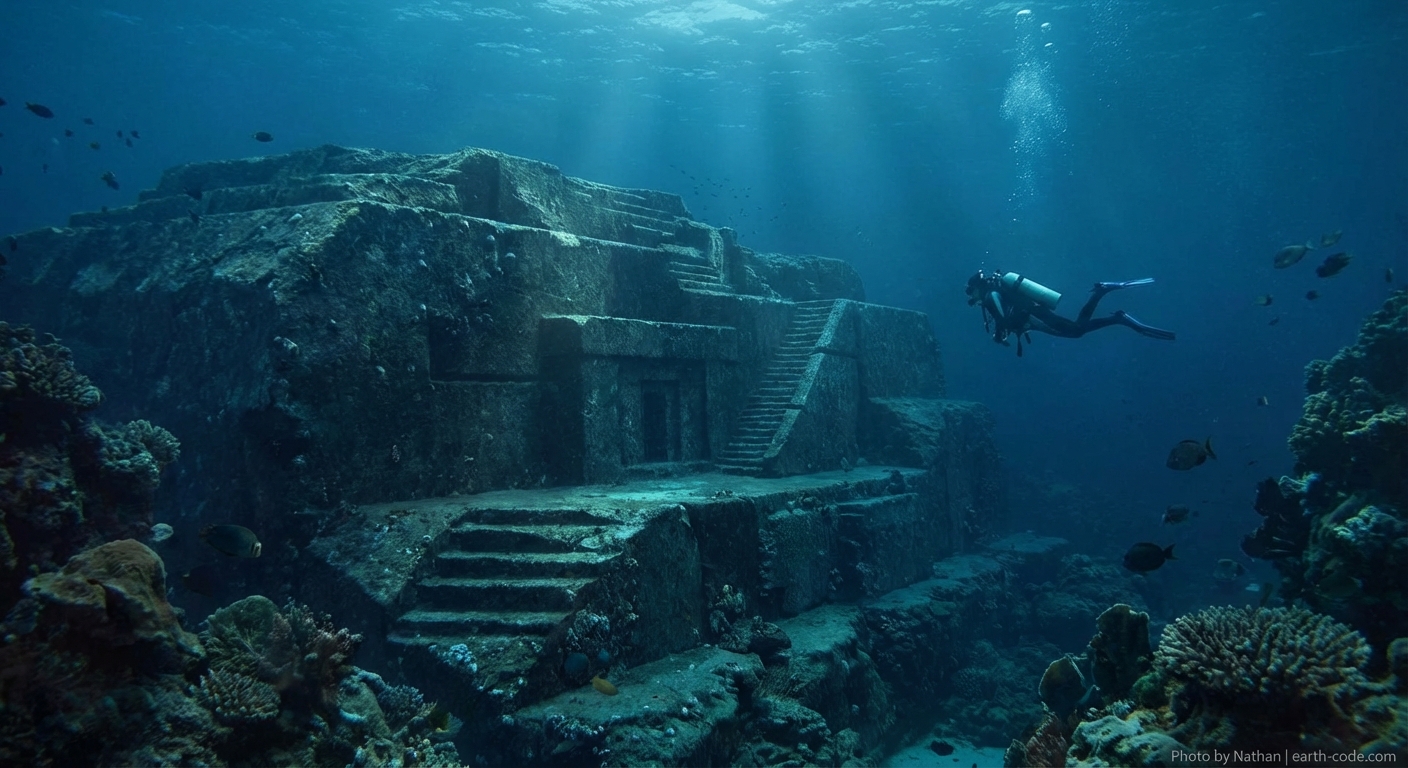
Giant stepped structure at Japan westernmost seabed. Evidence of 10,000 year old civilization?
The Yonaguni Underwater Monument: Ancient Temple or Natural Wonder?
Off the coast of Japan's westernmost island lies one of archaeology's most contentious mysteries. The Yonaguni Monument, a massive underwater rock formation discovered in 1987, continues to divide experts between those who see evidence of a lost civilization and those who attribute its geometric features to natural geological processes.
The Discovery and Structure
Japanese marine biologist Kihachiro Aratake first encountered this enigmatic structure while diving near Yonaguni Island in the Ryukyu chain. What he found was a colossal stone formation stretching approximately 150 meters long, 40 meters wide, and rising 27 meters from the seafloor. The monument's most striking features include massive stepped terraces, flat surfaces, sharp right angles, and what appear to be carved channels and passages.
The structure sits at depths ranging from 5 to 40 meters below sea level, positioned at coordinates that place it firmly within the geological timeline of post-glacial sea level rise. Radio-carbon dating of stalactites found on the monument suggests it was submerged approximately 10,000 years ago, coinciding with the end of the last Ice Age when melting glaciers caused global sea levels to rise dramatically.
The Case for Human Construction
Dr. Masaaki Kimura, a marine geologist from the University of the Ryukyus, has championed the artificial origin theory for decades. He points to several compelling features that seem to defy natural explanation: perfectly straight edges, symmetrical steps, and what appear to be drainage channels and road-like formations. Kimura has identified what he interprets as carved animals, human faces, and ceremonial areas, suggesting the monument was once a temple complex.
Supporters of the human-made hypothesis argue that the monument's geometric precision, particularly its 90-degree angles and flat surfaces, would be extremely unlikely to occur naturally in the local sandstone geology. They also point to similar stepped pyramid structures found in ancient civilizations worldwide, suggesting this could represent evidence of a sophisticated maritime culture that predates known Japanese civilizations by thousands of years.
The Natural Formation Theory
Mainstream geology and archaeology remain skeptical of artificial origins. Dr. Robert Schoch, a geologist from Boston University who has extensively studied the site, argues that the monument's features can be explained through natural geological processes. The local bedrock consists of alternating layers of sandstone and mudstone that fracture along natural joint planes, creating the appearance of deliberate construction.
Critics note the absence of construction marks, tool marks, or debris typically associated with human quarrying and building. They argue that underwater erosion, tectonic activity, and the natural weathering of sedimentary rock layers over millennia could produce the seemingly artificial features observed today.
Ongoing Debate and Future Research
The Yonaguni Monument remains officially unprotected and unexplored by major archaeological institutions, partly due to the controversy surrounding its origins. While local tourism has embraced the "lost civilization" narrative, the international scientific community continues to demand more rigorous evidence before accepting claims of prehistoric human construction.
Advanced underwater scanning technologies and more detailed geological analysis may eventually resolve this debate. Until then, the Yonaguni Monument stands as a fascinating reminder of how much we still don't know about our planet's prehistoric past and the possibility of lost chapters in human civilization.