Dwarka Underwater City - Krishna's Legendary City
Sacred city from Indian mythology found underwater. Discovery of city submerged 9,500 years ago
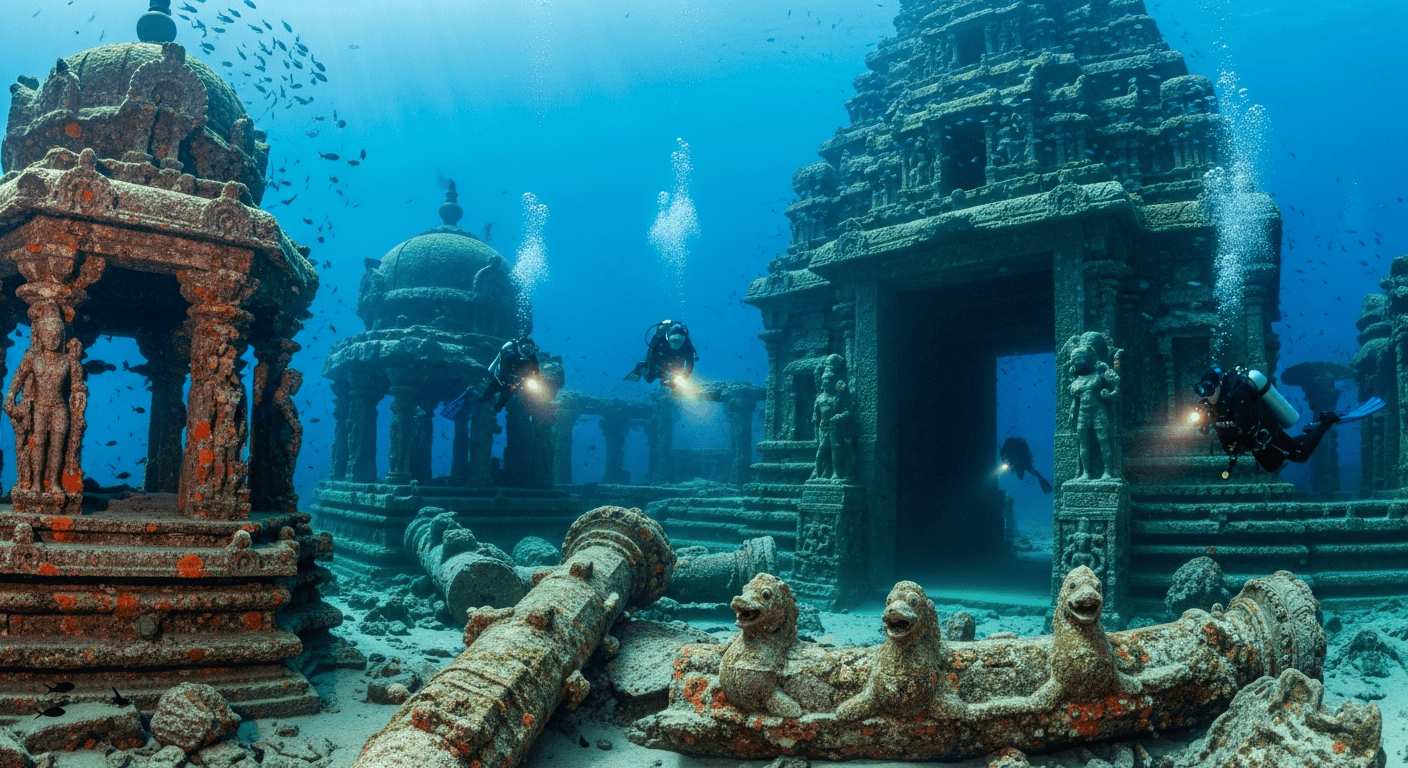
The Sunken Realm: Dwarka's Underwater Mysteries Unveiled
Krishna's Lost Kingdom Beneath the Waves
Deep beneath the turbulent waters of the Arabian Sea, off the coast of Gujarat, India, lies what many believe to be one of archaeology's most extraordinary discoveries. The submerged ruins of Dwarka, legendary capital of Lord Krishna from Hindu scriptures, have captured the imagination of archaeologists and devotees alike since systematic underwater explorations began in the 1980s.
According to the ancient Sanskrit epic Mahabharata, Dwarka was a magnificent city that sank into the ocean after Krishna's death, around 3102 BCE. For millennia, this remained merely mythological—until marine archaeologists began uncovering tangible evidence beneath the waves.
Remarkable Archaeological Evidence
The Marine Archaeology Unit of India, led by renowned archaeologist Dr. S.R. Rao, has conducted extensive underwater surveys revealing structures that appear to corroborate ancient texts. At depths of 20-40 feet, researchers have discovered:
- Massive stone walls extending over several kilometers
- Well-planned city layouts with what appear to be residential and commercial areas
- Stone anchors weighing up to 400 kilograms, suggesting an advanced maritime culture
- Pottery fragments and copper objects dating back thousands of years
- Geometric stone arrangements that match descriptions in Hindu scriptures
The most compelling discovery includes six major structural complexes spread across 954 hectares of seabed. Carbon dating of marine wood samples and artifacts suggests the site could be 9,000-9,500 years old, making it potentially one of the world's oldest submerged cities.
Scientific Analysis and Theories
Marine geologists propose that post-glacial sea level rise following the last Ice Age could explain how a coastal settlement became submerged. The Indus Valley region experienced significant geological changes around 7000-5000 BCE, when melting glaciers raised ocean levels by approximately 120 meters globally.
Dr. Alok Tripathi, current head of India's underwater archaeology division, suggests the structures represent multiple phases of construction and habitation. Sonar mapping has revealed defensive fortifications and harbor structures that align remarkably with descriptions in the Bhagavata Purana, which details Dwarka's sophisticated urban planning.
However, some scholars urge caution. Natural rock formations can sometimes mimic artificial structures underwater, and definitive proof of the site's connection to Krishna's mythological city remains elusive. Critics argue that while the discoveries are significant, the 9,500-year timeline would predate established historical records of complex urban civilizations in the region.
A Window into Ancient Maritime Culture
Whether or not this underwater city represents Krishna's legendary Dwarka, the discoveries illuminate an advanced maritime civilization that thrived along India's western coast millennia ago. The sophisticated stone anchors suggest knowledge of deep-sea navigation, while the urban layout indicates complex social organization.
The site continues yielding secrets through ongoing excavations. Recent discoveries include seal impressions and sculptural fragments that may provide crucial dating evidence. As underwater archaeology technology advances, Dwarka's submerged mysteries may finally reveal whether myth and reality converged beneath these ancient waters.
[!] Various theories exist. Information may contain errors.