Tutankhamun's Lost Queen Ankhesenamun May Be Found
Ring engraved with Tutankhamun's name found in unopened coffin containing 200 mummies
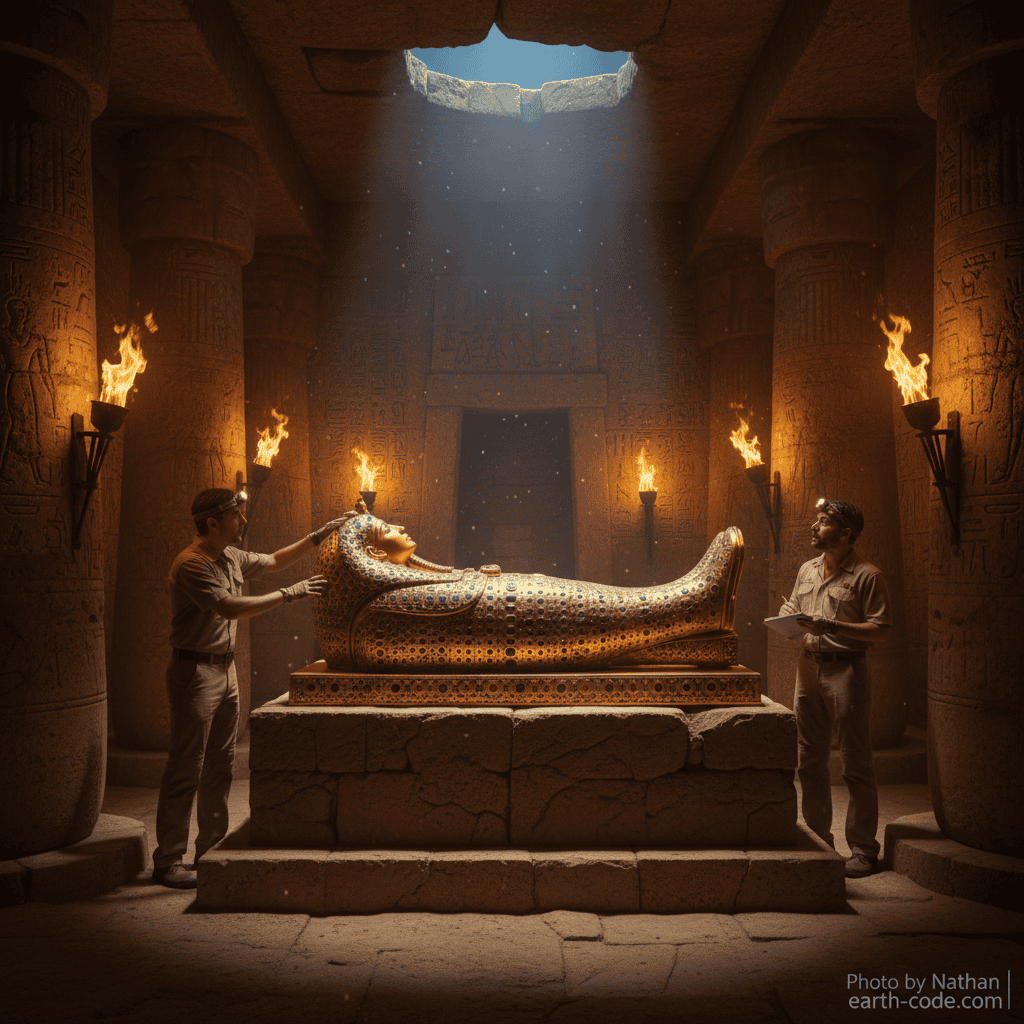
Could this be the key to ancient Egypt's greatest mystery?
The Ring That Could Rewrite Egyptian History: Is Tutankhamun's Lost Queen Finally Found?
Deep within the scorching sands of Egypt's Valley of the Kings, archaeologists may have stumbled upon one of the most significant discoveries since Howard Carter opened Tutankhamun's tomb in 1922. An unopened coffin containing approximately 200 mummies has yielded a tantalizing clue: a golden ring bearing hieroglyphics that spell out "Tutankhamun" — potentially marking the final resting place of the boy pharaoh's mysterious queen, Ankhesenamun.
A Royal Mystery Centuries in the Making
For nearly 3,300 years, Ankhesenamun's fate has remained one of ancient Egypt's most enduring puzzles. Born around 1348 BCE, she was originally named Ankhesenpaaten, daughter of the revolutionary pharaoh Akhenaten and the legendary Queen Nefertiti. When the religious upheaval of the Amarna period ended, she became Ankhesenamun and married her half-brother, the young Tutankhamun, around 1332 BCE.
The couple ruled during Egypt's tumultuous 18th Dynasty, a period marked by political instability and religious reformation. Their marriage, though producing two stillborn daughters found mummified in Tutankhamun's tomb, represented the royal family's attempt to legitimize the return to traditional Egyptian religious practices after Akhenaten's monotheistic experiment.
The Smoking Gun: A Royal Cartouche
The discovery of the ring within this 18th Dynasty coffin has sent shockwaves through the archaeological community. Cartouches — oval-shaped hieroglyphic inscriptions containing royal names — were rarely placed with non-royal individuals. The presence of Tutankhamun's name suggests either a direct royal connection or, more intriguingly, that this could be Ankhesenamun's burial site.
Dr. Zahi Hawass, former Egyptian Minister of Antiquities, has noted that the 200 mummies contained within the coffin represent an unprecedented find for a single burial chamber. This mass interment could indicate a period of political upheaval, possibly supporting theories that Ankhesenamun met a violent end during the power struggles following Tutankhamun's death in 1323 BCE.
Vanishing Into History's Shadows
Historical records show that after Tutankhamun's death, Ankhesenamun attempted to secure Egypt's throne by writing to the Hittite king Suppiluliuma I, requesting one of his sons as a husband. This unprecedented move — an Egyptian queen seeking a foreign prince — suggests desperation in the face of internal threats. The Hittite prince was murdered en route to Egypt, and Ankhesenamun subsequently disappeared from historical records entirely.
Some scholars theorize she was forced to marry Ay, Tutankhamun's elderly advisor who became pharaoh, while others suggest she was eliminated by rival court factions. The mysterious circumstances surrounding her disappearance have fueled decades of speculation about her ultimate fate.
The Revelation Awaits
As researchers carefully examine the newly discovered ring and prepare for the delicate process of investigating the mummy-filled coffin, the archaeological world holds its breath. If confirmed, this discovery could finally provide answers to one of ancient Egypt's greatest mysteries and offer unprecedented insights into the political machinations that shaped the end of the 18th Dynasty.
The implications extend far beyond solving a historical puzzle — this find could revolutionize our understanding of royal burial practices, inter-dynastic politics, and the role of women in ancient Egyptian power structures.
[!] Various theories exist. Information may contain errors.