What is Tree Code? - Climate Calendar Carved by Trees
Trees carve one ring per year. Dendrochronology reconstructs past climate year by year from ring width, density, and isotope ratios. This method is called Tree Code
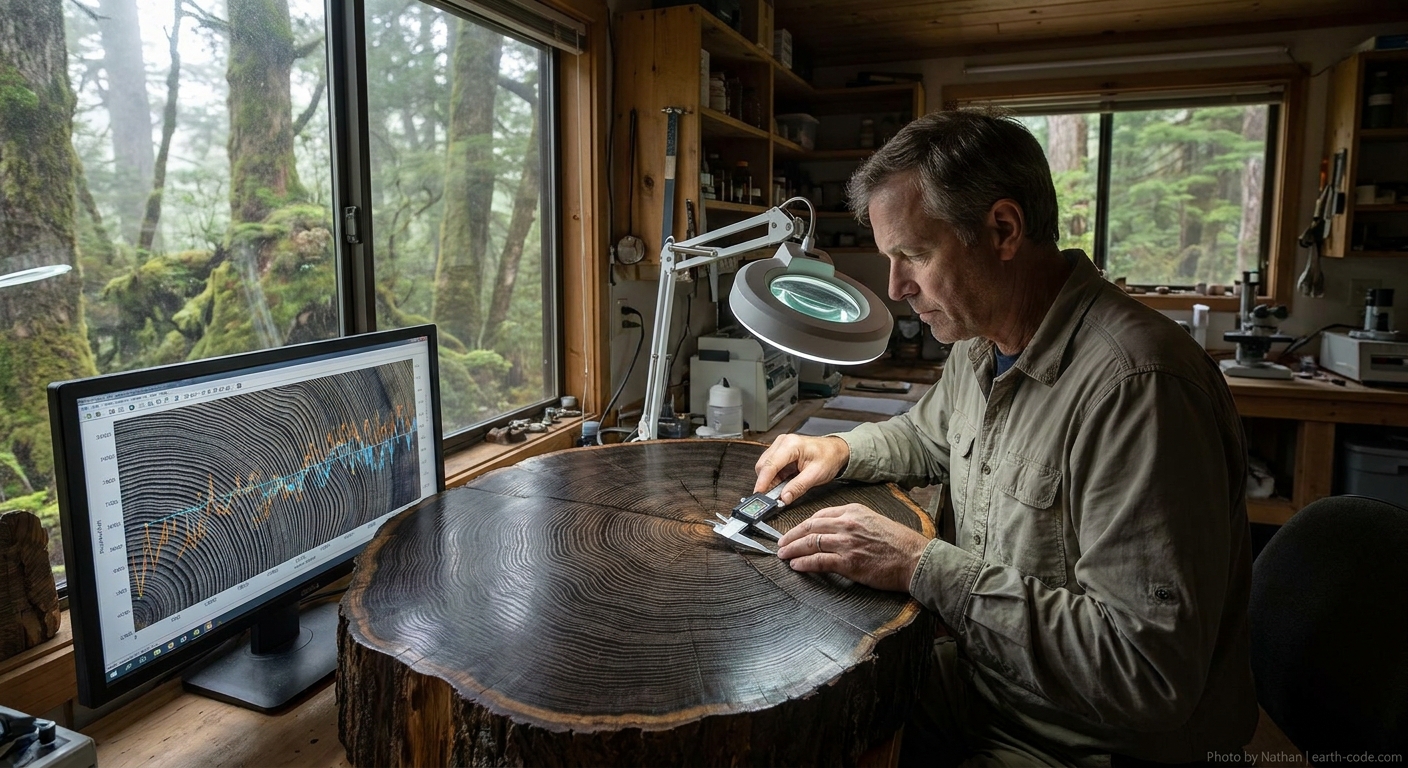
The Tree Code: Unlocking Earth's Climate Secrets Hidden in Ancient Rings
Deep in the White Mountains of California, a bristlecone pine named Methuselah stands as a silent witness to over 4,850 years of Earth's history. Its gnarled trunk, weathered by millennia of harsh mountain winds, contains within its rings a detailed record of climate changes that predates written human history. This ancient tree, along with countless others across the globe, holds what scientists call the "Tree Code" – nature's own climate calendar carved year by year in wood.
But what exactly is this mysterious code, and how do researchers decipher the secrets locked within these circular bands of cellulose? The answer lies in the fascinating science of dendrochronology, a field that transforms ordinary tree rings into extraordinary time machines capable of reconstructing past climates with stunning precision.
Historical Background: The Birth of Tree-Ring Science
The systematic study of tree rings began in the early 20th century with Andrew Ellicott Douglass, an astronomer at the University of Arizona who became captivated by the potential of tree rings to reveal past climate conditions. In 1904, Douglass began what would become a revolutionary approach to understanding Earth's climate history, establishing the world's first dendrochronology laboratory in 1937.
Douglass's initial observations were deceptively simple: trees in temperate regions produce distinct annual growth rings, with each ring representing one year of the tree's life. However, he noticed that the width and characteristics of these rings varied significantly from year to year, suggesting they contained valuable information about the environmental conditions during each growing season.
The breakthrough came when Douglass realized that trees in the same region would show similar ring patterns during the same time periods – what he termed "cross-dating." This principle became the foundation of modern dendrochronology, allowing researchers to extend climate records far beyond the lifespan of any single tree.
By the 1960s, scientists like Harold Fritts at the University of Arizona had developed sophisticated statistical methods for extracting climate signals from tree-ring data. The field exploded in the following decades as researchers discovered they could analyze not just ring width, but also wood density, cellular structure, and even isotope ratios within the rings themselves.
Decoding the Tree Code: Multiple Lines of Evidence
Ring Width: The Primary Signal
The most obvious characteristic of tree rings is their varying width. According to research by Malcolm Hughes and colleagues at the University of Arizona, ring width primarily reflects the availability of moisture and the length of the growing season. Wide rings typically indicate favorable growing conditions with adequate precipitation and moderate temperatures, while narrow rings suggest drought, extreme cold, or other environmental stresses.
Some researchers argue that the relationship between ring width and climate is more complex than initially understood. Fritz Schweingruber's studies in Switzerland revealed that temperature can be the limiting factor at high elevations and latitudes, while moisture availability dominates in arid regions. This discovery led to the development of region-specific calibration methods for interpreting ring-width data.
Wood Density: The Hidden Archive
Beyond simple width measurements, scientists discovered that the density of wood within each ring contains additional climate information. Dendrochronologist Rosanne D'Arrigo from Columbia University's Lamont-Doherty Earth Observatory has extensively studied how maximum latewood density correlates with summer temperatures, particularly in northern regions where temperature is the primary growth-limiting factor.
The process involves creating extremely thin wood sections and measuring density using X-ray techniques. According to one theory proposed by Gordon Jacoby and his research team, variations in cell wall thickness and the ratio of early wood to late wood within each ring reflect the tree's response to temperature fluctuations during specific parts of the growing season.
Isotope Signatures: Chemical Time Capsules
Perhaps the most sophisticated aspect of the Tree Code involves analyzing stable isotope ratios within the wood itself. Researchers like Danny McCarroll at Swansea University have shown that carbon and oxygen isotope ratios in tree rings can reveal information about temperature, humidity, and even atmospheric CO2 concentrations during past growing seasons.
The carbon isotope ratio (δ13C) reflects the tree's photosynthetic efficiency and water-use efficiency, which varies with atmospheric conditions. Meanwhile, oxygen isotope ratios (δ18O) are influenced by the isotopic composition of precipitation and relative humidity. Some researchers argue that these isotope signatures provide more direct climate proxies than ring width alone, as they're less influenced by non-climatic factors like forest competition or insect outbreaks.
Ancient Archives: Exceptional Tree Chroniclers
Bristlecone Pines: The Ultimate Climate Archive
The bristlecone pines of California and Nevada represent the pinnacle of natural climate archives. Research led by Matthew Salzer at the University of Arizona has identified living bristlecone pines over 5,000 years old, with dead specimens extending records even further back in time. The oldest known tree ring chronology, developed by Tom Harlan and colleagues, extends back over 9,000 years using both living and dead bristlecone pine specimens.
These remarkable trees grow in harsh, high-altitude environments where extreme longevity is achieved through incredibly slow growth rates. According to one theory, their exceptional longevity results from their ability to survive with minimal living tissue – sometimes as little as a narrow strip of bark connecting roots to a few living branches.
Yakusugi Cedars: Japan's Climate Historians
On the Japanese island of Yakushima, ancient cedar trees called Yakusugi have provided researchers with detailed records of Asian monsoon variability. Studies by Takeshi Nakatsuka from Nagoya University have used these trees to reconstruct summer precipitation patterns across Japan for the past 1,800 years, revealing cyclical patterns that correlate with Pacific Ocean climate oscillations.
The most famous of these trees, Jomon Sugi, is estimated to be between 2,170 and 7,200 years old, making it one of the oldest known trees in Asia. Some researchers argue that these cedars provide crucial insights into the East Asian monsoon system's long-term variability, information essential for understanding regional climate change.
European Oak Chronicles
In Europe, oak trees have provided extensive climate records spanning over 12,000 years. The work of Mike Baillie at Queen's University Belfast has created master chronologies using both archaeological wood and living trees, revealing detailed information about European climate variability, volcanic eruptions, and even possible cosmic events.
The German Oak and Pine Chronology, developed by Bernd Becker and colleagues, represents one of the most precisely dated tree-ring sequences in the world, serving as a crucial calibration tool for radiocarbon dating methods.
Volcanic Signatures and Global Events
One of the most dramatic applications of the Tree Code involves detecting the climatic impacts of major volcanic eruptions. Research by Kevin Anchukaitis and colleagues has shown how massive eruptions create distinctive "frost ring" patterns in trees worldwide, as volcanic aerosols temporarily cool global temperatures.
The 1815 eruption of Mount Tambora in Indonesia, which caused the "Year Without a Summer" in 1816, left clear signatures in tree rings across the Northern Hemisphere. Similarly, the 1991 eruption of Mount Pinatubo created measurable growth reductions in trees worldwide, providing modern validation for interpreting volcanic signals in ancient tree-ring records.
According to one theory proposed by Clive Oppenheimer from Cambridge University, tree rings may contain evidence of historical eruptions not recorded in written records, potentially extending our knowledge of volcanic climate impacts back thousands of years.
Cross-Dating: Extending Records Through Time
The technique of cross-dating represents one of dendrochronology's most powerful tools. Researchers like Henri Grissino-Mayer at the University of Tennessee have refined methods for matching ring patterns between trees of different ages, allowing scientists to extend climate records far beyond the lifespan of any individual tree.
This process involves identifying distinctive sequences of wide and narrow rings that occur simultaneously across multiple trees in a region. By overlapping ring patterns from trees of different ages – including living trees, historical wooden structures, and subfossil wood – researchers can create master chronologies spanning many millennia.
Some researchers argue that cross-dating accuracy depends critically on understanding local environmental factors that might cause trees to respond differently to the same climatic conditions. Work by Malcolm Cleaveland at the University of Arkansas has shown how factors like soil type, slope aspect, and forest composition can influence ring formation, requiring careful site selection and replication.
Counter-Arguments and Methodological Challenges
The Divergence Problem
Not all researchers agree that tree rings provide straightforward climate proxies. The so-called "divergence problem," identified by Keith Briffa and colleagues at the University of East Anglia, describes situations where tree growth fails to track temperature increases in recent decades, despite strong historical correlations.
Some researchers argue this divergence results from CO2 fertilization effects, nitrogen deposition, or other anthropogenic factors that complicate the climate-growth relationship. Others suggest that temperature-growth relationships may be non-linear, breaking down under extreme conditions not present in historical calibration periods.
Regional Representativeness
Critics like Rob Wilson from the University of St. Andrews have raised questions about the spatial representativeness of tree-ring chronologies. They argue that individual tree-ring sites may reflect highly local conditions rather than regional climate patterns, potentially limiting the broader applicability of dendroclimatic reconstructions.
This concern has led to increased emphasis on developing networks of tree-ring sites across climatically coherent regions, rather than relying on single locations. However, some researchers argue that this approach may smooth out important climate variability that occurs at smaller spatial scales.
Dating Accuracy and Missing Rings
The fundamental assumption of annual ring formation faces challenges in certain environments. Research by Flurin Babst and colleagues has identified situations where trees may produce multiple rings in a single year or fail to produce rings during extremely stressful years.
These "false" and "missing" rings can introduce dating errors that propagate through entire chronologies. While experienced dendrochronologists have developed techniques to identify and account for these anomalies, some researchers argue that dating uncertainties may be larger than typically acknowledged, particularly for very old chronologies.
Technological Advances and Future Directions
Modern dendrochronology increasingly relies on sophisticated analytical techniques. Researchers like Niklaus Zimmermann at the Swiss Federal Research Institute are using high-resolution CT scanning to examine ring structure in three dimensions, revealing details invisible to traditional microscopic analysis.
Mass spectrometry techniques now allow scientists to analyze isotope ratios in individual rings with unprecedented precision. According to one theory proposed by Gerhard Schleser and colleagues in Germany, combining multiple isotope systems (carbon, oxygen, and hydrogen) may provide more robust climate reconstructions than any single proxy.
Machine learning approaches are also being applied to tree-ring analysis. Work by Ramzi Touchan and colleagues suggests that artificial intelligence techniques may help identify complex climate-growth relationships that escape traditional statistical analysis.
The Global Network: Expanding the Tree Code
International collaboration has created vast networks of tree-ring chronologies. The International Tree-Ring Data Bank, maintained by NOAA Paleoclimatology, contains thousands of chronologies from around the world, enabling global-scale climate reconstructions.
Research led by Ulf Büntgen from Cambridge University has used these networks to reconstruct large-scale climate patterns, such as the Medieval Climate Anomaly and Little Ice Age, revealing how climate changes propagated across different regions and time scales.
Some researchers argue that expanding this global network to include more sites from the Southern Hemisphere and tropical regions represents the next frontier in dendrochronology. Work by Fidel Roig in Argentina and Brendan Buckley in Vietnam demonstrates the potential for extending tree-ring networks into previously undersampled regions.
Implications for Understanding Climate Change
The Tree Code provides crucial context for understanding modern climate change. Paleoclimatologist Edward Cook from Columbia University has argued that tree-ring records reveal the full range of natural climate variability, helping scientists distinguish anthropogenic climate signals from natural fluctuations.
Long-term tree-ring records have revealed that severe droughts and extreme climate events occurred regularly throughout the pre-industrial period, sometimes persisting for decades or centuries. This information proves essential for water resource planning and climate adaptation strategies.
However, some researchers argue that past climate variability may not provide reliable guidance for future conditions, particularly given the unprecedented rate and magnitude of current greenhouse gas emissions. Work by Rosanne D'Arrigo and colleagues suggests that modern climate change may be pushing Earth's climate system beyond the range of natural variability captured in tree-ring records.
Conclusion: Reading Nature's Climate Diary
As we stand at the threshold of unprecedented global climate change, the Tree Code offers both sobering historical perspective and remarkable scientific opportunity. These ancient archives, written in wood and preserved in Earth's forests, mountains, and archaeological sites, provide our longest and most detailed records of climate variability.
Yet significant questions remain: How accurately can we interpret these natural archives? What climate information might we be missing from regions where suitable trees don't grow? How will changing atmospheric composition and environmental conditions affect tree growth relationships in the future?
The ongoing development of new analytical techniques, expanding global chronology networks, and improved understanding of tree biology suggests that the Tree Code still holds many secrets waiting to be unlocked. Perhaps most intriguingly, what other natural archives might exist alongside tree rings – in corals, ice cores, lake sediments, and speleothems – that could complement and extend our understanding of Earth's climate history?
As researchers continue decoding these natural climate records, one thing becomes increasingly clear: the trees have been keeping track all along, waiting for us to learn their language and understand the stories they've been carefully recording, ring by ring, year by year, for millennia.
[!] Various theories exist. Information may contain errors.