Tassili n'Ajjer Rock Art - Aliens in the Sahara?
Strange humanoid figures in Saharan rock art. The site that inspired ancient astronaut theories
Tassili n'Ajjer Rock Art: Ancient Mysteries in the Heart of the Sahara
The Gallery of the Ancients
Deep within Algeria's Tassili n'Ajjer plateau, a vast open-air museum stretches across 72,000 square kilometers of what is now barren desert. Here, scattered across sandstone cliffs and hidden caves, lies one of the world's most extraordinary collections of prehistoric rock art—over 15,000 petroglyphs and paintings that span an incredible 12,000 years of human history.
This UNESCO World Heritage site, whose name means "plateau of rivers" in the local Tuareg language, tells a remarkable story of climate change and human adaptation. But it's the peculiar humanoid figures among these ancient artworks that have sparked decades of debate and inspired some of the most controversial theories in archaeology.
A Green Sahara's Lost Civilization
When French ethnologist Henri Lhote first systematically studied the site in the 1950s, he documented artwork spanning several distinct periods. The earliest paintings, dating back to 8000-6000 BCE, reveal a shocking truth: the Sahara was once a lush, green landscape teeming with life. These ancient artists depicted elephants, giraffes, rhinoceroses, and crocodiles—animals that today exist thousands of kilometers to the south.
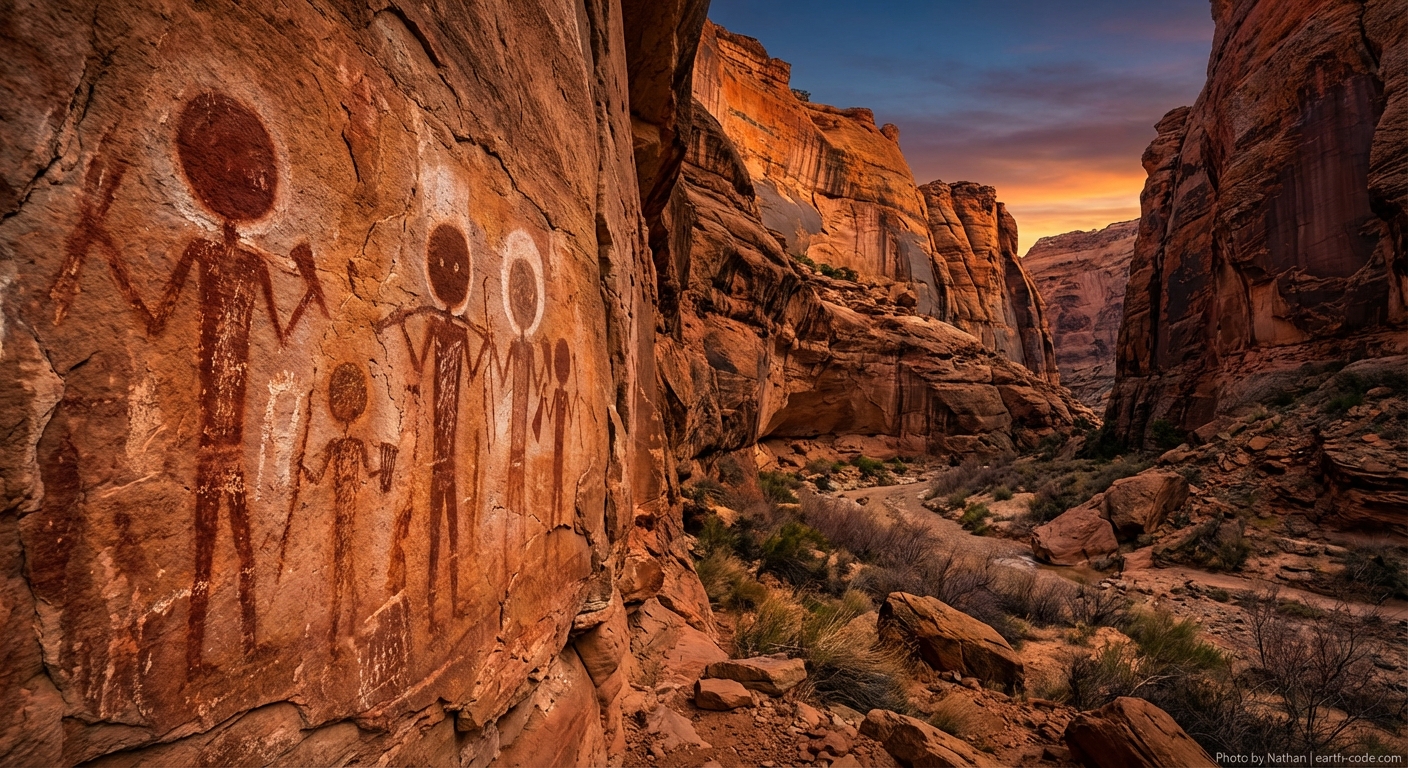
The human figures from this period are equally fascinating. Among the naturalistic depictions of hunters and herders, archaeologists have identified several enigmatic paintings that defy easy explanation. The most famous is the so-called "Great Martian God"—a towering figure over 6 meters tall, depicted with a round head that appears to lack facial features, surrounded by smaller humanoid forms with similar mysterious characteristics.
The Ancient Astronaut Connection
These unusual figures caught the attention of Erich von Däniken in his 1968 bestseller "Chariots of the Gods?" Von Däniken argued that the round-headed beings represented extraterrestrial visitors, complete with helmets and space suits. The theory gained further traction when researchers noted other anomalous details: figures appearing to float or fly, strange objects in the sky, and what some interpret as technological devices.
However, mainstream archaeologists offer more grounded explanations. Dr. Jean-Dominique Lajoux, who worked extensively at Tassili, suggests the round heads might represent masks used in religious ceremonies or stylized depictions of ancestors. The "floating" figures could simply be artistic conventions showing dance or spiritual transcendence.
Scientific Perspectives and Ongoing Mysteries
Recent archaeological work has provided more context for understanding these enigmatic artworks. Carbon dating and stylistic analysis suggest the most unusual figures belong to the "Round Head Period" (8000-6000 BCE), when the region's inhabitants were transitioning from hunting-gathering to pastoralism.
Some researchers propose the mysterious figures represent shamanic visions or spiritual entities from ancient religious practices. The consistent appearance of certain motifs across different sites suggests these weren't random artistic choices but part of a coherent belief system that flourished during the Sahara's green period.
A Window into Lost Worlds
Whether depicting ancient gods, shamanic visions, or something else entirely, the Tassili n'Ajjer rock art remains one of archaeology's most intriguing puzzles. These 12,000-year-old images continue to challenge our understanding of prehistoric cultures and remind us how much mystery still surrounds our ancient past.
[!] Various theories exist. Information may contain errors.