Varve Formation - Why Did the Miracle Happen Only at Lake Suigetsu
Conditions for varve formation are extremely strict. Explaining why Lake Suigetsu preserved 70,000 years of records
The Miracle of Lake Suigetsu: Japan's 70,000-Year Time Capsule That Defied All Odds
Deep in the mountains of central Japan lies a seemingly ordinary lake that harbors one of the most extraordinary natural archives on Earth. Lake Suigetsu, measuring just 4.5 kilometers long and 17 meters deep, has achieved something that countless other lakes worldwide have failed to accomplish: preserving an unbroken record of Earth's climate spanning the last 70,000 years. But what makes this achievement so remarkable isn't just its duration—it's the astronomical odds against such preservation ever occurring at all.
A Discovery That Rewrote Climate History
The story of Lake Suigetsu's scientific significance began in earnest during the 1990s when Japanese researchers led by Professor Takeshi Nakagawa from Newcastle University and Professor Ryuji Tada from the University of Tokyo embarked on an ambitious drilling project. What they extracted from the lake's sediments would fundamentally challenge our understanding of how nature preserves its historical records.
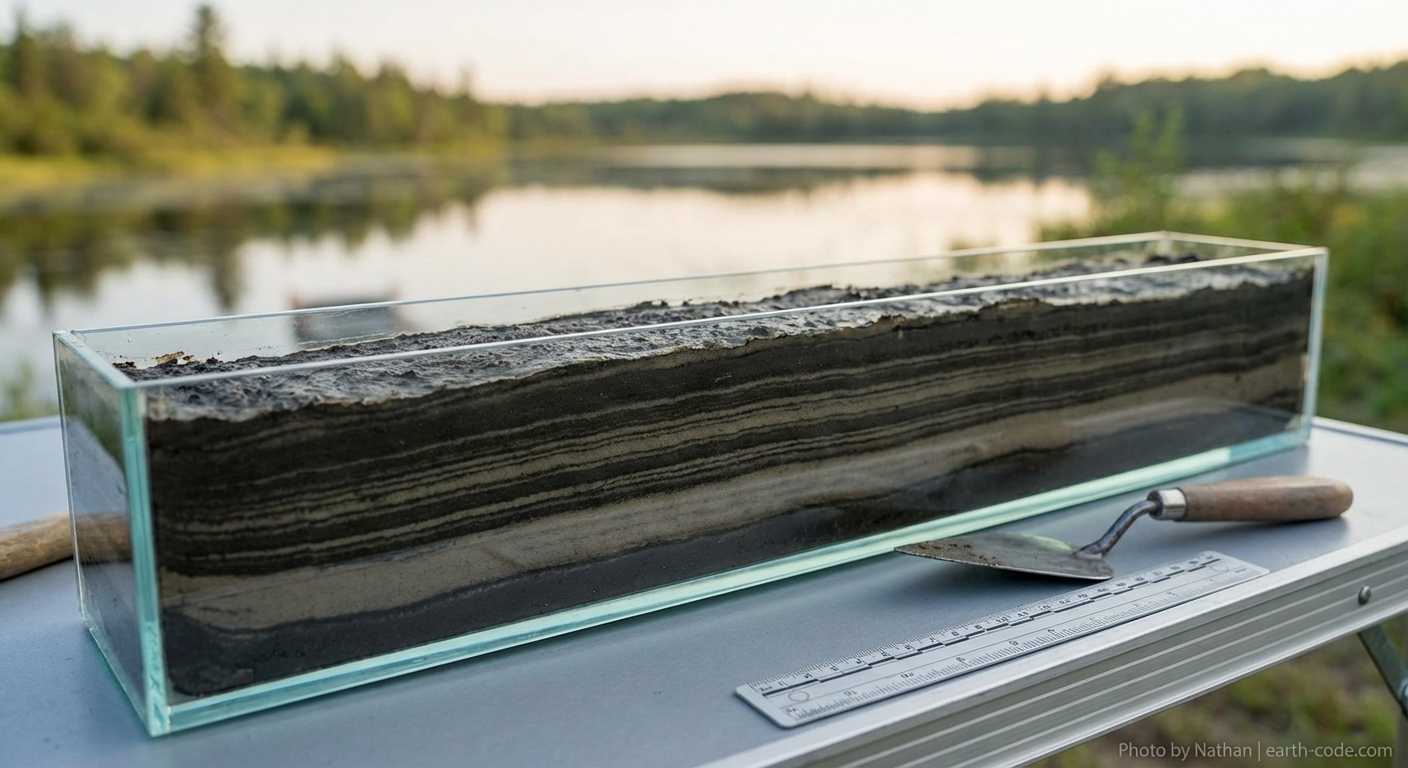
The first major breakthrough came in 1993 when the team successfully retrieved a sediment core extending back approximately 45,000 years. But it wasn't until the comprehensive SG06 drilling project in 2006 that the true scope of Lake Suigetsu's treasure became apparent. The new core revealed 70,000 annual layers—called varves—stacked with clockwork precision, each representing a single year of deposition dating back to Marine Isotope Stage 4.
Dr. Christopher Bronk Ramsey of Oxford University, who led the radiocarbon calibration efforts using Suigetsu's sediments, described the discovery as "unprecedented in its resolution and continuity." The lake had accomplished what researchers previously thought nearly impossible: maintaining perfect annual layering for tens of millennia without interruption.
The Astronomical Requirements for Varve Preservation
To understand why Lake Suigetsu's achievement borders on miraculous, one must first grasp the extraordinarily specific conditions required for varve formation and preservation. Dr. Pierre Francus from the Institut national de la recherche scientifique has extensively studied varve formation worldwide and emphasizes that "the conditions must align perfectly, like tumblers in a cosmic lock."
The first critical requirement involves anoxic bottom waters—a complete absence of oxygen in the lake's deeper layers. This condition prevents the survival of bottom-dwelling organisms that would otherwise burrow through and mix the sediment layers, destroying the annual record through a process called bioturbation. According to research by Professor Bernd Zolitschka from the University of Bremen, fewer than 0.1% of the world's lakes maintain the stable stratification necessary for long-term anoxia.
But anoxia alone isn't sufficient. The lake must also receive a consistent and balanced sediment supply throughout the year. Too little sediment, and the annual layers become too thin to distinguish; too much, and rapid deposition can create unstable conditions leading to underwater landslides that scramble the chronological record. Dr. Achim Brauer from the German Research Centre for Geosciences notes that this balance requires "a Goldilocks zone of sediment input—not too much, not too little, but just right."
Perhaps most challenging of all is the requirement for protection from catastrophic disturbance. A single major flood, earthquake-triggered turbidity current, or volcanic eruption can destroy thousands of years of accumulated sediment layers in minutes. Research by Professor Yusuke Yokoyama from the University of Tokyo reveals that most varved sequences worldwide are interrupted by such events every few hundred to few thousand years at most.
Lake Suigetsu's Perfect Storm of Preservation
So how did Lake Suigetsu manage to thread this needle for 70 millennia? The answer lies in a remarkable convergence of geographical, geological, and climatic factors that created what researchers now call "the Suigetsu anomaly."
Geographical Protection: Lake Suigetsu occupies a unique position within the Mikata Five Lakes system in Fukui Prefecture. The lake sits in a tectonically stable basin that has experienced minimal seismic disruption over the past 70,000 years. Dr. Yusuke Yokoyama's geological surveys indicate that unlike many Japanese lakes, Suigetsu has been remarkably free from the catastrophic earthquakes that regularly reshape the archipelago's landscape.
Hydrological Stability: The lake's water chemistry has remained extraordinarily stable due to its position as a closed basin with minimal inflow and outflow. Professor Nakagawa's detailed analysis shows that this isolation has prevented the dramatic water level fluctuations that typically disrupt sediment layering in most lakes. The lake's depth of 17 meters has provided a stable thermal stratification, with dense, cold bottom waters remaining isolated from the oxygen-rich surface layers.
Optimal Sediment Supply: Perhaps most remarkably, Lake Suigetsu has received what researchers term "calibrated sediment input" for tens of millennia. Dr. Tsuyoshi Haraguchi from Osaka City University discovered that the surrounding watershed provides approximately 0.5-2.0 millimeters of sediment annually—enough to create distinct annual layers but not so much as to destabilize the lake floor. This consistency suggests that the watershed's erosion patterns have remained remarkably stable despite dramatic climate changes over the past 70,000 years.
The Biological Miracle: Life That Didn't Interfere
Equally important is what Lake Suigetsu lacks: a thriving benthic ecosystem. Dr. Maarten Blaauw from Queen's University Belfast, who contributed to the statistical analysis of Suigetsu's chronology, points out that "most freshwater lakes teem with bottom-dwelling organisms that act like biological bulldozers, constantly mixing and churning the sediments."
Lake Suigetsu's anoxic bottom waters have prevented the establishment of such communities for tens of millennia. Research by Professor Hitoshi Hasegawa from Kanazawa University reveals that while the lake's surface waters support typical freshwater plankton communities, the deeper layers remain a biological desert—a condition essential for varve preservation but extraordinarily rare in nature.
Some researchers argue that this biological sterility might result from the lake's unusual chemistry. Dr. Katsuaki Koike from Kyoto University suggests that trace elements concentrated in the lake's bottom waters may actively suppress biological activity, creating a natural preservation chamber.
Alternative Theories and Lingering Questions
Despite decades of research, several aspects of Lake Suigetsu's preservation story remain enigmatic. Dr. Scott Stine from California State University East Bay argues that the lake's record might not be as continuous as initially believed. His analysis suggests that subtle erosional episodes could have removed sediment layers without obvious traces, potentially creating gaps in the record that appear seamless.
Professor Norbert Nowaczyk from the GFZ German Research Centre for Geosciences has proposed an alternative theory focusing on the lake's magnetic properties. His research indicates that Lake Suigetsu's sediments possess unusual magnetic characteristics that might reflect unique preservation conditions not fully understood by current models.
Perhaps most intriguingly, Dr. Yusuke Yokoyama has raised questions about why Lake Suigetsu succeeded where other seemingly similar lakes failed. His comparative studies of nearby Lake Biwa and Lake Mikata reveal that despite sharing similar geological settings, these lakes lack Suigetsu's exceptional preservation. "There's something special about Suigetsu that we haven't fully identified," Yokoyama admits.
Recent research by Dr. Rebecca Schlegel from the University of Massachusetts has suggested that subtle atmospheric circulation patterns unique to the Suigetsu basin might have provided additional protection from erosive storm events. Her climate modeling indicates that the lake sits in a "wind shadow" that has persisted for tens of millennia, reducing wave action that could disturb bottom sediments.
The Broader Mystery: Why So Few?
Lake Suigetsu's uniqueness raises profound questions about preservation in the natural world. Professor Bernd Zolitschka's global survey of varved lakes reveals that continuous sequences extending beyond 10,000 years are extraordinarily rare, with only a handful of sites worldwide achieving even 20,000-year records.
Some researchers argue that Lake Suigetsu's achievement might reflect a combination of factors so specific that they're unlikely to be replicated elsewhere. Dr. Achim Brauer suggests that "Suigetsu represents a perfect storm of preservation conditions that may occur perhaps once in a million lake-years."
Others, like Professor Takeshi Nakagawa, propose that similar long-term records might exist but remain undiscovered. His team's ongoing surveys of Japanese lake systems have identified several candidates that might harbor comparable archives, though none yet examined have approached Suigetsu's remarkable continuity.
The Implications for Understanding Deep Time
Lake Suigetsu's 70,000-year record has already revolutionized our understanding of past climate variability and the calibration of radiocarbon dating. The precision of its annual layers has provided researchers with a direct link to calendar years extending far beyond the range of tree-ring chronologies, fundamentally improving the accuracy of archaeological dating worldwide.
But perhaps more importantly, Lake Suigetsu stands as a testament to the rarity of perfect preservation in nature. Its existence suggests that our understanding of past environments might be skewed toward catastrophic events and dramatic changes, simply because the quiet, continuous records that capture gradual processes are so rarely preserved.
Dr. Christopher Bronk Ramsey reflects that "Suigetsu reminds us how much of the past remains invisible to us. For every Lake Suigetsu that preserves its record, there might be thousands of other lakes whose stories were lost to time."
As researchers continue to probe the mysteries of Lake Suigetsu, new questions emerge about the conditions that enable such extraordinary preservation. Could similar archives exist in other parts of the world, waiting to be discovered? What specific factors allowed Suigetsu to succeed where countless other lakes failed? And perhaps most intriguingly, what other natural archives might be hidden in plain sight, their secrets locked away by equally improbable combinations of circumstances?
The miracle of Lake Suigetsu continues to unfold, one thin layer at a time, reminding us that sometimes the most profound discoveries come from the most unlikely places—and that nature's capacity to preserve its own history depends on alignments so rare they border on the miraculous.
[!] Various theories exist about Lake Suigetsu's unique preservation conditions. Information may contain errors as research continues to evolve our understanding of this remarkable natural archive.