Kikai Caldera Eruption - The 7,300-Year-Old Disaster That Destroyed Jomon Culture
The largest eruption of the Holocene. Evidence of 300km/h pyroclastic flows devastating southern Kyushu preserved in Lake Suigetsu
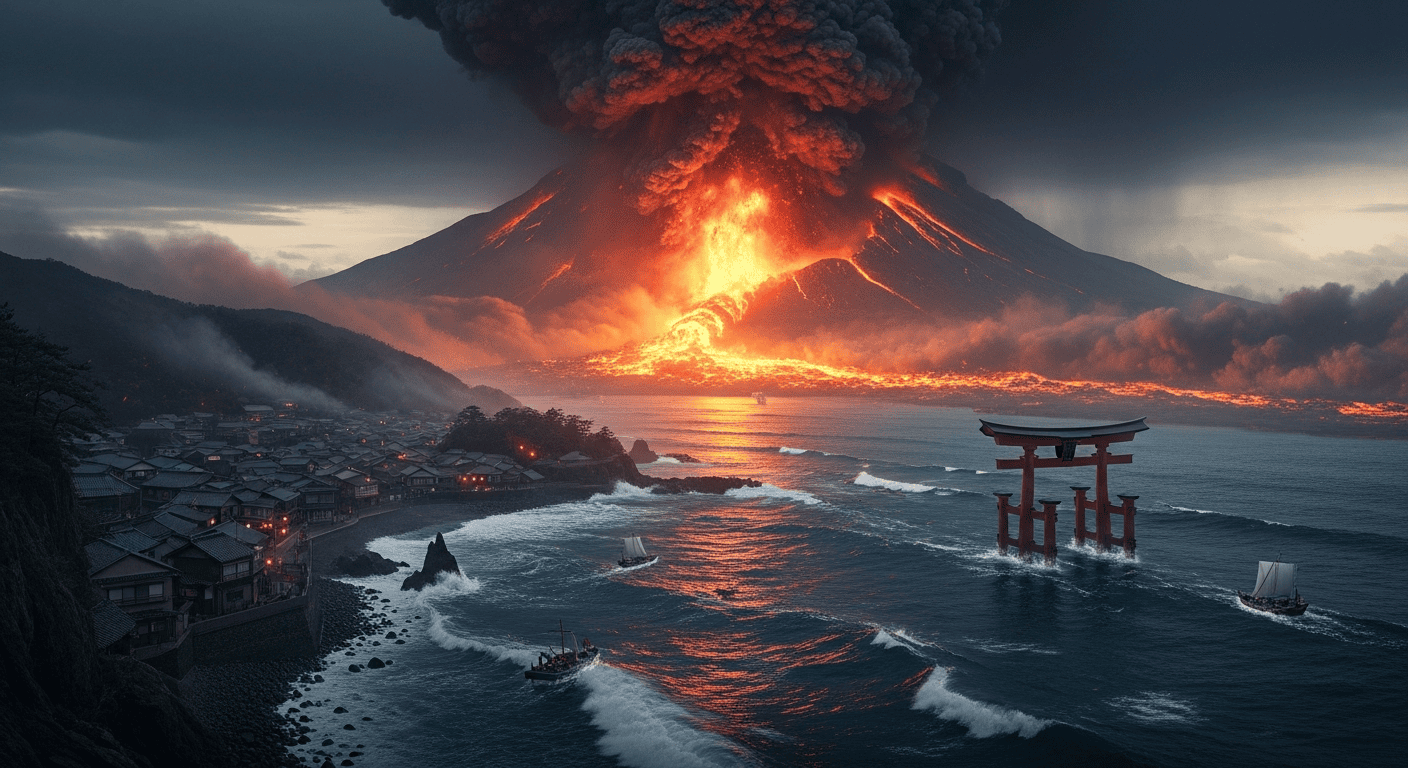
7,300 years ago, the Jomon people living in Kyushu vanished overnight. What happened?
Kikai Caldera Eruption: The Holocene's Largest Disaster That Destroyed Jomon Culture
The World's Largest Eruption in 10,000 Years
Approximately 7,300 years ago, one of history's largest volcanic eruptions occurred beneath the ocean about 50 km south of the Satsuma Peninsula. The eruption of "Kikai Caldera" is considered the world's largest in the past 10,000 years (Holocene) and instantly devastated the Jomon culture of southern Kyushu.
Evidence of this disaster remains even in Lake Suigetsu, far away in Fukui Prefecture. The "Akahoya volcanic ash" layer sandwiched in the varves records the precise timing of this catastrophe.
Scale of the Eruption
The scale of the Kikai Caldera eruption defies imagination:
- Ejecta volume: Approximately 170 cubic kilometers
- Caldera diameter: About 20 kilometers
- Pyroclastic flow reach: Over 100 km across the sea
- Pyroclastic flow speed: Estimated 300 km/h
- Ash distribution: Reached as far as Tohoku region
For comparison, the 2011 Sakurajima eruption was about 0.0001 cubic kilometers. Kikai Caldera was 1.7 million times larger.
Pyroclastic Flows That Ran Across the Sea
The most terrifying aspect was the final large pyroclastic flow called the "Koya pyroclastic flow."
This pyroclastic flow - a mixture of hot gas and volcanic ash - "ran" across the sea at 300 km/h. Normally, pyroclastic flows cause steam explosions when reaching water and stop, but the Koya flow glided over the sea surface and landed on the Osumi and Satsuma peninsulas.
The Jomon people living in southern Kyushu at the time had no way to escape.
Precise Dating from Lake Suigetsu
Lake Suigetsu varve research precisely dated the Kikai Caldera eruption.
By counting varve layers containing Akahoya volcanic ash, the eruption was dated to 7,165-7,303 years ago (cal. yBP) with high precision. This is more accurate than radiocarbon dating (approximately 6,300 years ago).
This date determination serves as a "measuring stick" for dating other archaeological sites.
Devastating Impact on Jomon Culture
Before the eruption, southern Kyushu was one of the Jomon period's most prosperous regions. The warm climate and rich marine resources supported an advanced Jomon culture.
However, the Kikai Caldera eruption completely devastated this region:
- Instant death: People directly hit by pyroclastic flows
- Starvation: Plants died from ash, food sources vanished
- Migration: Survivors fled northward
Excavations show that southern Kyushu remained uninhabited for approximately 1,000 years after the eruption. People only began resettling in the Late Jomon period.
A Warning for Today
Kikai Caldera remains active today. A 2018 survey confirmed new lava domes forming within the caldera.
Kobe University researchers suggest Kikai Caldera may be accumulating magma for its next major eruption. If an eruption of similar scale occurred today, all of Kyushu would suffer catastrophic damage, and ash would reach Honshu.
The disaster recorded in Lake Suigetsu's varves 7,300 years ago serves as a warning for those of us living in volcanic Japan.
[!] Various theories exist. Information may contain errors.