Dansgaard-Oeschger Events - Rapid Warming Cycles During the Ice Age
25 rapid warming events of 10 degrees during the last ice age. Evidence of climate changing drastically in decades
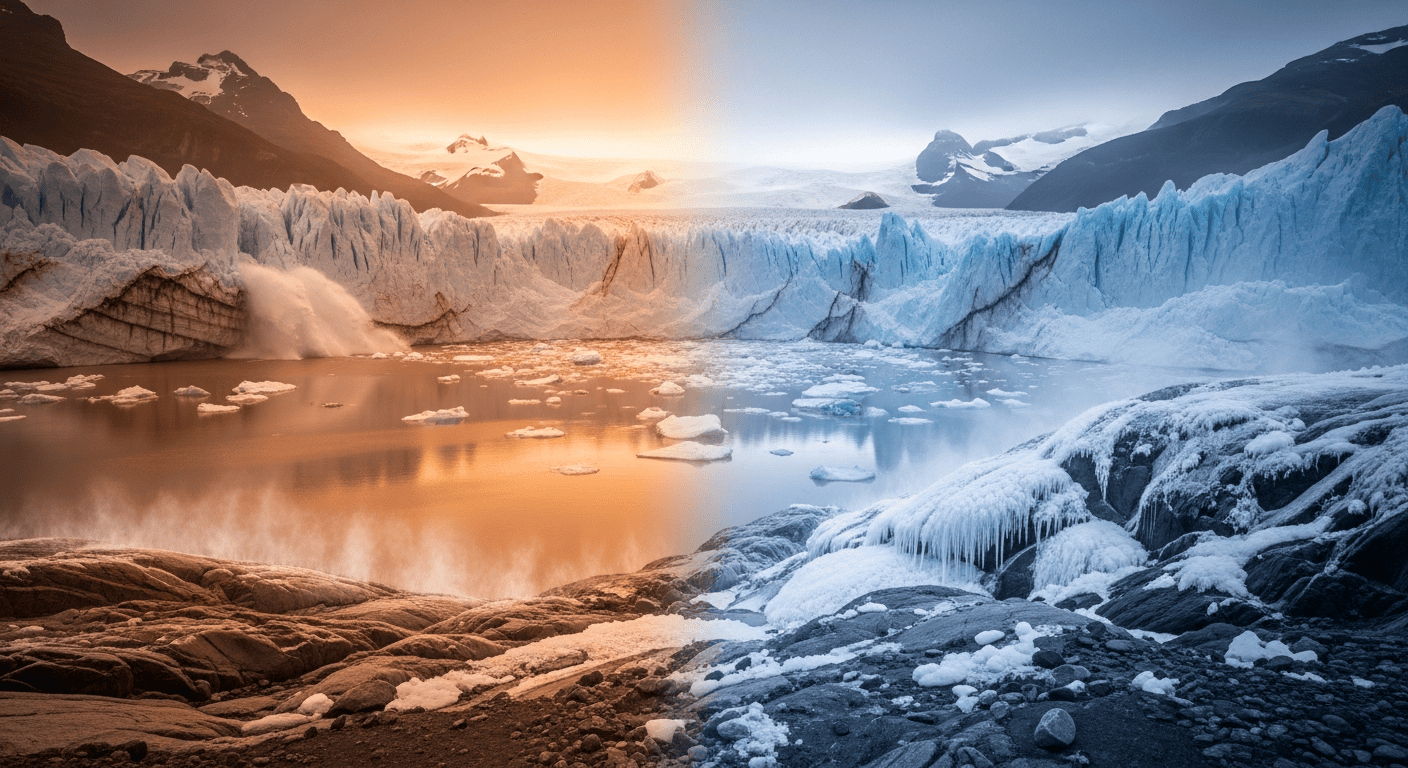
Ice age climate was not stable. Amazing cycles where temperatures swung 10 degrees in decades
Dansgaard-Oeschger Events: Climate Chaos During the Ice Age
The Ice Age Was Not "Stable Cold"
When you hear "ice age," you might imagine a long period of stable, cold temperatures. However, Lake Suigetsu varves and Greenland ice cores reveal a surprising truth: during the last ice age (approximately 70,000-11,000 years ago), climate underwent violent oscillations, swinging up to 10°C in just decades.
These rapid climate changes are called "Dansgaard-Oeschger Events" (D-O Events) after their discoverers.
25 Climate Jumps
Analysis from the Greenland ice core project "NGRIP" confirmed at least 25 D-O Events during the last ice age.
Characteristics of each event:
- Temperature change: Rapid warming of 5-10°C in decades
- Duration: Warm periods lasted hundreds to thousands of years
- Ending: Gradual cooling back to original state
- Cycle: Repeated every approximately 1,500-3,000 years
Vegetation Changes Confirmed at Lake Suigetsu
Pollen analysis from Lake Suigetsu varves confirms D-O Events occurred in Japan as well.
During warming events, vegetation rapidly changed from cold-temperate conifers to temperate deciduous broadleaf trees. This change occurred in decades, confirming the rapidity of climate change.
Cause: Atlantic Ocean Circulation
The leading theory for D-O Events involves variations in the North Atlantic's thermohaline circulation.
Normally, the warm Gulf Stream reaches as far as offshore Greenland, warming North America and Northern Europe. However, when massive freshwater from melting ice sheets flows into the North Atlantic, this circulation weakens or stops.
When circulation weakens, the Northern Hemisphere rapidly cools; when it restarts, rapid warming occurs. D-O Events are thought to represent this circulation switching "on and off."
Relationship with Heinrich Events
After several weakening D-O Events, a larger cooling event called a "Heinrich Event" occurs.
Heinrich Events happen when ice sheets in North America and Europe collapse, sending massive quantities of icebergs into the North Atlantic. These events can be traced by rock fragments deposited on the ocean floor by melting icebergs.
The combined cycle of D-O and Heinrich Events is called the "Bond Cycle," repeating every approximately 5,000-10,000 years.
Impact on Humanity
D-O Events may have influenced human migration patterns and cultural development.
Particularly during warming events, humans could more easily expand into higher latitudes. Conversely, during cooling events, they were forced to move southward. Some researchers believe these climate changes influenced modern humans' expansion into Europe and interactions with Neanderthals.
Warning for Today
The most important lesson from D-O Events is that climate systems are nonlinear.
Climate doesn't change gradually - when certain "tipping points" are crossed, rapid and irreversible changes can occur. Lake Suigetsu's records provide crucial reference data for understanding what tipping points current global warming might trigger.
Professor Nakagawa warns: "Current global warming is in an abnormal mode unlike anything we've experienced before. Civilization exists on climate stability that is more fragile than we imagine."
[!] Various theories exist. Information may contain errors.