Story of Discovery - How a Small Lake in Fukui Changed the World
From accidental discovery in 1991 to world standard adoption. 30-year history of Lake Suigetsu research
The Lake That Rewrote Time: How Japan's Lake Suigetsu Became the World's Most Precise Calendar
Introduction: A Quiet Revolution Beneath the Waters
In the mountains of central Japan, nestled among the rolling hills of Fukui Prefecture, lies a small lake that has quietly revolutionized how we understand the past 50,000 years of human history. Lake Suigetsu, measuring just 4.4 kilometers long and barely 200 meters at its widest point, holds within its sediments what scientists now consider the most accurate natural calendar ever discovered. This unassuming body of water has become the gold standard for dating archaeological sites, climate events, and even cosmic phenomena across the globe.
The story of Lake Suigetsu reads like a scientific thriller—from an accidental discovery in 1991 to its adoption as the international standard for radiocarbon calibration in 2013. Along the way, it has challenged long-held assumptions about human migration, rewritten the timeline of major volcanic eruptions, and provided unprecedented insights into how our planet's climate has shifted over millennia. But perhaps most remarkably, this breakthrough came not from a massive research institution or cutting-edge laboratory, but from the patient work of scientists drilling into the bottom of a lake that most of the world had never heard of.
Historical Background: From Accident to Ambition
The Lake Suigetsu story begins in 1991, not with grand scientific ambitions, but with a stroke of serendipity. Dr. Takeshi Nakagawa, then a young researcher at the University of Newcastle, was conducting routine sediment sampling in Japan's Fukui Prefecture when he encountered something extraordinary. The lake's bottom contained layer upon layer of pristinely preserved sediments, each representing a single year of deposition—what scientists call "varves."
Unlike most lakes, where sediments become mixed and churned by bottom-dwelling organisms and water circulation, Lake Suigetsu's deeper waters remain perpetually oxygen-free. This anoxic environment creates a natural time capsule, preserving each year's deposits as distinct, paper-thin layers. Nakagawa immediately recognized the potential: here was a continuous, undisturbed record stretching back tens of thousands of years.
The initial coring operation in 1991 extracted sediment cores totaling about 75 meters in length, representing roughly 45,000 years of continuous deposition. These early samples revealed something that would prove revolutionary: the sediments contained abundant organic material suitable for radiocarbon dating, while the varve structure provided an independent method of counting years. For the first time, scientists had a way to directly compare radiocarbon ages with actual calendar years over such an extended period.
Dr. Christopher Bronk Ramsey of Oxford University, who would later become a key figure in the Lake Suigetsu project, described the initial findings as "almost too good to be true." The implications were staggering—if these sediments could be properly analyzed, they would provide a calibration curve that could correct radiocarbon dates worldwide, making archaeological and climate chronologies far more accurate than ever before.
The International Breakthrough: 2006 and Beyond
The true transformation of Lake Suigetsu from scientific curiosity to global standard began in 2006, when an international consortium launched an ambitious project to extract and analyze a complete sediment record. Led by Dr. Takeshi Nakagawa, now at Ritsumeikan University, and supported by researchers from Oxford University, the University of Newcastle, and institutions across Japan, the team set out to retrieve the most comprehensive paleoenvironmental record ever attempted.
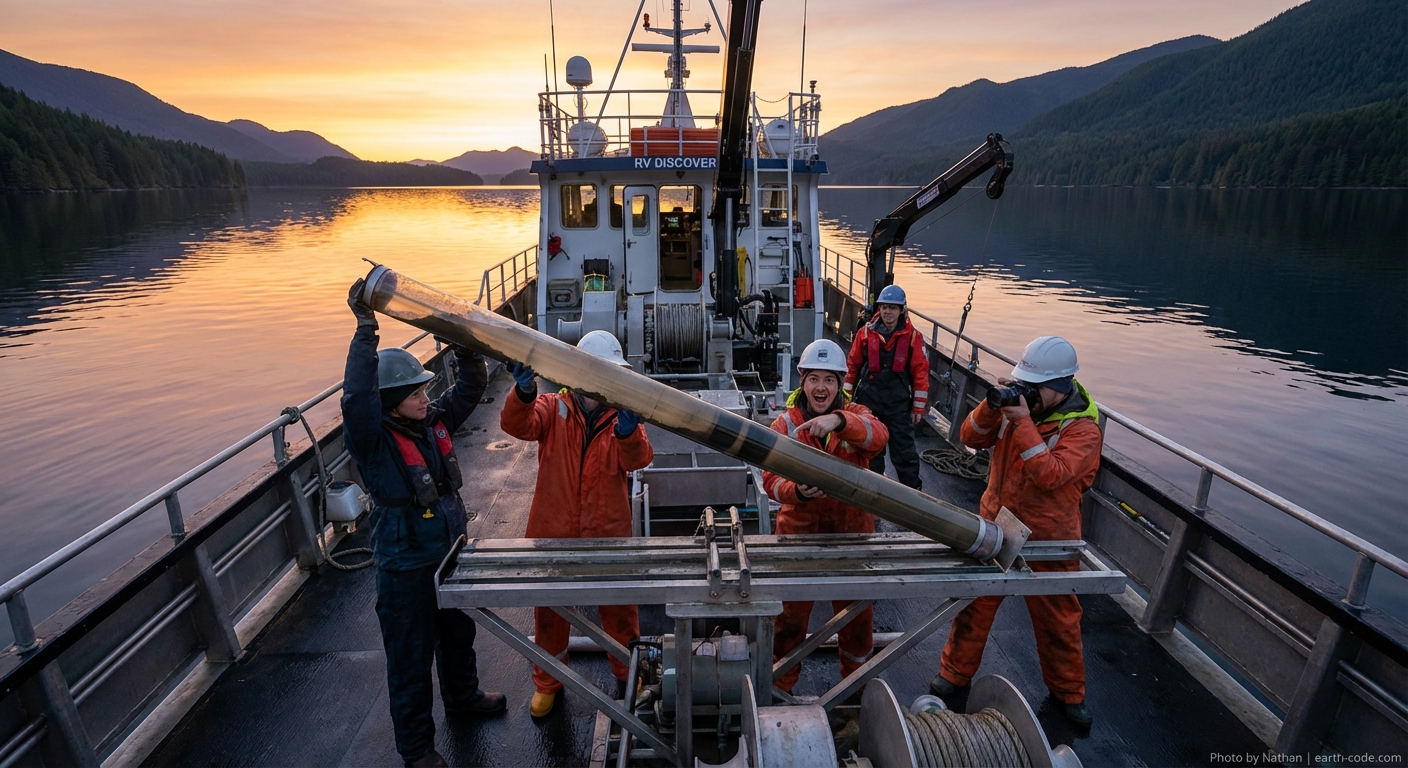
The 2006 drilling operation was a masterpiece of precision engineering. Using state-of-the-art coring equipment, the team extracted multiple overlapping cores from the deepest part of the lake, ultimately recovering a continuous 45-meter sequence representing approximately 60,000 years of deposition. The cores were extracted with such care that individual annual layers, some less than a millimeter thick, remained perfectly intact.
Dr. Gordon Schlolaut from the MARUM Center for Marine Environmental Sciences described the extraction process as "archaeological excavation in reverse." Each meter of core required hours of careful handling, with sections immediately sealed and transported to climate-controlled facilities where they could be analyzed layer by layer.
The international nature of the project proved crucial to its success. While Japanese researchers provided local expertise and logistical support, British scientists brought advanced radiocarbon dating techniques, and German specialists contributed high-resolution imaging and chemical analysis methods. This collaborative approach ensured that every aspect of the sediment record could be examined with the highest possible precision.
Multiple Lines of Evidence: Building the Perfect Timeline
What makes Lake Suigetsu's sediments so remarkable is not just their continuity, but the multiple independent dating methods they support. According to one theory proposed by the research team, the combination of varve counting, radiocarbon dating, and additional chronological markers creates an unprecedented level of accuracy in age determination.
The varve counting process itself represents a triumph of painstaking scientific work. Each individual layer must be identified and counted under high-magnification microscopes, with multiple researchers independently verifying the counts to minimize errors. Dr. Achim Brauer of the German Research Centre for Geosciences noted that "counting 50,000 annual layers is like reading a 50,000-page book where you cannot skip a single line."
Some researchers argue that the lake's unique geochemical conditions provide additional chronological markers. Volcanic ash layers from major eruptions, including the catastrophic Aira-Tanzawa tephra from southern Japan approximately 30,000 years ago, appear as distinct markers within the sediment sequence. These layers can be precisely dated using independent methods and serve as crucial calibration points.
The radiocarbon dating component required analyzing thousands of individual samples, each containing organic material from specific annual layers. The research team, led by Dr. Christopher Bronk Ramsey at Oxford, developed new techniques for extracting and purifying organic carbon from microscopic plant remains and pollen grains preserved in the sediments. This process yielded radiocarbon dates that could be directly compared to the varve-counted calendar ages for the same layers.
The 2013 Revolution: IntCal Adoption and Global Impact
The culmination of two decades of research came in 2013, when the international radiocarbon community officially adopted the Lake Suigetsu calibration curve as part of IntCal13, the global standard for converting radiocarbon ages to calendar years. This decision, ratified at the 21st International Radiocarbon Conference, represented one of the most significant advances in dating methodology since the invention of radiocarbon dating itself.
The impact was immediate and profound. Archaeological sites across the world suddenly had access to more accurate dates, with some chronologies shifting by hundreds or even thousands of years. According to research published in the journal Radiocarbon, the new calibration curve reduced dating uncertainties by up to 50% for materials between 12,000 and 50,000 years old.
Dr. Paula Reimer of Queen's University Belfast, who chaired the IntCal working group, emphasized the global significance: "Lake Suigetsu has given us the most precise picture we've ever had of how atmospheric radiocarbon levels have changed over the past 50,000 years. This isn't just important for Japan—it's changing how we understand human history worldwide."
The adoption process itself revealed the meticulous nature of the Lake Suigetsu research. The international committee required not just the primary data, but extensive statistical analysis, independent verification of key measurements, and detailed documentation of every methodological step. The fact that the Lake Suigetsu team met all these stringent requirements speaks to the exceptional quality of their work.
Counter-Arguments and Ongoing Mysteries
Despite its widespread acceptance, the Lake Suigetsu calibration curve has not been without its critics and ongoing challenges. Some researchers argue that regional variations in atmospheric radiocarbon concentrations might limit the global applicability of a single lake's record. Dr. Irka Hajdas of ETH Zurich has suggested that additional high-resolution records from different geographical regions are needed to fully validate the Lake Suigetsu data.
Another area of ongoing debate concerns the interpretation of certain anomalous periods within the sediment record. According to some theories, brief intervals where the varve structure becomes less distinct might indicate periods of unusual environmental conditions or methodological challenges in counting. These periods, though representing less than 5% of the total record, continue to generate scientific discussion about the limits of varve-based chronology.
The question of completeness also remains partially unresolved. While the Lake Suigetsu record extends back approximately 60,000 years, gaps in the deepest sections leave some uncertainty about the earliest portions of the sequence. Some researchers argue that future drilling operations might recover even longer records, potentially extending the calibration curve back to 70,000 years or more.
Perhaps most intriguingly, the Lake Suigetsu data has revealed several periods of rapid atmospheric radiocarbon change that remain unexplained. These fluctuations, occurring over timescales of just decades or centuries, might reflect previously unknown variations in cosmic ray intensity, solar activity, or even changes in ocean circulation patterns. Understanding these phenomena represents one of the most exciting frontiers in radiocarbon research.
Technological Innovation and Future Possibilities
The success of the Lake Suigetsu project has sparked innovations in paleoenvironmental research methods that extend far beyond radiocarbon dating. The high-resolution imaging techniques developed for analyzing the sediment cores, including X-ray fluorescence scanning and micro-CT imaging, are now being applied to lake records around the world.
Dr. Takeshi Nakagawa's team has continued to push technological boundaries, developing new methods for extracting environmental information from microscopic samples. Recent advances include DNA analysis of ancient plant and animal remains preserved in the sediments, providing insights into ecosystem changes over the past 50,000 years. Some researchers argue that these biological records might eventually prove as important as the chronological data for understanding long-term environmental change.
The potential for expanding the Lake Suigetsu record continues to generate excitement. Preliminary surveys suggest that deeper drilling might recover sediments extending back 100,000 years or more, potentially doubling the length of the available record. Such an expansion would provide calibration data covering the entire span of modern human dispersal out of Africa and into Europe and Asia.
Global Applications and Unexpected Discoveries
The practical applications of the Lake Suigetsu calibration curve have already led to numerous breakthroughs in archaeology and climate science. The recalibrated dates have refined our understanding of human migration patterns, revealing that modern humans reached Europe several thousand years earlier than previously thought. Sites like Grotte du Renne in France and Bacho Kiro Cave in Bulgaria have yielded older ages that better align with genetic evidence for human dispersal.
Climate researchers have also benefited enormously from the improved chronology. The more precise dating has revealed that some major climate transitions, such as the end of the Younger Dryas cold period, occurred more rapidly than previously believed. This has important implications for understanding how quickly modern climate change might unfold.
Volcanic hazard assessment has been another unexpected beneficiary. By providing more accurate ages for major eruptions recorded in the Lake Suigetsu sediments, researchers can better understand the frequency and timing of catastrophic volcanic events. This information is crucial for assessing risks to modern populations living near active volcanoes.
Conclusion: Questions That Echo Across Time
The story of Lake Suigetsu raises profound questions about scientific discovery and the nature of knowledge itself. How many other "ordinary" places on Earth might contain extraordinary records of our planet's history? What other natural archives lie waiting to be discovered and decoded by future generations of researchers?
The lake's sediments have not only revolutionized radiocarbon dating but have also demonstrated the power of international scientific collaboration. The fact that researchers from Japan, Britain, Germany, and other nations could work together for over two decades to achieve this breakthrough suggests possibilities for addressing even larger scientific challenges.
Perhaps most remarkably, Lake Suigetsu reminds us that the most important discoveries often come from the most unexpected places. A small lake in rural Japan has become a window into 50,000 years of Earth's history, changing how we understand human evolution, climate change, and the very nature of time itself. What other secrets might be hidden beneath the surface of seemingly ordinary landscapes around the world?
As we face an uncertain future marked by rapid environmental change, the lessons preserved in Lake Suigetsu's sediments become more relevant than ever. The lake has shown us that our planet's climate can change dramatically and rapidly, but it has also demonstrated the remarkable persistence of natural systems over vast timescales. Perhaps, in learning to read the language of sediments and time, we might better understand not just where we have been, but where we are going.
The quiet revolution that began in a small Japanese lake continues to ripple outward, touching every corner of our understanding of the past—and pointing toward questions we have yet to learn how to ask.
---
[!] Various theories exist about the formation and preservation mechanisms of Lake Suigetsu's sediments. Information may contain errors and interpretations continue to evolve with ongoing research.