Climate Change and Civilization Collapse - Turning Points in Human History from Varves
Varves record evidence of civilization collapses caused by climate change: 4.2k event, Bronze Age collapse
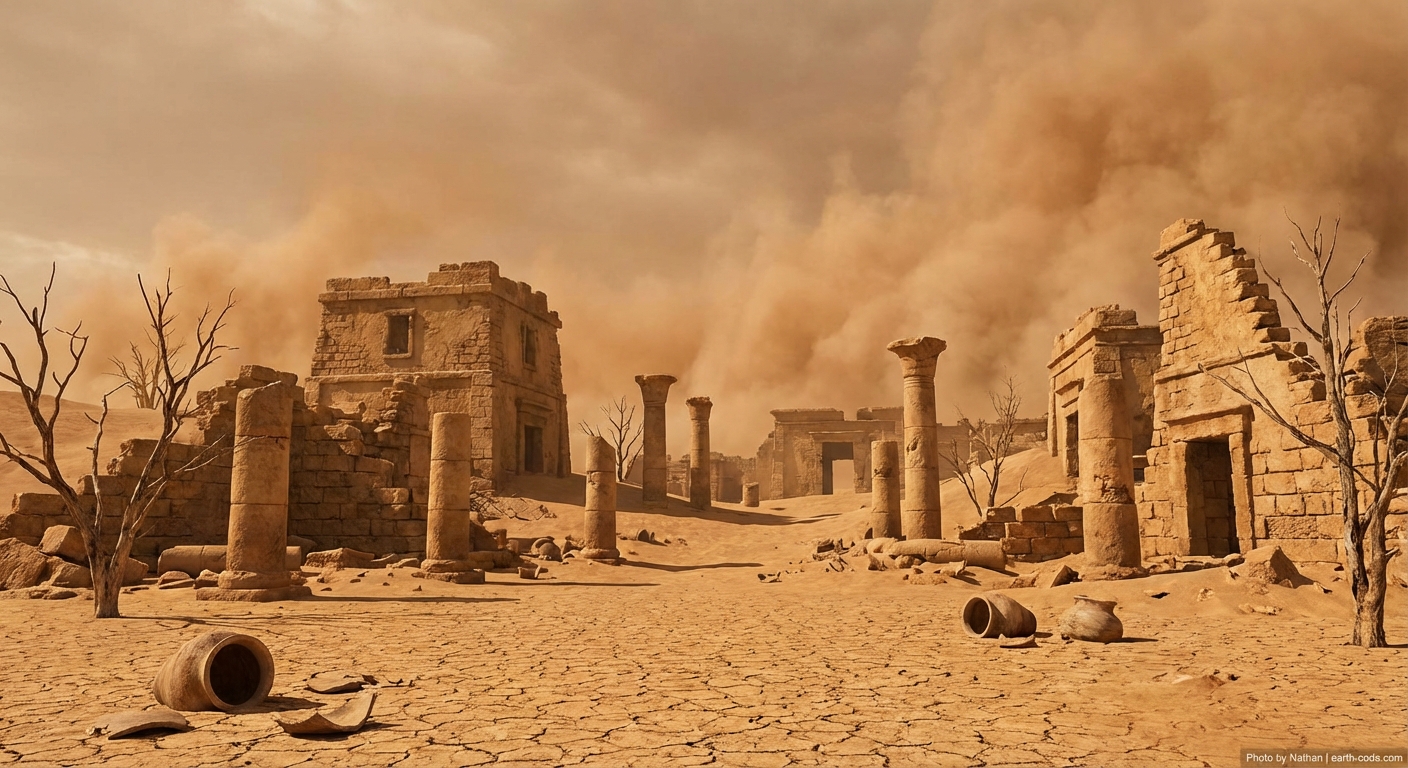
The Silent Witnesses: How Lake Varves Reveal Climate's Role in Civilizational Collapse
Deep beneath the still waters of Lake Suigetsu in Japan, thin layers of sediment have been quietly recording Earth's climate history for over 150,000 years. These varves—annual layers of sediment deposition—serve as nature's own archive, preserving a record more precise than any human chronicle. Within these microscopic strata lies evidence of a sobering truth: throughout history, abrupt climate changes have repeatedly brought mighty civilizations to their knees, often within the span of a single human generation.
The story written in these lake bed archives challenges our understanding of human resilience and reveals climate change as one of history's most powerful forces of civilizational transformation. From the mysterious collapse of the world's first empire to the Bronze Age catastrophe that reshaped the ancient world, varve records are helping archaeologists and climatologists piece together a narrative of human vulnerability that spans millennia.
The Varve Revolution in Archaeological Science
The systematic study of varves as historical records began in the early 20th century with Swedish geologist Gerard De Geer, but it wasn't until the 1990s that Lake Suigetsu emerged as the world's premier climate archive. Located in central Japan's Fukui Prefecture, this unassuming lake contains what researchers now call the most complete terrestrial record of climate change in the Northern Hemisphere.
Professor Takeshi Nakagawa of Newcastle University led the groundbreaking SG06 drilling project in 2006, extracting a continuous 73-meter sediment core that spans 150,000 years. Each varve in this core represents a single year, with lighter layers deposited during spring diatom blooms and darker layers formed from autumn leaf fall and winter erosion. The precision is extraordinary—individual years can be identified and counted like tree rings, but with far greater temporal depth.
Dr. Christopher Bronk Ramsey of Oxford University's Radiocarbon Accelerator Unit has called the Suigetsu record "the Rosetta Stone of climate archaeology," noting that it provides calendar-year precision that allows researchers to correlate abrupt climate shifts with specific historical events and civilizational collapses.
What makes varve records particularly valuable is their ability to capture rapid climate transitions that might be smoothed over or missed entirely in other proxy records like ice cores or tree rings. According to Dr. Achim Brauer of the German Research Centre for Geosciences, varves can reveal climate changes that occurred within decades or even individual years—the timescale on which human societies actually experience and respond to environmental stress.
The 4.2-Kiloyear Event: When Climate Toppled the World's First Empire
Around 4,200 years ago, the world experienced one of the most dramatic climate events in recorded history. Varve records from multiple sites, including Suigetsu, reveal a sudden shift toward arid conditions that persisted for nearly two centuries. This 4.2-kiloyear event has left its signature not only in lake sediments but in the archaeological record of collapsed civilizations across the globe.
The Akkadian Empire, established by Sargon the Great around 2334 BCE in Mesopotamia, was the world's first multi-ethnic empire, stretching from the Persian Gulf to the Mediterranean. At its height, it controlled critical trade routes and commanded the loyalty of numerous city-states. Yet by 2154 BCE, this mighty empire had completely vanished, leaving archaeologists puzzled for decades about the cause of such a rapid collapse.
Dr. Harvey Weiss of Yale University has spent over three decades investigating the connection between the 4.2-kiloyear event and the Akkadian collapse. His excavations at Tell Leilan in northern Syria revealed a dramatic story written in the archaeological stratigraphy: a thriving Akkadian settlement suddenly abandoned around 2200 BCE, with nearly two meters of wind-blown dust covering the ruins—clear evidence of severe drought conditions.
Varve records from Lake Van in Turkey, analyzed by Professor Rik Tjallingii and his team, show a dramatic shift in sediment composition exactly coinciding with this period. The varves reveal a sudden decrease in precipitation and an increase in dust deposition, indicating that the entire region experienced severe aridification. Some researchers argue that this drought was so severe that it transformed the fertile agricultural lands of northern Mesopotamia into virtual desert.
The human cost was staggering. Cuneiform texts from the period describe conditions of extreme hardship. One Akkadian text laments: "The large arable tracts yielded no grain, the inundated tracts yielded no fish, the irrigated orchards yielded no syrup and wine." Archaeological evidence from sites across the Fertile Crescent shows mass migrations, abandoned settlements, and the complete breakdown of complex trade networks.
Dr. Peter deMenocal of Columbia University's Lamont-Doherty Earth Observatory has identified similar patterns in marine sediment cores from the Arabian Sea, which show increased dust flux precisely during this period, confirming that the drought extended far beyond Mesopotamia. According to one theory proposed by Professor Yurco Kushnir, the event was triggered by a weakening of the Indian monsoon system, which created a domino effect of climate disruption across the entire region.
The Bronze Age Collapse: A Civilization-Wide Catastrophe
Perhaps no period in ancient history has puzzled archaeologists more than the Bronze Age Collapse around 1200-1150 BCE, also known as the 3.2-kiloyear event. Within the span of just a few decades, the sophisticated palace civilizations of the eastern Mediterranean—the Mycenaeans in Greece, the Hittites in Anatolia, and numerous city-states in the Levant—simply vanished, ushering in what historians call the Dark Ages of the ancient world.
Varve records from multiple sources paint a picture of severe climate disruption during this period. Dr. David Kaniewski of the University of Toulouse has analyzed pollen and sediment cores from the Levantine coast that reveal a dramatic shift toward arid conditions beginning around 1250 BCE. The varves show decreased precipitation, increased dust storms, and evidence of widespread vegetation die-off.
Lake Suigetsu's varves from this period tell a similar story of climate instability. Professor Takeshi Nakagawa's analysis reveals increased variability in seasonal deposition patterns, suggesting more erratic precipitation and temperature fluctuations. Some researchers argue that this climate instability, rather than a simple drought, made agricultural planning and long-term food storage nearly impossible for Bronze Age societies.
The archaeological evidence for widespread collapse is overwhelming. At Pylos in Greece, Professor Carl Blegen's excavations revealed a thriving Mycenaean palace complex that was suddenly destroyed and never reoccupied. Similar patterns appear at Tiryns, Thebes, and dozens of other sites across the Aegean. The palace at Knossos in Crete, rebuilt after earlier destructions, was finally abandoned around 1380-1100 BCE.
Dr. Eric Cline of George Washington University argues in his comprehensive analysis that the Bronze Age Collapse was a "perfect storm" of interconnected factors, with climate change serving as the primary trigger. According to his research, the Late Bronze Age Mediterranean was a highly interconnected system of trade and diplomatic relations. When climate change disrupted agricultural productivity in multiple regions simultaneously, it created cascading failures throughout the entire network.
The human toll was catastrophic. Professor Robert Drews estimates that the population of Greece declined by as much as 75% between 1200 and 1000 BCE. Writing systems disappeared, monumental architecture ceased, and complex crafts like bronze-working were abandoned in many regions. Some researchers suggest that the mysterious "Sea Peoples" mentioned in Egyptian texts were actually climate refugees from the collapsing Bronze Age civilizations.
The Little Ice Age: Climate and the Rise and Fall of Nations
Moving forward in time, varve records also illuminate the role of climate in more recent historical events. The Little Ice Age, spanning roughly from 1300 to 1850 CE, is well-documented in the Suigetsu varves and other records worldwide. Professor Michael Mann of Pennsylvania State University has shown how this prolonged cool period influenced everything from the collapse of the Norse Greenland settlements to the French Revolution.
The Suigetsu varves from this period show distinct changes in seasonal patterns, with evidence of cooler temperatures and altered precipitation regimes. Dr. Ulf Büntgen of the Swiss Federal Research Institute has correlated these changes with historical records of crop failures, famines, and social unrest across Europe and Asia.
According to one theory proposed by Professor Geoffrey Parker of Ohio State University, the Little Ice Age triggered what he calls a "global crisis" in the 17th century. His analysis of historical records from around the world reveals that approximately one-third of the global population died from warfare, disease, and famine during this period—much of it directly traceable to climate-induced agricultural failures.
The varve records provide crucial context for understanding how even relatively modest climate changes can have profound social impacts. Dr. Jürg Luterbacher of the University of Giessen notes that the Little Ice Age cooling was only about 1°C on average, yet it was sufficient to trigger crop failures, population displacement, and political upheaval across multiple continents.
Alternative Theories and Ongoing Debates
Despite the compelling evidence for climate-driven collapse, not all researchers agree that environmental factors were the primary drivers of civilizational breakdown. Professor Susan Sherratt of the University of Sheffield argues that the Bronze Age Collapse, in particular, may have been primarily caused by internal political and economic factors rather than climate change. She points to evidence of increasing social stratification, resource depletion, and warfare in the centuries leading up to the collapse.
Dr. Jesse Byock of UCLA has proposed that some apparent "collapses" were actually transformations—that societies adapted to changing conditions rather than simply disappearing. His research on medieval Iceland suggests that communities could maintain complex social structures even under severe environmental stress.
Some researchers question the precision and interpretation of varve chronologies themselves. Professor Mark Abbott of the University of Pittsburgh has noted that varve formation can be disrupted by unusual weather events, potentially creating gaps or false layers in the record. However, Dr. Nakagawa and his team have addressed these concerns through extensive cross-validation with other dating methods, including radiocarbon dating and volcanic ash layers.
The relationship between climate change and social complexity remains hotly debated. Professor Joseph Tainter of Utah State University argues that collapse is often the result of diminishing returns on social complexity rather than external environmental shocks. According to his theory, societies become increasingly complex and resource-intensive over time, making them more vulnerable to any disruption—whether climatic or otherwise.
Lessons from the Past, Questions for the Future
As our own civilization faces the specter of anthropogenic climate change, the lessons preserved in varve archives take on new urgency. The prehistoric and historical record reveals that human societies—no matter how sophisticated or powerful—remain vulnerable to rapid environmental change. The precision of varve records allows us to see that climate-driven collapses often occurred within decades, not centuries, challenging assumptions about our ability to adapt gradually to changing conditions.
Dr. Brian Fagan, author of numerous works on climate and civilization, argues that modern society's global interconnectedness may make us more vulnerable to climate-driven collapse than our ancestors, not less. Like the Bronze Age Mediterranean, our world relies on complex networks of trade, communication, and resource distribution that could be disrupted by relatively localized climate impacts.
Yet the varve records also reveal stories of resilience and adaptation. Some societies, like medieval Iceland and Japan, weathered severe climate changes by developing flexible social structures and diverse economic strategies. Professor Dagomar Degroot of Georgetown University has shown how the Dutch Golden Age was partly built on adaptations to Little Ice Age conditions, including innovations in agriculture, maritime technology, and urban planning.
The Suigetsu varves continue to yield new insights as analytical techniques improve. Recent work by Dr. Yusuke Yokoyama of the University of Tokyo has begun to identify sub-annual climate variations in the record, potentially revealing seasonal patterns of climate stress that could inform modern adaptation strategies.
As we face an uncertain climatic future, the silent witnesses preserved in lake sediments remind us that the relationship between climate and civilization is neither simple nor predictable. The varve records force us to confront uncomfortable questions: How resilient is our own global civilization? What climate thresholds might trigger system-wide failures? And perhaps most importantly, what can we learn from past collapses to better prepare for future challenges?
The answers lie partly buried in the annual layers of lakes around the world, waiting for researchers to decode their messages. Each varve represents a year in the life of our planet—a reminder that human history and natural history are inextricably intertwined, and that understanding this relationship may be crucial for our survival as a species.
[!] Various theories exist. Information may contain errors.