Richat Structure - Eye of the Sahara
Giant concentric circles visible from space. Renewed attention as Atlantis candidate
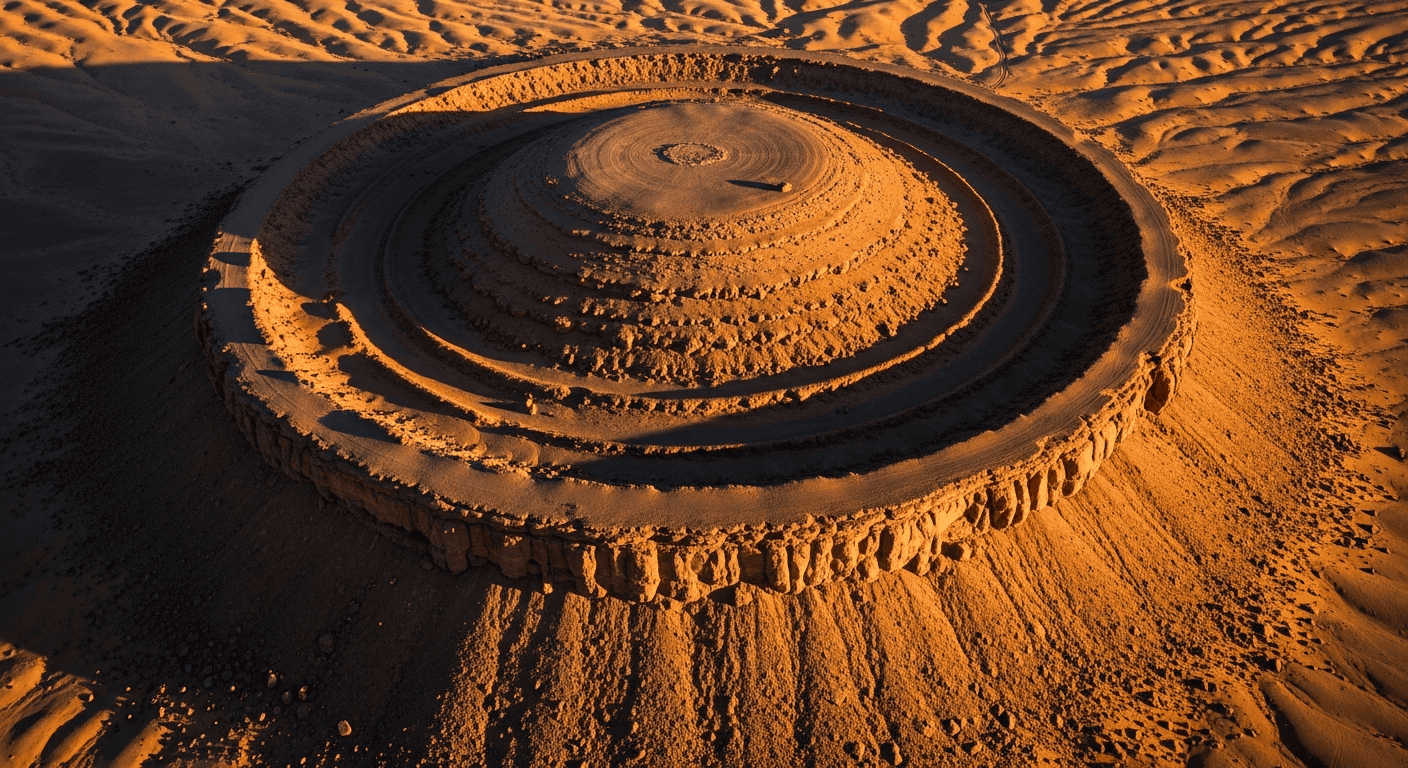
The Richat Structure: Could the "Eye of the Sahara" Be the Lost Atlantis?
Deep in the heart of the Mauritanian Sahara Desert, a mysterious geological formation catches the eye of astronauts orbiting 400 kilometers above Earth. Known as the Richat Structure or the "Eye of the Sahara," this massive circular feature spans approximately 50 kilometers in diameter and consists of concentric rings that seem almost too perfect to be natural.
A Geological Marvel in the Desert
The Richat Structure was first brought to global attention in the 1960s during NASA's Gemini missions, when astronauts noticed the distinctive bull's-eye pattern from space. Located at coordinates 21.1224° N, 11.3971° W in the Adrar Plateau, this formation consists of alternating bands of resistant quartzite ridges and less resistant rock that has eroded away over millions of years.
For decades, scientists believed the structure was an impact crater created by a meteorite collision. However, extensive geological surveys conducted in the 1970s and 1980s revealed no evidence of shock metamorphism or meteorite fragments typically associated with impact sites. Instead, researchers determined that the Richat Structure is likely a geological dome that formed through uplift and subsequent erosion, possibly influenced by volcanic activity approximately 100 million years ago.
The Atlantis Connection
Recent years have witnessed renewed interest in the Richat Structure, not from geologists, but from researchers investigating one of history's most enduring mysteries: the location of Atlantis. The connection was popularized by researchers like Bright Insight's Jimmy Corsetti and geographer George S. Alexander, who noted striking similarities between the structure and Plato's description of the lost civilization.
In his dialogues "Timaeus" and "Critias" (circa 360 BCE), Plato described Atlantis as a circular city with alternating rings of land and water, measuring approximately 127 stadia in diameter—roughly 23 kilometers. While this is smaller than the Richat Structure's full extent, proponents argue that Plato may have described only the central portion of a larger complex.
The parallels are intriguing: both feature concentric circular patterns, both are located near the Atlantic Ocean (Plato placed Atlantis beyond the "Pillars of Hercules"), and both show evidence of advanced engineering. Additionally, the Richat Structure sits in what was once a much wetter region of Africa, with paleoclimatic evidence suggesting the area supported lakes and rivers as recently as 6,000-8,000 years ago.
Challenges and Controversies
Critics of the Atlantis hypothesis point out significant problems with this identification. The Richat Structure shows no evidence of human construction or ancient settlements. Archaeological surveys have uncovered only scattered Neolithic artifacts, nothing resembling an advanced Bronze Age civilization. Furthermore, the structure's formation predates human civilization by millions of years.
Mainstream archaeologists maintain that Plato's Atlantis was likely a philosophical allegory rather than a historical account, designed to illustrate political concepts rather than document an actual place. The timing also presents challenges—Plato claimed Atlantis existed 9,000 years before his time (approximately 11,600 years ago), but the Sahara's transformation into desert occurred more gradually.
The Mystery Continues
Whether the Richat Structure represents a remarkable geological coincidence or holds clues to ancient history remains hotly debated. What's undeniable is that this "Eye of the Sahara" continues to captivate researchers, adventurers, and dreamers seeking answers to one of antiquity's greatest puzzles.
[!] Various theories exist. Information may contain errors.