Qin Shi Huang's Tomb - The Unopened Underground Palace
The world's largest unopened tomb guarded by terracotta warriors. Legend of an underground palace with rivers of mercury
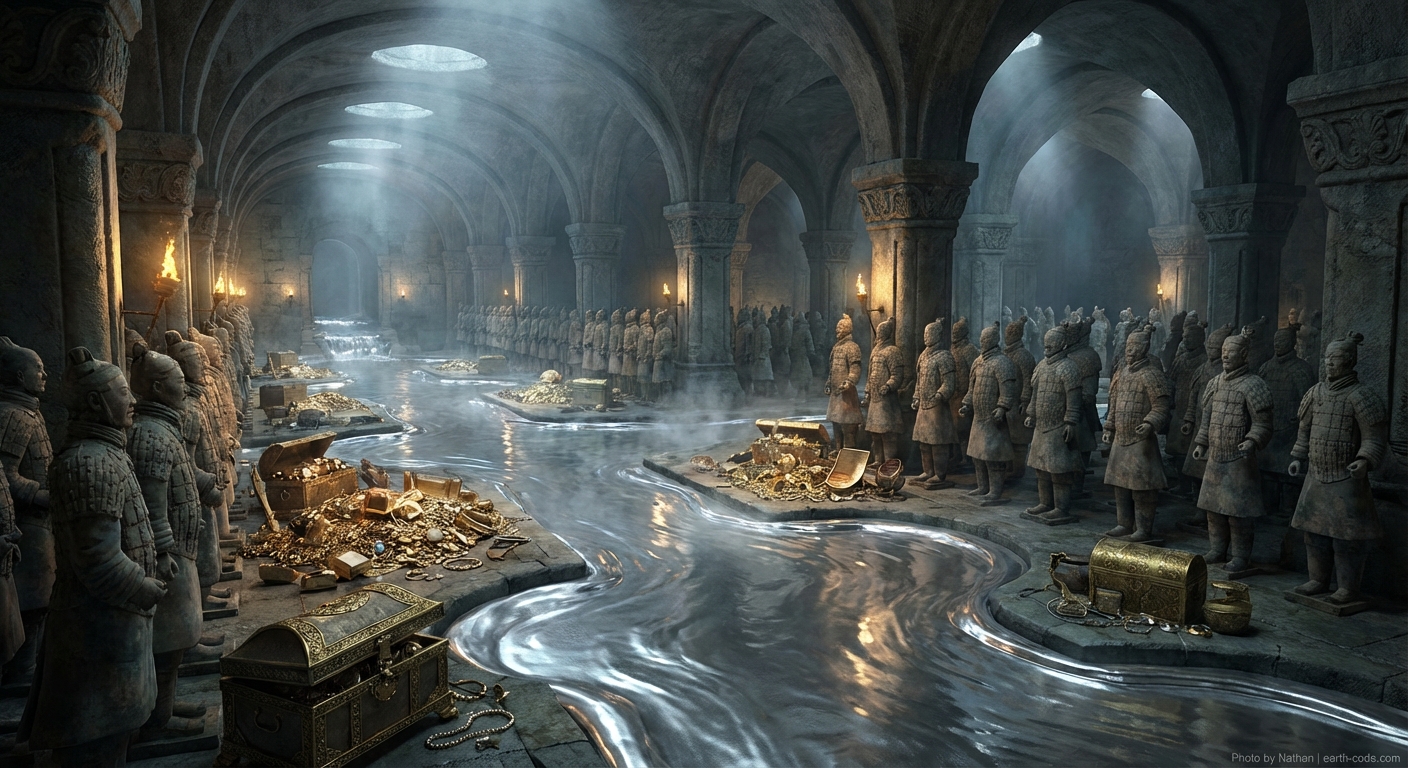
The Emperor's Eternal Palace: Qin Shi Huang's Unopened Underground Tomb
Beneath the rolling hills of Xi'an, China, lies one of archaeology's greatest mysteries: the unopened tomb of Qin Shi Huang, the first Emperor of China. For over 2,200 years, this massive underground palace has remained sealed, guarded by an army of terracotta warriors and shrouded in legends that sound more like fantasy than historical fact.
A Monument to Absolute Power
The burial complex spans an astounding 56 square kilometers—larger than many modern cities. Construction began in 246 BCE when the future emperor was just 13 years old, and continued for nearly four decades. According to ancient historian Sima Qian, over 700,000 workers labored to create what may be the most elaborate tomb ever constructed.
The famous Terracotta Army, discovered in 1974, represents merely the outer guardian force of this vast necropolis. These 8,000 life-sized warriors, each with unique facial features, stand in battle formation as eternal protectors of their emperor. Yet they pale in comparison to what lies beneath the central burial mound—a structure that rises 76 meters above ground level.
The Mercury Mystery
Perhaps the most intriguing aspect of the tomb involves mercury—lots of it. Ancient texts describe rivers and seas of liquid mercury flowing through the underground palace, mechanically operated to mimic the waterways of the emperor's realm. Modern soil tests around the tomb have detected mercury levels 100 times higher than normal, lending credibility to these seemingly fantastical accounts.
Dr. Duan Qingbo, leading archaeologist at the site, notes that these mercury concentrations form distinct patterns that mirror the ancient Chinese understanding of geography. If accurate, the tomb may contain several tons of mercury—a staggering amount that would have represented immense wealth in ancient times.
Technological Marvels and Deadly Traps
Historical records suggest the tomb contains sophisticated crossbow mechanisms designed to automatically fire upon intruders. Recent ground-penetrating radar and electrical resistivity surveys have revealed a complex network of chambers, corridors, and what appear to be drainage systems—supporting accounts of an elaborate underground city.
The tomb's multi-level construction includes at least four distinct chambers, with the emperor's burial chamber positioned at the center. Archaeologists believe the complex may extend 30 meters underground, creating a three-dimensional maze of unprecedented complexity.
The Preservation Dilemma
Chinese authorities have deliberately chosen not to excavate the main tomb, citing concerns about preserving organic materials and managing the mercury contamination. Current technology may not adequately protect the tomb's contents from oxidation and decay once exposed to air.
Some theories suggest the unopened tomb could contain irreplaceable silk manuscripts, detailed maps of the ancient world, and artifacts that would revolutionize our understanding of early Chinese civilization. Others propose more speculative possibilities, including alchemical laboratories or even the emperor's attempts to achieve physical immortality.
The tomb of Qin Shi Huang remains archaeology's most tantalizing unopened treasure, holding secrets that have waited over two millennia to see daylight once again.
[!] Various theories exist. Information may contain errors.