Phaistos Disc - Undeciphered Ancient Script
Mysterious disc found in Crete. What do the 242 symbols mean?
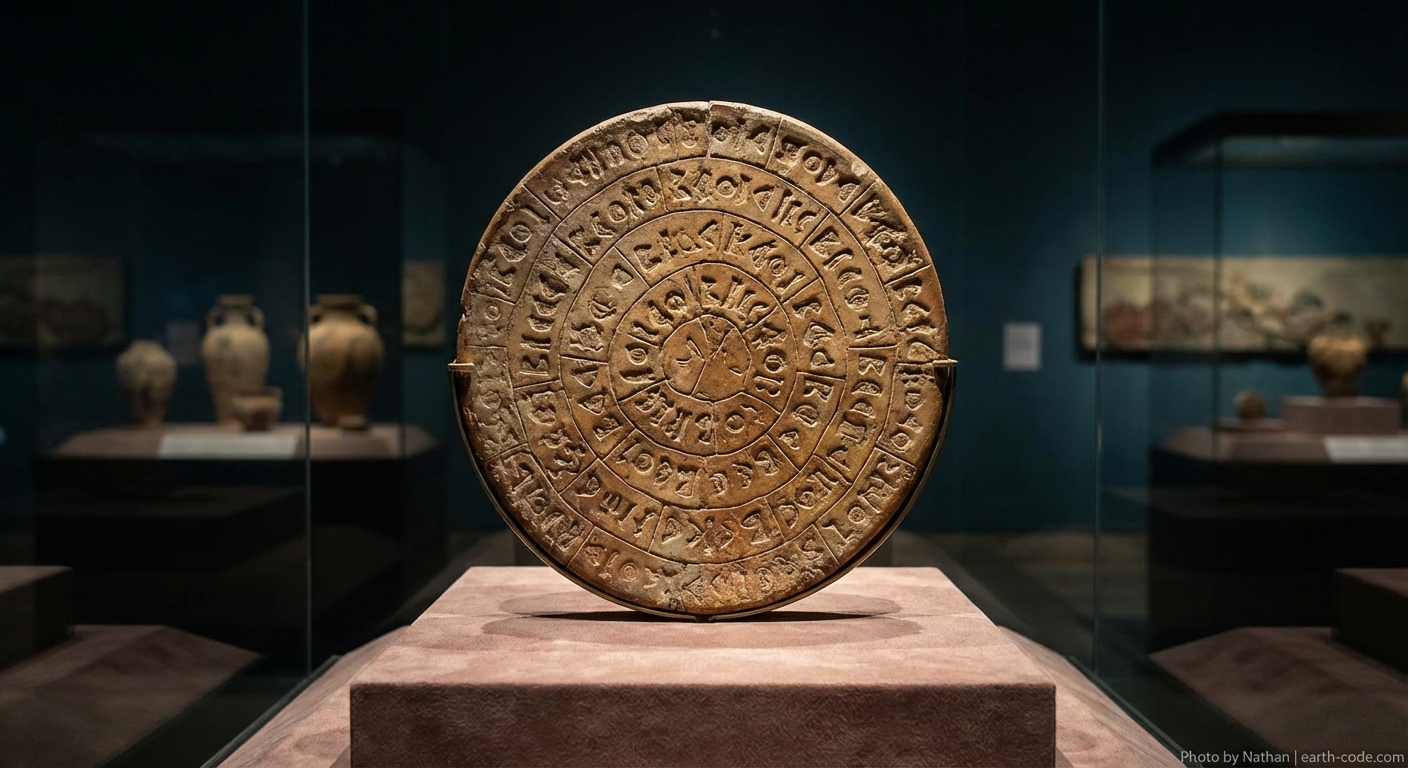
3,500-year-old mystery challenges modern minds—242 indecipherable symbols
The Phaistos Disc: Crete's Greatest Archaeological Mystery
A Clay Puzzle That Has Stumped Scholars for Over a Century
In 1908, Italian archaeologist Luigi Pernier made a discovery at the ancient Minoan palace of Phaistos that would become one of archaeology's most enduring mysteries. Hidden within the ruins of this 3,600-year-old Cretan palace, he unearthed a small clay disc covered in 242 mysterious symbols arranged in a spiral pattern—symbols that, to this day, no scholar has definitively deciphered.
The Enigmatic Artifact
The Phaistos Disc measures just 15 centimeters in diameter and 2 centimeters thick, yet its significance far outweighs its modest size. The disc contains 241 tokens representing 45 distinct symbols, stamped into wet clay using individual seals before being fired. This technique was remarkably advanced for its time, essentially representing the world's first known example of movable type printing—predating Gutenberg by over 3,000 years.
The symbols spiral from the outside edge toward the center on both sides, divided into groups by vertical lines, suggesting they represent words or phrases. The imagery includes human figures, animals, plants, tools, and geometric shapes—a visual vocabulary that tantalizes researchers with its apparent meaning while remaining frustratingly opaque.
Theories and Interpretations
Scholars have proposed dozens of theories about the disc's purpose and meaning. Some believe it represents a religious hymn or prayer, pointing to repeated symbol patterns that could indicate ritual refrains. Others suggest it might be a land tenure document, recording property rights or agricultural instructions relevant to Minoan society.
The linguistic theories are equally diverse. Some researchers argue the symbols represent syllabic writing similar to Linear A and Linear B scripts found elsewhere in Crete. Dr. Gareth Owens of the Technological Educational Institute of Crete proposed in 2014 that the disc contains a prayer to a Minoan mother goddess, identifying repeated sequences he translates as devotional phrases.
More controversial interpretations include suggestions that the disc represents an ancient board game, a calendar system, or even an astronomical calculator. The geometric precision and mathematical relationships between symbol groups have led some to propose it encoded scientific knowledge about lunar cycles or agricultural seasons.
The Authentication Debate
Remarkably, some scholars question whether the Phaistos Disc is authentic at all. The symbols' unique nature—appearing nowhere else in the archaeological record—combined with their suspiciously modern-looking typography has led skeptics to suggest it might be a 20th-century hoax. However, thermoluminescence dating and clay analysis have consistently supported its ancient Minoan origins.
The Mystery Endures
Despite advances in computational linguistics and pattern recognition, the Phaistos Disc remains stubbornly undeciphered. Its isolation—no other examples of this script have been discovered—makes traditional comparative analysis impossible. The disc sits in the Heraklion Archaeological Museum, continuing to inspire new generations of cryptographers, linguists, and amateur enthusiasts.
Perhaps the disc's greatest achievement is not what it says, but what it represents: a reminder that ancient civilizations possessed sophisticated communication systems and technologies that continue to challenge our understanding of the past.
[!] Various theories exist. Information may contain errors.