Knossos Labyrinth - Home of the Minotaur
Did the mythical labyrinth exist? Mysterious structures beneath Crete
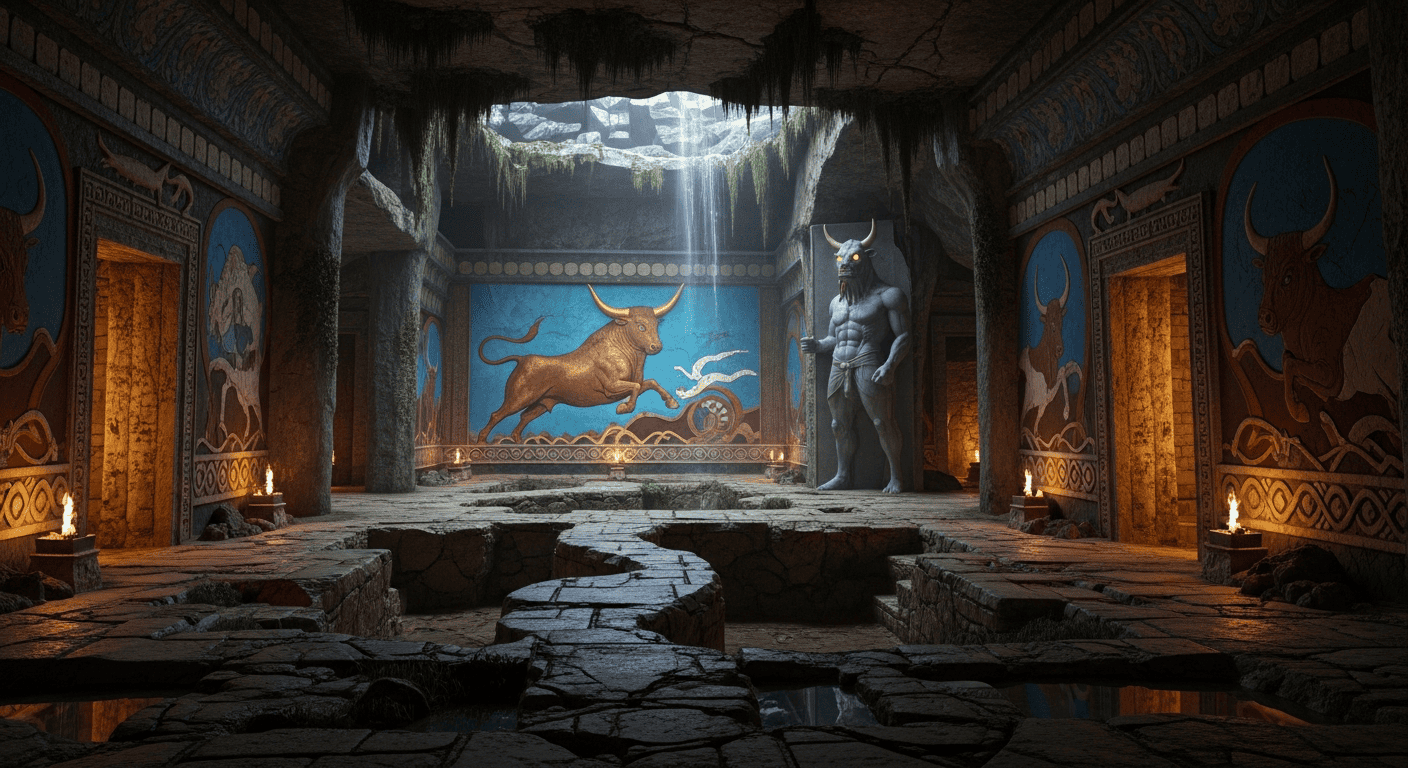
The Knossos Labyrinth: Unraveling the Mystery Beneath Crete's Ancient Palace
Deep beneath the sun-baked hills of Crete lies one of archaeology's most tantalizing puzzles: could the legendary labyrinth of the Minotaur have been more than mere myth? Recent discoveries at Knossos Palace suggest that ancient Greek storytellers may have woven their tales around a very real and extraordinary architectural wonder.
The Palace of Endless Corridors
When British archaeologist Sir Arthur Evans first excavated Knossos in 1900, he uncovered a sprawling complex that defied comprehension. The palace contained more than 1,300 interconnected rooms, arranged in such a bewildering maze-like pattern that even today, visitors regularly lose their way among its reconstructed corridors. Built around 1700 BCE by the sophisticated Minoan civilization, this architectural marvel covered approximately 20,000 square meters and rose up to four stories high.
The palace's layout is genuinely labyrinthine – narrow passages suddenly widen into grand halls, staircases lead to dead ends, and rooms connect through seemingly random doorways. Evans himself noted that the complex required careful navigation, leading him to propose that this very building inspired the Greek legend of Theseus navigating the deadly maze to slay the Minotaur.
Underground Secrets Revealed
Perhaps more intriguing than the palace itself are the extensive underground tunnels and chambers discovered beneath Knossos. Modern ground-penetrating radar and archaeological surveys have revealed a vast subterranean network that remains largely unexplored. These underground passages, some reaching depths of 8 meters below the main palace floor, create an even more complex three-dimensional labyrinth.
Some researchers theorize these tunnels served practical purposes – storage, drainage, or escape routes during sieges. Others suggest more ritualistic functions, noting their proximity to areas containing Minoan religious artifacts and ceremonial chambers.
The Bull Cult Connection
The mythological Minotaur – half-man, half-bull – finds striking parallels in Minoan religious practices. Archaeological evidence throughout Knossos reveals an obsession with bull worship that permeated Minoan society. The famous bull-leaping frescoes depict acrobats vaulting over charging bulls, while countless bull-horn symbols (called rhyta) appear throughout the palace.
In 1979, archaeologists discovered a chamber containing over 300 clay bull figurines arranged in ritualistic patterns. The Throne Room, with its griffin frescoes and ceremonial basin, sits directly above one of the largest underground chambers – perhaps where bull sacrifices occurred, feeding the legend of human tribute to the Minotaur.
Modern Theories and Ancient Truths
Could the Knossos complex truly be the labyrinth of Greek mythology? Some scholars argue that the palace's confusing layout, combined with its underground network and bull-centered religious practices, created the perfect conditions for mythological storytelling. Prisoners or sacrificial victims navigating these passages might indeed have felt trapped in an inescapable maze guarded by a monstrous bull-god.
Others propose that the "labyrinth" referred to the double-axe symbol (labrys) prevalent throughout Minoan culture, giving the palace its name rather than describing its architecture.
Whether architectural accident or deliberate design, Knossos remains a testament to Minoan ingenuity and the enduring power of ancient mysteries to capture human imagination.
[!] Various theories exist. Information may contain errors.