Geomagnetic Reversal Cycles - Earth's Rewriting of Magnetic Code
Earth's magnetic field has reversed many times. The cycle, causes, and what the next reversal means for humanity
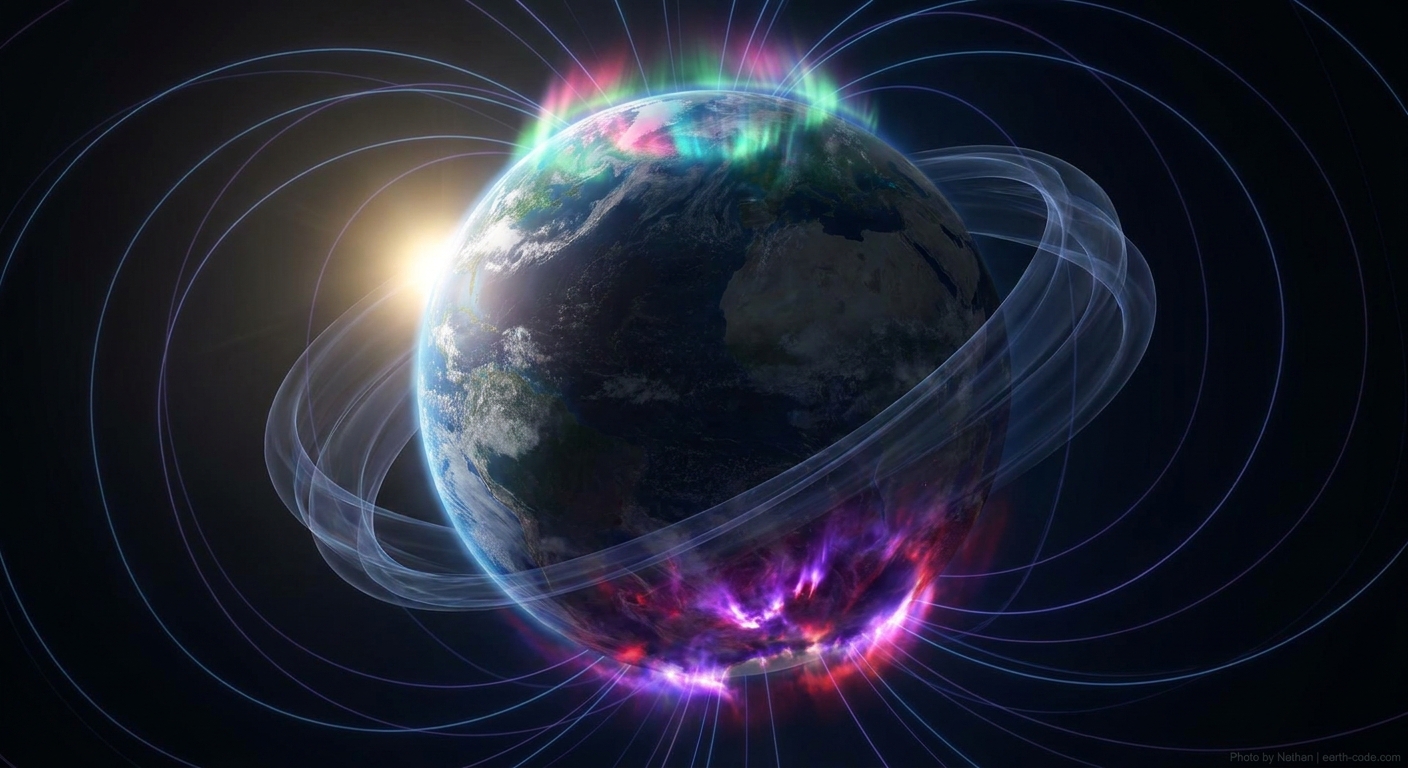
Earth's Magnetic Field Reversals: When North Becomes South and Civilization Hangs in the Balance
Deep beneath our feet, something extraordinary is happening. The molten iron core of our planet is slowly stirring, generating the invisible magnetic shield that protects us from deadly cosmic radiation. But this shield is not permanent—in fact, it's been flipping upside down repeatedly throughout Earth's history, and according to mounting evidence, we may be living through the early stages of another dramatic reversal right now.
For the past 780,000 years, Earth's magnetic north has pointed roughly toward the geographic North Pole. But this seemingly stable arrangement is actually an anomaly in our planet's deep history. The geological record reveals that Earth's magnetic field has reversed its polarity hundreds of times over the past few million years, with magnetic north suddenly becoming magnetic south, and vice versa. What's more unsettling for modern civilization is that we're now overdue for the next flip—and when it happens, the consequences could reshape life as we know it.
The Discovery That Changed Everything
The story of geomagnetic reversals begins with a French physicist named Bernard Brunhes, who in 1906 made a discovery that initially seemed impossible. While studying volcanic rocks in the Massif Central region of France, Brunhes found that the magnetic minerals in certain ancient lava flows pointed in the opposite direction from Earth's current magnetic field. Rather than pointing north, they pointed south.
This finding was so counterintuitive that it took decades for the scientific community to accept what Brunhes had uncovered. It wasn't until the 1950s and 1960s, when researchers like Allan Cox, Richard Doell, and Brent Dalrymple at the United States Geological Survey began systematically studying magnetic reversals in volcanic rocks around the world, that the true scope of this phenomenon became clear.
Their groundbreaking work revealed that Earth's magnetic field doesn't just occasionally flip—it does so with surprising regularity. By analyzing the magnetic orientation of volcanic rocks of different ages, these pioneering geophysicists constructed the first comprehensive timeline of geomagnetic polarity reversals stretching back millions of years.
The breakthrough came when oceanographer Harry Hess and geologist Fred Vine connected magnetic reversals to seafloor spreading in the early 1960s. They discovered that the ocean floor contains parallel stripes of alternating magnetic polarity, like a giant barcode recording Earth's magnetic history. As new oceanic crust forms at mid-ocean ridges, it preserves the magnetic orientation of that time period, creating a permanent record of when the field was "normal" (like today) and when it was "reversed."
The Rhythm of Reversal: Decoding Earth's Magnetic Heartbeat
Through decades of painstaking research, scientists have mapped Earth's magnetic reversals back over 160 million years. What they've found is both fascinating and deeply concerning for our modern world. The data reveals that geomagnetic reversals follow no predictable pattern—some periods see rapid-fire flips every 50,000 years, while others remain stable for over 40 million years.
However, for the past 5 million years, Earth has settled into a more regular rhythm. According to research led by Brad Singer at the University of Wisconsin-Madison and published in 2019, the average interval between reversals during this period has been approximately 200,000 to 300,000 years. Some researchers, including Gary Glatzmaier at the University of California, Santa Cruz, argue that this represents Earth's "normal" reversal frequency.
The most recent complete reversal, known as the Brunhes-Matuyama reversal (named after Bernard Brunhes and Japanese geophysicist Motonori Matuyama), occurred 780,000 years ago. This means we're currently living in what scientists call the Brunhes Normal Chron—a period of stable magnetic polarity that has lasted nearly four times longer than the average reversal interval.
But perhaps most intriguingly, the geological record shows that reversals don't happen overnight. Research by Xixi Zhao and colleagues at the Scripps Institution of Oceanography indicates that a complete polarity flip typically takes between 1,000 and 10,000 years to complete. During this transition period, the magnetic field doesn't simply switch directions—it becomes chaotic, with multiple magnetic poles appearing and disappearing across the globe.
The Mechanics of Magnetic Mayhem
Understanding why Earth's magnetic field reverses requires delving into the complex dynamics of our planet's core. The magnetic field is generated by the geodynamo—a self-sustaining process where the motion of electrically conductive molten iron in the outer core creates electric currents, which in turn generate the magnetic field.
Peter Olson at Johns Hopkins University has spent decades creating computer models of the geodynamo process. His research suggests that magnetic reversals occur when the delicate balance of forces within the outer core becomes unstable. According to Olson's models, published in 2006 and refined through 2014, several factors can trigger a reversal: changes in heat flow from the inner core, variations in the Earth's rotation rate, or disruptions caused by the motion of tectonic plates above.
Some researchers argue that reversals may be linked to external factors. Laschamp and Mono Lake events—brief periods of magnetic field instability that occurred 41,000 and 34,000 years ago respectively—coincide with significant climate changes and increased cosmic ray exposure. Jean-Pierre Valet at the Institute of Earth Physics in Paris has proposed that these events might be triggered by impacts from asteroids or comets, though this theory remains highly debated.
Another compelling hypothesis comes from Monika Korte at the German Research Centre for Geosciences, who argues that reversals might be influenced by the growth rate of the solid inner core. As the inner core slowly crystallizes and grows, it releases heat and light elements that drive convection in the outer core. Variations in this process could destabilize the magnetic field and trigger reversals.
Signs of an Impending Flip: The Weakening Shield
What makes the current situation particularly alarming for scientists is the mounting evidence that Earth's magnetic field is already showing signs of instability. Satellite data from the European Space Agency's Swarm mission, launched in 2013, reveals that the magnetic field has been weakening at an accelerating rate.
Chris Finlay at the Technical University of Denmark, who leads the Swarm satellite data analysis, reports that the field strength has declined by approximately 9% over the past 170 years. More dramatically, certain regions are experiencing much more rapid changes. The South Atlantic Anomaly—a region stretching from Chile to Zimbabwe where the magnetic field is already significantly weaker—has been expanding and intensifying since at least 1958.
According to Julien Aubert at the Institute of Earth Physics in Paris, computer simulations suggest that the South Atlantic Anomaly might represent the early stages of a magnetic field reversal. His 2019 study, published in Nature Geoscience, shows that similar anomalies appear in geodynamo models just before complete polarity reversals.
Even more concerning are recent measurements of the magnetic north pole's movement. Larry Newitt of the Geological Survey of Canada has been tracking the pole's position since the 1990s and reports that it's moving from Canada toward Siberia at an accelerating pace—currently traveling at about 55 kilometers per year, compared to just 15 kilometers per year in 2000.
The Human Cost of Magnetic Chaos
While Earth has survived hundreds of magnetic reversals throughout its history, never before has a reversal occurred during an era of advanced technological civilization. The potential consequences for modern society are staggering and largely untested.
Jeffrey Love at the U.S. Geological Survey has spent years studying the potential impacts of geomagnetic reversals on human infrastructure. His research indicates that during a reversal, when the magnetic field becomes weak and chaotic, Earth would lose much of its protection from harmful solar and cosmic radiation. This could have devastating effects on both technology and human health.
Satellite systems would be particularly vulnerable. According to Daniel Baker at the University of Colorado's Laboratory for Atmospheric and Space Physics, the increased radiation exposure could destroy the electronic components of satellites within months or years. This would cripple GPS navigation, weather forecasting, communications, and countless other services that modern civilization depends upon.
Power grids on Earth's surface would also face unprecedented challenges. John Kappenman, a consultant who specializes in geomagnetic hazards, argues that the electrical currents induced by a chaotic magnetic field could overwhelm power transformers and cause widespread blackouts lasting months or even years.
Some researchers argue that biological effects could be even more severe. Henrik Svensmark at the Technical University of Denmark has proposed that increased cosmic ray exposure during magnetic reversals could significantly increase cancer rates and cause genetic mutations in humans and other species.
Alternative Perspectives and Ongoing Mysteries
Not all scientists agree that we're approaching an imminent magnetic reversal. Gauthier Hulot at the Institute of Earth Physics in Paris argues that the current magnetic field changes might represent normal fluctuations rather than signs of an approaching flip. His analysis of 400 years of magnetic field observations suggests that similar weakening events have occurred in the past without leading to reversals.
According to one theory proposed by Mioara Mandea at the German Research Centre for Geosciences, the magnetic field might be entering a period of low intensity similar to the Laschamp event 41,000 years ago, rather than a complete reversal. During this event, the field strength dropped to about 25% of its normal value for several thousand years but eventually recovered without flipping polarity.
Some researchers also question whether magnetic reversals are as catastrophic as commonly portrayed. Brad Singer's research suggests that past reversals don't correlate strongly with mass extinction events in the fossil record. This has led scientists like Vincent Courtillot at the Institute of Earth Physics in Paris to argue that life on Earth is more resilient to magnetic field changes than previously thought.
However, many aspects of geomagnetic reversals remain deeply mysterious. Why do some reversals take only 1,000 years while others require 10,000 years? Why do certain geological periods show frequent reversals while others remain stable for millions of years? And perhaps most puzzling of all, why does the magnetic field sometimes begin to reverse and then return to its original polarity without completing the flip?
Gary Glatzmaier and Paul Roberts have used supercomputer simulations to explore these questions, but their models can only approximate the incredibly complex dynamics of Earth's core. Real answers may require new breakthroughs in our understanding of planetary magnetism and geophysical processes.
Living on the Edge of Magnetic Uncertainty
As we face the possibility of Earth's magnetic field undergoing its first reversal in nearly 800,000 years, humanity finds itself in uncharted territory. The geological evidence makes clear that reversals are a normal part of our planet's behavior, but the potential consequences for our technology-dependent civilization remain largely unknown.
Recent research by teams around the world continues to refine our understanding of when and how the next reversal might occur. Fabio Donadini at the Munich University has suggested that improved monitoring of the magnetic field's evolution could provide decades of advance warning before a complete flip occurs. Meanwhile, Rainer Hollerbach at the University of Leeds is working on more sophisticated computer models that might predict the timing and duration of future reversals.
What remains clear is that geomagnetic reversals represent one of the most fundamental and least understood processes affecting our planet. As we continue to probe the mysteries of Earth's magnetic behavior, we're forced to confront profound questions about our technological vulnerability and our place in the cosmic order.
Are we living through the early stages of a magnetic reversal that will reshape human civilization? Will our technological infrastructure survive the chaos of a flipping magnetic field? And what can the deep history of Earth's magnetic field tell us about the future of our planet and our species?
[!] Various theories exist. Information may contain errors.