What is Magnet Code? - Earth's Magnetic Memory Recorded in Rocks
When lava cools, Earth's magnetic field direction is burned into the rock. Magnet Code reads geomagnetic reversals, excursions, and plate movements from rock magnetism
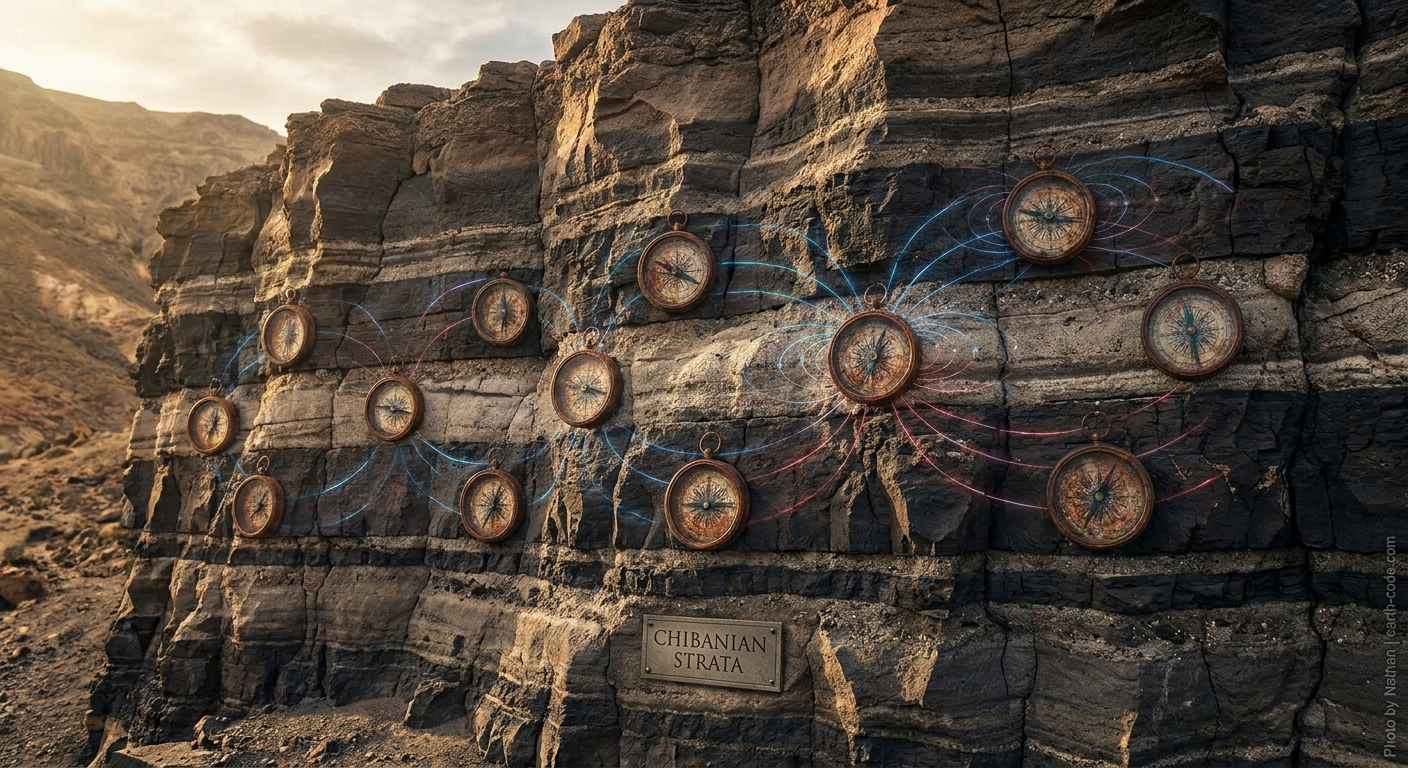
The Earth's Hidden Archive: Deciphering the Magnetic Code Locked in Ancient Rocks
Deep beneath our feet, scattered across ocean floors, and embedded within towering mountain ranges lies one of Earth's most remarkable historical records—a magnetic archive that chronicles our planet's tumultuous past with stunning precision. This ancient library, written not in stone tablets or papyrus, but in the very atoms of cooling lava and sedimentary layers, holds the key to understanding billions of years of planetary history. Scientists call it paleomagnetism, but we might better describe it as Earth's own "Magnetic Code"—a cryptic language that, once deciphered, reveals extraordinary secrets about our planet's magnetic field, continental drift, and even the survival of early humans.
Imagine, if you will, that every volcanic eruption, every grain of iron-rich sediment settling on an ancient lake bed, and every cooling igneous intrusion has been quietly recording data for eons—capturing not just the direction of Earth's magnetic field at that precise moment, but preserving it like a fossil for millions of years. This is no mere geological curiosity; it's a revolutionary discovery that has fundamentally transformed our understanding of how Earth works, providing concrete evidence for plate tectonics, revealing dramatic magnetic pole reversals that occurred long before human civilization, and even suggesting connections to mass extinction events.
The Birth of Magnetic Archaeology
The story of deciphering Earth's Magnetic Code begins in the early 20th century, though its true significance wouldn't be recognized for decades. In 1906, French physicist Bernard Brunhes made a startling discovery while studying volcanic rocks in the Massif Central region of France. Brunhes found that certain ancient lava flows displayed magnetic orientations completely opposite to Earth's current magnetic field—as if the planet's magnetic poles had somehow flipped upside down.
This observation seemed so preposterous that many scientists initially dismissed it as experimental error. However, by the 1920s, Japanese geophysicist Motonori Matuyama had confirmed similar reversals in volcanic rocks across Japan. Matuyama's systematic studies revealed that rocks older than approximately 780,000 years consistently showed reversed magnetic polarity, while younger rocks aligned with today's magnetic field. This boundary, now known as the Brunhes-Matuyama reversal, became the first widely accepted evidence that Earth's magnetic field had indeed undergone complete reversals throughout geological history.
The breakthrough that transformed paleomagnetic research from curiosity to revolutionary science came in the 1950s and 1960s, driven by the pioneering work of researchers like Keith Runcorn at Cambridge University and Ted Irving in Australia. Using increasingly sophisticated magnetometers, these scientists began systematically sampling rocks from around the globe, creating the first comprehensive maps of ancient magnetic field directions. Their work revealed not just isolated reversals, but a complex pattern of magnetic behavior spanning millions of years.
Reading the Magnetic Manuscript
The process by which rocks acquire and preserve magnetic information is elegantly simple, yet profoundly significant. When lava erupts from a volcano and begins to cool, iron-bearing minerals within the molten rock—primarily magnetite and hematite—align themselves with Earth's magnetic field like countless tiny compass needles. As the temperature drops below approximately 580°C (the Curie point for magnetite), these mineral orientations become permanently locked in place, creating what scientists call thermoremanent magnetization.
But volcanic rocks aren't the only carriers of this magnetic code. Sedimentary rocks formed in ancient lakes, rivers, and ocean basins also preserve magnetic records through a different mechanism. As iron-rich particles settle through water columns, they orient themselves with the prevailing magnetic field before being buried and lithified. This depositional remanent magnetization provides an equally valuable record, often with even finer temporal resolution than volcanic rocks.
According to paleomagnetic specialist Dr. Catherine Constable of UC San Diego, "These rocks are essentially frozen compasses, each one pointing toward the magnetic pole that existed at the moment of their formation. When we sample systematically across different ages, we can literally watch the magnetic field change through time."
The most dramatic changes recorded in this magnetic archive are the complete geomagnetic reversals—periods when Earth's magnetic north and south poles exchange positions entirely. Current research indicates that our planet has experienced at least 183 confirmed magnetic reversals over the past 83 million years, with the frequency varying considerably through geological time. Some periods, like the Cretaceous Normal Superchron (121-83 million years ago), show remarkable magnetic stability, while other intervals display rapid, chaotic reversals occurring every few hundred thousand years.
The Seafloor Revelation
Perhaps nowhere is Earth's Magnetic Code more clearly written than on the ocean floor, where it provided the smoking gun evidence for one of geology's most revolutionary theories. In the early 1960s, marine geologists Harry Hess and Robert Dietz proposed the radical idea of seafloor spreading—that new oceanic crust was continuously being created at mid-ocean ridges and spreading outward like a vast conveyor belt.
Fred Vine and Drummond Matthews of Cambridge University made the connection that would prove this theory beyond doubt. In their landmark 1963 paper, they demonstrated that the seafloor displays perfectly symmetrical magnetic stripe patterns on either side of mid-ocean ridges. These stripes alternate between normal and reversed magnetic polarity, creating a barcode-like pattern that mirrors the timing of magnetic reversals recorded in continental volcanic rocks.
The implications were staggering. As Dr. James Channell of the University of Florida explains, "The seafloor was acting like a giant tape recorder, continuously documenting magnetic reversals as new oceanic crust formed at the ridge axis and then spread outward. This provided irrefutable evidence not just for seafloor spreading, but for the entire theory of plate tectonics."
This magnetic evidence transformed geology from a largely descriptive science into one capable of precise quantitative analysis. By measuring the width of magnetic stripes and dating the reversals they represent, scientists could calculate spreading rates with remarkable accuracy. The Mid-Atlantic Ridge, for instance, spreads at approximately 2-3 centimeters per year, while the East Pacific Rise spreads at rates exceeding 15 centimeters per year—measurements that would have been impossible without the magnetic code preserved in oceanic crust.
The Chibanian Standard: A Japanese Time Capsule
Among the most significant recent developments in magnetic code research is the establishment of the Chibanian Stage, a geological time period formally recognized in 2020 and based on magnetic evidence from Japan. The Chiba Prefecture section, located in the Boso Peninsula, contains an extraordinarily detailed record of the most recent major magnetic reversal—the Brunhes-Matuyama boundary at approximately 770,000 years before present.
Dr. Makoto Okada of Ibaraki University, who led the research team that established this Global Boundary Stratotype Section and Point (GSSP), describes the Chiba section as "a magnetic time capsule that preserves not just the reversal itself, but the entire transition process in unprecedented detail." The sedimentary sequence reveals that this reversal was not an instantaneous event, but rather a complex process lasting several thousand years, during which the magnetic field weakened dramatically and the poles wandered erratically before stabilizing in their new positions.
The Chibanian designation is significant beyond its scientific value—it represents the first geological time period named after a Japanese locality, highlighting the global nature of paleomagnetic research and the importance of preserving detailed magnetic records from diverse geographical locations.
The Laschamp Excursion: When the Magnetic Shield Failed
Not all changes in Earth's magnetic field result in complete pole reversals. Sometimes the field undergoes dramatic excursions—temporary departures from normal behavior that can last anywhere from centuries to tens of thousands of years. Perhaps the most studied and significant of these is the Laschamp Excursion, which occurred approximately 42,000 years ago and may have had profound implications for early human populations.
During the Laschamp Excursion, Earth's magnetic field strength dropped to as little as 6% of its current intensity, while the magnetic poles wandered far from their normal positions. Research led by Dr. Chris Turney of the University of New South Wales suggests this magnetic catastrophe coincided with several significant events in human prehistory, including the extinction of Neanderthals in Europe and major changes in cave art styles.
The connection isn't coincidental, according to some researchers. Earth's magnetic field serves as a crucial shield against harmful cosmic radiation and solar particles. When this shield weakened during the Laschamp Excursion, radiation levels at Earth's surface may have increased by up to 170%, potentially driving early humans deeper into caves for protection and fundamentally altering their behavior patterns.
Dr. Alan Cooper of the South Australian Museum argues, "The magnetic field collapse would have been like removing the Earth's space helmet. Suddenly, our ancestors would have been exposed to much higher levels of cosmic radiation, forcing them to seek shelter and possibly explaining the proliferation of cave paintings during this period."
Controversial Interpretations and Unresolved Mysteries
Despite decades of research, several aspects of Earth's Magnetic Code remain hotly debated among scientists. One of the most contentious issues concerns the relationship between magnetic reversals and mass extinction events. Some researchers, including Dr. David Raup of the University of Chicago, have proposed that magnetic reversals coincide suspiciously often with biodiversity crises, suggesting that periods of weakened magnetic shielding allow increased cosmic radiation to reach Earth's surface, causing genetic damage and ecological disruption.
However, this "magnetic catastrophe hypothesis" faces significant criticism. Dr. Vincent Courtillot of the Institut de Physique du Globe de Paris counters, "The correlation between magnetic reversals and extinctions is far from perfect. Many reversals occur without associated extinctions, and several major extinction events show no clear magnetic signal."
Another ongoing controversy surrounds the frequency and predictability of magnetic reversals. While some researchers argue for cyclical patterns linked to processes in Earth's core, others contend that reversals are fundamentally chaotic and unpredictable. Dr. Peter Olson of Johns Hopkins University suggests, "The magnetic field is generated by turbulent convection in the liquid outer core—a system so complex that long-term prediction may be impossible, even with perfect knowledge of current conditions."
Perhaps most intriguingly, some scientists have proposed that extremely rapid magnetic changes—occurring over decades rather than millennia—may be recorded in certain geological sequences. If confirmed, these "geomagnetic jerks" would revolutionize our understanding of core dynamics and potentially provide new insights into earthquake prediction and volcanic forecasting.
The Arctic Ocean's magnetic record presents another puzzle. Recent research by Dr. Martin Jakobsson of Stockholm University has revealed complex magnetic patterns beneath Arctic sea ice that don't fit conventional models of seafloor spreading. Some researchers argue these patterns reflect previously unknown tectonic processes, while others suggest they result from interactions between the magnetic field and unique Arctic Ocean conditions.
The Code's Modern Implications
Understanding Earth's Magnetic Code has implications far beyond academic geology. As our technological society becomes increasingly dependent on satellite communications, GPS navigation, and electrical power grids, the potential for future magnetic reversals or excursions poses significant risks. The magnetic field currently shows signs of weakening, particularly over the South Atlantic Ocean, where the South Atlantic Anomaly allows increased radiation to reach satellite altitudes.
Dr. Gauthier Hulot of the Institut de Physique du Globe de Paris warns, "We may be witnessing the early stages of a magnetic reversal or excursion. If so, the implications for modern technology could be severe—imagine GPS systems failing during a critical navigation maneuver or power grids collapsing due to magnetic storms."
This concern has driven increased investment in paleomagnetic research, with scientists racing to decode Earth's magnetic history more completely. New techniques, including high-resolution measurements of single crystals and environmental magnetic studies, are revealing ever-finer details of past magnetic behavior.
The International Ocean Discovery Program continues to drill cores from ocean basins worldwide, extending the magnetic record deeper into Earth's history. Recent discoveries suggest that magnetic reversals may have been even more common in Earth's early history, with some periods showing reversals every few thousand years.
Questions for the Future
As we stand at the threshold of potentially witnessing a magnetic reversal in our own lifetimes, Earth's ancient Magnetic Code raises profound questions that continue to challenge our understanding of planetary processes. What triggers magnetic reversals—are they random events or do they follow hidden patterns we haven't yet recognized? How did early human populations really respond to periods of magnetic instability, and what can their survival strategies teach us about preparing for future magnetic catastrophes?
The rocks beneath our feet continue to whisper their magnetic secrets, waiting for new technologies and fresh perspectives to unlock their remaining mysteries. Each volcanic eruption, each sediment layer, each grain of magnetite continues adding to this vast library of planetary memory. In a universe where most historical records are lost to time, Earth has provided us with an archive that spans billions of years—if only we can learn to read its magnetic language fluently.
Perhaps most remarkably, this Magnetic Code suggests that our planet has survived countless magnetic catastrophes throughout its history, each time rebuilding its protective magnetic shield and continuing the long journey through space. As we face an uncertain magnetic future, these ancient rocks offer both warning and reassurance—reminding us that while magnetic reversals may reshape civilizations, they are also part of the natural rhythm of planetary evolution.
[!] Various theories exist. Information may contain errors.