Longyou Caves - Newly Discovered Underground City
Massive man-made caves in China. Ancient technology that excavated 1 million cubic meters
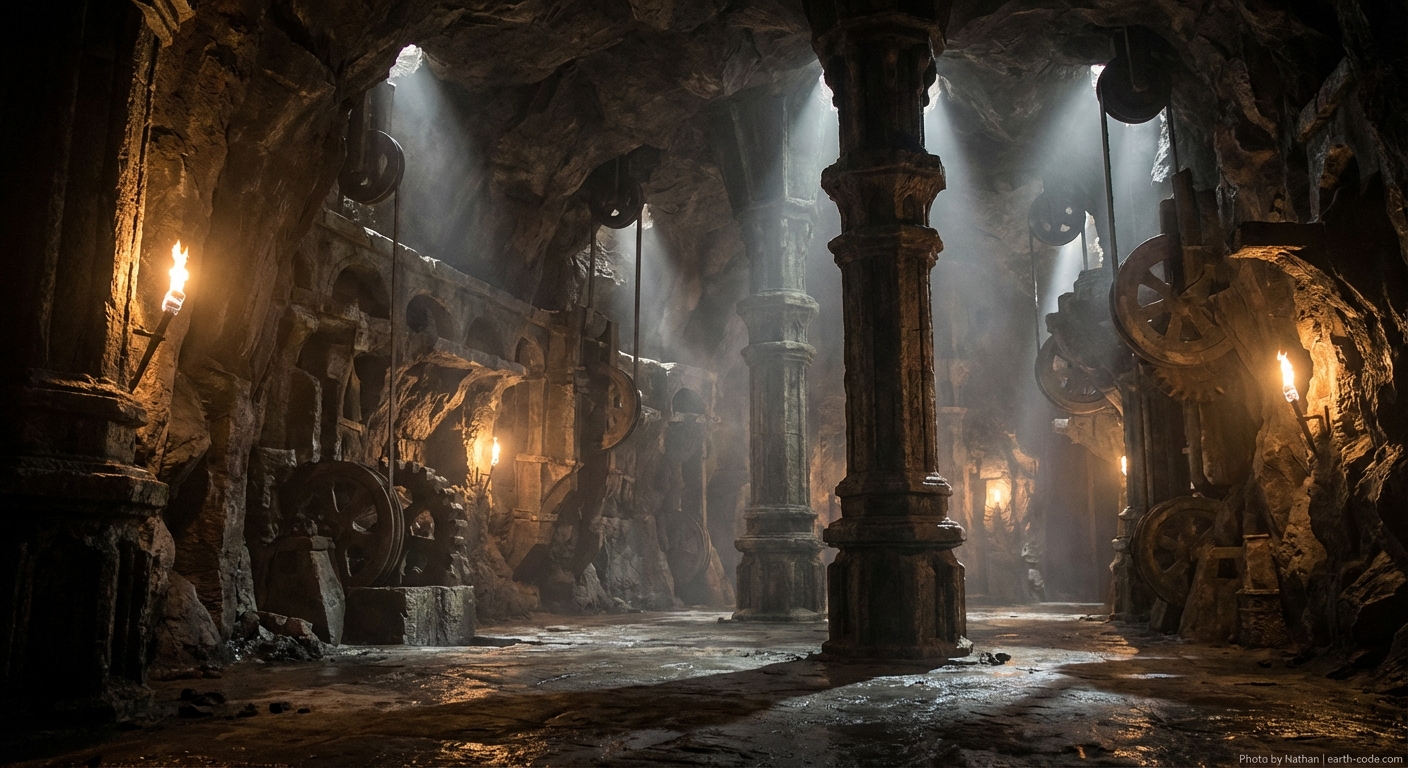
The Longyou Caves: China's Impossible Underground Metropolis
The Discovery That Rewrote Ancient Engineering
In 1992, a local farmer in Longyou County, Zhejiang Province, China, made a decision that would baffle archaeologists and engineers for decades to come. Wu Anai, driven by curiosity about the seemingly bottomless ponds that had existed in his village for generations, began pumping water from one of these mysterious pools. What emerged from beneath the murky waters would challenge everything we thought we knew about ancient Chinese engineering capabilities.
After 17 days of continuous pumping, Wu revealed the entrance to a colossal artificial cave system—one so sophisticated and precisely engineered that it seems to defy the technological limitations of any known ancient civilization. The Longyou Caves, as they came to be known, represent perhaps the most enigmatic archaeological discovery in modern China, a testament to an unknown chapter in human engineering achievement that has left researchers grappling with more questions than answers.
A Monument Hidden in Plain Sight
The Longyou Caves complex sits in the hills near Longyou County, approximately 120 kilometers southwest of Hangzhou. Dr. Yang Hongxun, a leading archaeologist from the Chinese Academy of Social Sciences, has spent over two decades studying these mysterious chambers. According to his research, the caves were likely carved between 2,000 and 2,500 years ago, during China's Spring and Autumn period (770-476 BCE) or the early Warring States period (475-221 BCE).
Twenty-four caves have been discovered so far, though ground-penetrating radar suggests the complex may contain dozens more. Each cave demonstrates a level of architectural sophistication that rivals modern construction techniques. The largest excavated chamber, designated Cave 1, spans an area of 2,000 square meters with a volume of approximately 13,000 cubic meters. The ceiling soars to heights of 30 meters, supported by massive stone pillars that were carved directly from the bedrock.
Professor Feng Zhanhai from the Beijing Institute of Archaeology estimates that the total volume of rock removed from all known caves exceeds 1 million cubic meters—equivalent to moving the Great Pyramid of Giza stone by stone. Yet perhaps most remarkably, this monumental feat of engineering was accomplished without leaving a single trace in China's otherwise meticulous historical records.
The Engineering Marvel That Shouldn't Exist
The precision of the Longyou Caves defies conventional understanding of ancient construction capabilities. Dr. Liu Jiulong, a structural engineer from Tongji University who has analyzed the site extensively, points out that the caves demonstrate advanced knowledge of load distribution, ventilation, and water management that wouldn't be seen again in Chinese architecture for centuries.
The cave walls bear millions of chisel marks, each approximately 60 centimeters long and arranged in parallel bands that create a distinctive scaled pattern. According to research conducted by Professor Zhang Zhonghua from the China University of Geosciences, these marks show remarkable consistency in angle and depth, suggesting the use of standardized tools and systematic excavation techniques.
Some researchers argue that the caves' design incorporates sophisticated engineering principles. Dr. Chen Weishan, a specialist in ancient Chinese architecture, has noted that the pillars supporting each cave's ceiling are positioned according to precise geometric ratios that distribute weight optimally across the structure. The caves also feature an intricate drainage system that has kept them dry for over two millennia, despite being carved below the local water table.
According to one theory proposed by archaeologist Li Ming, the caves demonstrate knowledge of acoustic engineering. Sound tests conducted in 2003 revealed that certain chambers possess unique acoustic properties, with some areas amplifying whispers while others seem to absorb sound entirely.
The Mystery of the Missing Million Cubic Meters
Perhaps the most puzzling aspect of the Longyou Caves is what didn't happen: where did all the excavated rock go? Conservative estimates suggest that creating these caves would have required removing over 1 million cubic meters of sandstone and siltstone—enough material to build a small mountain. Yet archaeological surveys of the surrounding area have found no evidence of this massive quantity of displaced stone.
Professor Wang Jinping from the Institute of Archaeology at the Chinese Academy of Social Sciences has proposed several theories to explain this mystery. Some researchers argue that the stone was carefully transported away from the site, possibly for use in construction projects that have since been destroyed or remain undiscovered. Others suggest that the rock was ground to powder for use in mortar or other applications.
Dr. Sarah Chen, a geoarchaeologist from Stanford University who has studied the site, offers a more intriguing possibility: "The precision with which these caves were carved suggests that every piece of removed stone had a predetermined purpose. The builders weren't just excavating randomly—they were following a master plan that accounted for every cubic meter of material."
Theories About the Caves' Purpose
The absence of historical records has led researchers to develop numerous theories about the caves' intended function. Dr. Huang Kexin from the Shanghai Institute of Ancient Architecture argues that the complex served as an underground military installation, pointing to the caves' strategic location and sophisticated ventilation systems as evidence of their defensive capabilities.
According to one theory championed by Professor Liu Xiaoming of Beijing University, the caves functioned as a massive underground storage facility for grain and other supplies. The controlled environment and protection from both weather and warfare would have made them ideal for long-term preservation of resources during China's tumultuous Warring States period.
Some researchers propose more exotic purposes. Dr. Ma Zhenhua, a specialist in ancient Chinese religious practices, suggests the caves may have served as underground temples or meditation chambers. He points to the acoustic properties and the careful orientation of certain chambers as evidence of spiritual or ceremonial use.
Anthropologist Dr. Rebecca Morrison from Oxford University has proposed that the caves represented a massive public works project designed to demonstrate imperial power. "The sheer scale of the undertaking would have required coordinating thousands of workers over many years," she notes. "This wasn't just construction—it was a statement of technological and organizational supremacy."
The Technology Question
The tools and techniques used to create the Longyou Caves remain a subject of intense debate. Professor Xu Pingfang, a leading expert on ancient Chinese technology, has analyzed the chisel marks extensively and concluded that they were made using bronze tools—impressive given the hardness of the local rock and the precision of the cuts.
However, Dr. Wang Lei from the Chinese Academy of Engineering disagrees, arguing that bronze tools alone could not have achieved such consistent results across such a vast area. According to his analysis, the builders must have possessed advanced metallurgical knowledge and possibly even primitive machine tools to maintain such uniformity in their work.
Some researchers have proposed that the caves demonstrate knowledge of controlled demolition techniques. Professor Zhang Weihua from Beijing Institute of Technology points out that certain structural features suggest the builders understood how to weaken rock systematically, allowing large sections to be removed intact rather than chipped away piece by piece.
Counter-Arguments and Unexplained Aspects
Despite decades of research, significant aspects of the Longyou Caves remain unexplained, leading some scholars to question the conventional dating and purpose theories. Dr. James Peterson, a geological engineer from MIT who visited the site in 2018, argues that the precision of the excavation and the advanced engineering principles suggest a much later date of construction.
"The level of mathematical understanding required to design these chambers rivals what we see in Roman architecture," Peterson notes. "If these caves truly date to the Spring and Autumn period, we need to completely reassess our understanding of ancient Chinese technological capabilities."
According to one controversial theory proposed by independent researcher Dr. Li Hongshan, the caves may represent evidence of a previously unknown advanced civilization that has been lost to history. While this theory has been largely dismissed by mainstream archaeology, Li points to several unexplained features, including tool marks that don't match any known ancient implements and mathematical relationships that seem to incorporate concepts not formally described until much later periods.
The complete absence of artifacts within the caves also raises questions. Dr. Chen Xiaoli from the National Museum of China points out that even if the caves were thoroughly cleaned before abandonment, some trace of their original contents or purpose should remain. "It's as if the builders deliberately erased all evidence of what these caves were meant for," she observes.
The mysterious uniformity of the chisel marks has also puzzled researchers. Professor David Richards from Cambridge University, who specializes in ancient construction techniques, notes that achieving such consistency across millions of individual cuts would require either impossibly skilled craftsmen or standardized tools and techniques far beyond what we know existed in ancient China.
Modern Investigations and Ongoing Mysteries
Recent technological advances have allowed researchers to probe deeper into the caves' mysteries. Ground-penetrating radar surveys conducted in 2019 by Dr. Zhang Ming from the Chinese Academy of Sciences revealed what appear to be additional chambers sealed behind walls of seemingly natural stone. These findings suggest the cave complex may be even larger than currently known.
Carbon dating of organic materials found in sediment layers has confirmed the caves' ancient origin, but precise dating remains elusive. Professor Liu Bin from the Institute of Vertebrate Paleontology and Paleoanthropology reports dates ranging from 2,500 to 1,800 years ago, a spread that encompasses several distinct historical periods.
Acoustic analysis using modern equipment has revealed even more intriguing properties. Dr. Elena Vasquez, an acoustics engineer from the University of Barcelona who studied the caves in 2020, discovered that several chambers exhibit acoustic phenomena that appear to be deliberately engineered. "The resonance patterns suggest these spaces were designed with specific sound properties in mind," she reports.
Water management within the caves continues to baffle hydrologists. Despite being carved below the regional water table, the caves remain remarkably dry. Professor Wang Jianhua from the China University of Geosciences has mapped what appears to be an sophisticated drainage system, but admits that the engineering principles behind it remain unclear.
Questions That Spark the Imagination
The Longyou Caves stand as a testament to human capability and ambition, but they also represent one of archaeology's most enduring puzzles. How did ancient Chinese engineers achieve such precision with the tools available to them? What motivated such a massive undertaking, and why was all trace of it erased from historical records?
Perhaps most intriguingly, if a project of this magnitude could be completed and then forgotten, what other achievements of ancient civilizations remain hidden beneath our feet? The caves force us to reconsider our assumptions about ancient technological capabilities and the completeness of historical records.
As researchers continue to probe the mysteries of the Longyou Caves, each new discovery seems to deepen rather than resolve the enigma. The caves remind us that the ancient world may have been far more sophisticated and mysterious than we ever imagined, and that the most profound discoveries sometimes lie hidden in plain sight, waiting for a curious farmer to drain a pond.
The Longyou Caves challenge us to question what we think we know about the past and to remain open to possibilities that conventional wisdom might dismiss. In an age when we believe we have mapped and catalogued most of the world's wonders, these ancient chambers whisper of secrets yet to be uncovered and remind us that mystery and discovery remain very much alive.
[!] Various theories exist. Information may contain errors.