Longyou Caves - Mystery of China's Giant Man-Made Caverns
Giant caverns carved over 2000 years ago. Where did 1 million cubic meters of rock disappear to?
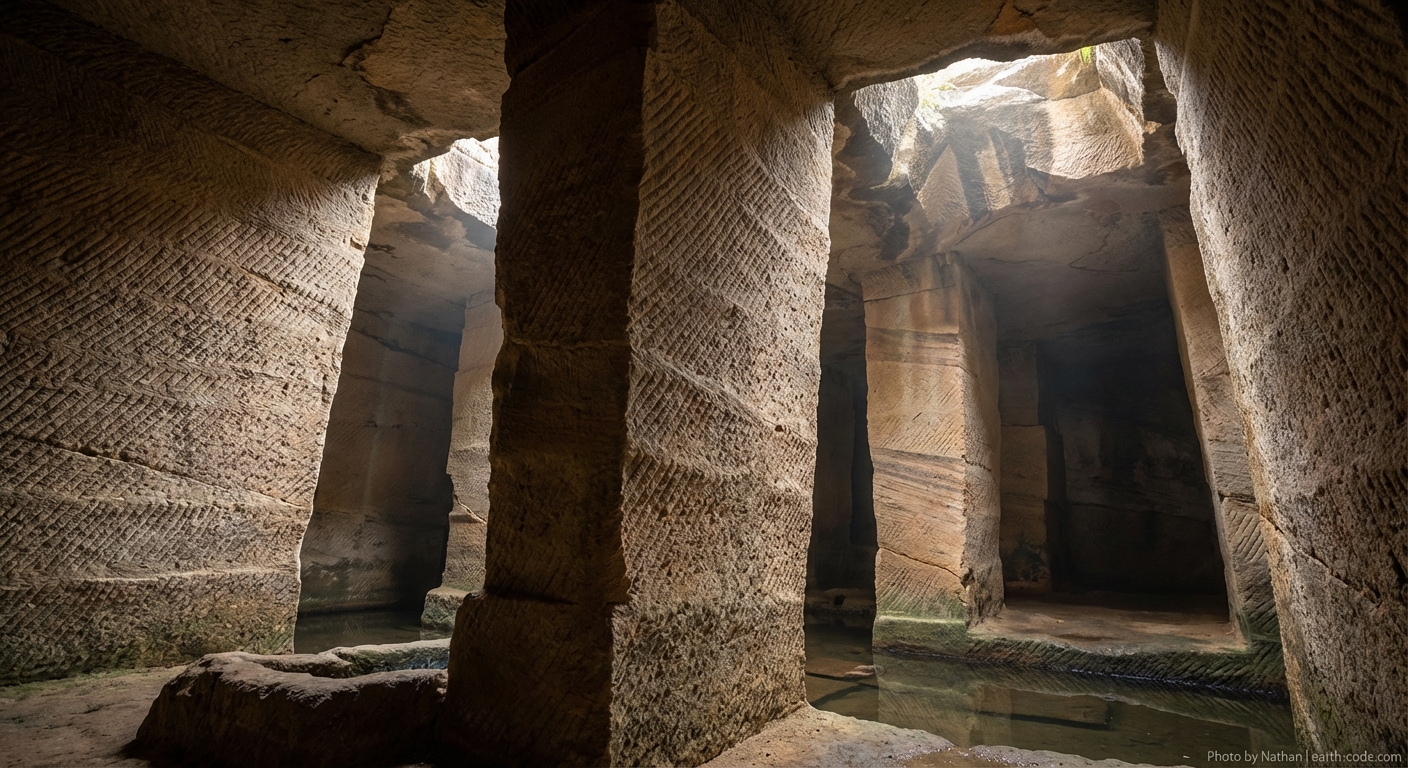
Ancient China's greatest mystery: where did 1 million cubic meters of stone vanish?
The Longyou Caves: China's Enigmatic Underground Marvel
An Underground City Hidden for Millennia
In 1992, a local villager in Longyou County, Zhejiang Province, made a discovery that would puzzle archaeologists and engineers for decades. What began as routine pond pumping revealed the entrance to one of 24 massive artificial caverns carved into solid sandstone—a subterranean complex that had remained hidden for over 2,000 years.
The Longyou Caves represent one of China's most perplexing archaeological mysteries. These aren't natural formations or simple storage chambers, but sophisticated man-made caverns spanning depths of up to 30 meters and covering areas as large as 2,000 square meters each. The scale is staggering: archaeologists estimate that ancient workers removed approximately 1 million cubic meters of rock to create this underground labyrinth.
Engineering Marvel of the Ancient World
What makes the Longyou Caves extraordinary isn't just their size, but their remarkable preservation and sophisticated design. Each cavern features precisely carved pillars supporting massive stone roofs, with walls bearing distinctive chisel marks arranged in parallel lines. The chambers maintain consistent angles and proportions, suggesting the work of master craftsmen following detailed architectural plans.
The largest excavated cavern, known as Cave 1, spans 12.4 meters in height and covers 1,200 square meters—roughly equivalent to a modern airplane hangar. Yet despite their enormous scale, the caves show no evidence of structural failure or collapse, testament to the builders' understanding of load distribution and geological engineering.
Temperature inside remains constant at 17-18°C year-round, and the caverns feature sophisticated drainage systems that have kept them remarkably dry despite two millennia of seasonal flooding in the region above.
The Million-Cubic-Meter Mystery
Perhaps the most baffling aspect of the Longyou Caves is the complete absence of the excavated material. Removing one million cubic meters of sandstone would have created mountain-sized piles of debris, yet archaeologists have found virtually no trace of the removed rock anywhere in the surrounding landscape.
This missing stone has sparked numerous theories. Some researchers suggest the material was transported elsewhere for construction projects, though no known ancient structures in the region account for such massive quantities of sandstone. Others propose that the rock was pulverized and used as agricultural amendment, though this seems impractical given ancient technology.
Dating evidence places construction during the Qin Dynasty (221-206 BCE) or earlier Han periods, based on pottery fragments and tool marks consistent with iron implements of that era. However, no historical records mention such a massive undertaking, adding another layer to the mystery.
Purpose and Theories
The caves' original purpose remains hotly debated. Theories range from imperial tombs and military storage facilities to underground cities designed to shelter populations during warfare. The uniform construction style and advanced engineering suggest state-sponsored construction rather than gradual excavation by local communities.
Some scholars propose they served as strategic grain storage, given their excellent preservation conditions and proximity to fertile agricultural regions. Others suggest religious or ceremonial purposes, noting the caves' cathedral-like proportions and acoustic properties.
The Longyou Caves continue to yield new discoveries as excavation proceeds, with researchers estimating that fewer than 10 of the suspected 24 caverns have been fully explored.
[!] Various theories exist. Information may contain errors.