Hawaii Hotspot - Letters from the Mantle
Hawaiian volcanic chain records Pacific Plate movement - messages from the mantle spanning 70 million years
Hawaii Hotspot - Letters from the Mantle
The Pacific's Ancient Postal Service
Deep beneath the Pacific Ocean lies one of Earth's most remarkable geological storytellers. The Hawaiian hotspot has been sending messages from the mantle for over 70 million years, creating a volcanic chain that reads like a detailed diary of our planet's crustal movements. These "letters from the mantle" tell an extraordinary tale of how the Pacific Plate has journeyed across the ocean floor, leaving behind a trail of volcanic islands and seamounts that stretches an astounding 6,000 kilometers across the Pacific.
Decoding the Volcanic Chronicle
The Hawaiian-Emperor seamount chain represents one of geology's most pristine examples of hotspot volcanism. Unlike the random scatter of volcanic activity found at plate boundaries, this chain follows a remarkably linear path that reveals the Pacific Plate's ancient migration patterns with stunning precision.
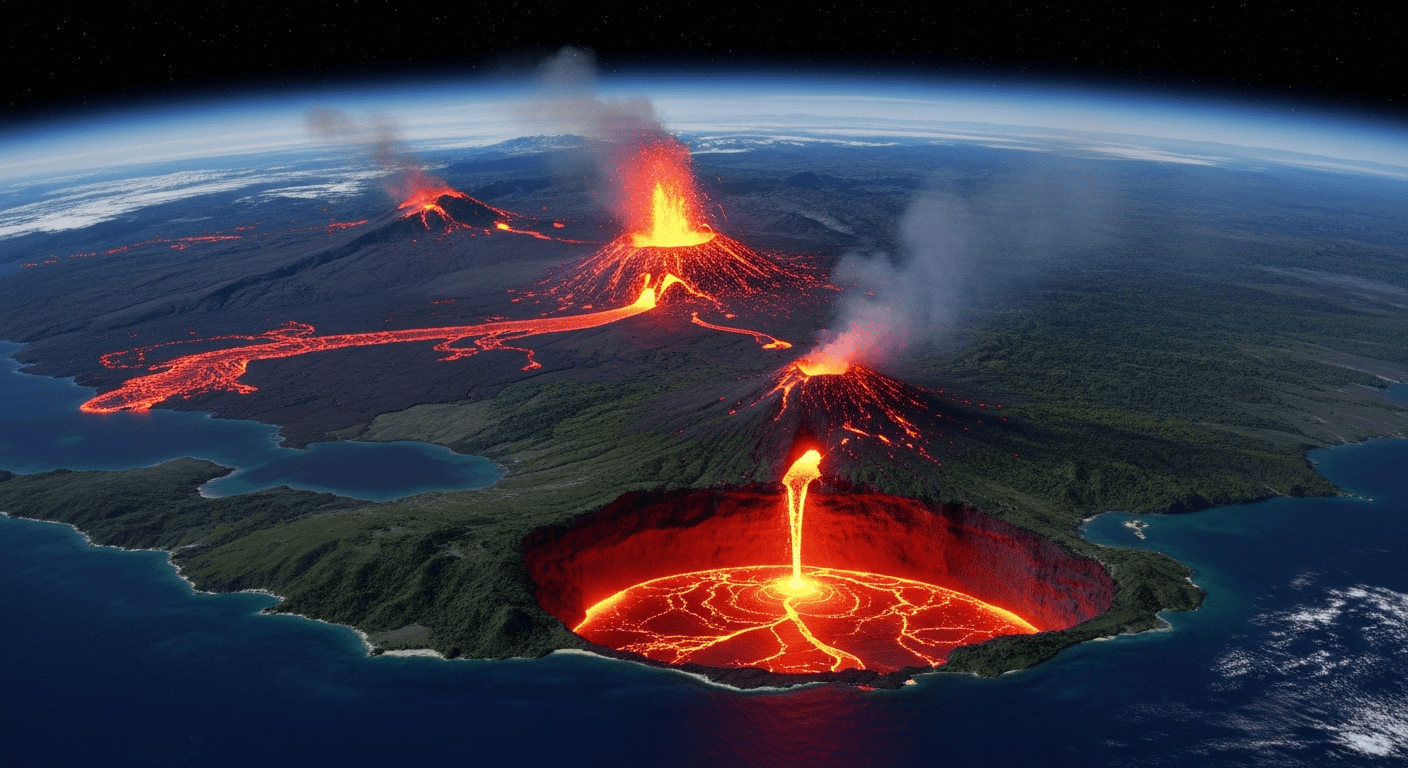
Kilauea, currently one of Earth's most active volcanoes, sits directly above this mantle plume today, continuing to write new chapters in this geological saga. Scientists estimate that the hotspot generates temperatures exceeding 1,500°C, creating a persistent upwelling of molten rock that has remained virtually stationary while the Pacific Plate drifted overhead like a massive conveyor belt.
The volcanic trail begins with the youngest islands in the southeast—Hawaii's Big Island—and extends northwest through progressively older formations. Kauai, formed approximately 5.1 million years ago, gives way to the Midway Islands at 28 million years, creating a timeline that geologists can read with remarkable accuracy.
The Great Pacific Pivot
Perhaps the most intriguing chapter in this mantle manuscript occurred 47 million years ago, when the volcanic chain records a dramatic shift in direction. The seamount trail, which had been trending north-northwest as the Emperor Seamounts, suddenly pivots to its current northwest trajectory, forming what we now call the Hawaiian Ridge.
This angular bend, located near the Detroit Seamount, represents one of the most significant plate motion changes in Earth's recent geological history. Various theories attempt to explain this pivot: some researchers propose changes in Pacific Plate motion due to collisions with other plates, while others suggest alterations in the mantle plume's behavior or even shifts in the hotspot's position.
Recent studies using high-resolution bathymetric mapping have revealed that this transition wasn't instantaneous but occurred over several million years, suggesting complex interactions between the moving plate and the underlying mantle dynamics.
Reading Earth's Ancient GPS
The Hawaiian chain functions as a natural GPS system, allowing scientists to track the Pacific Plate's speed and direction with unprecedented accuracy. Current measurements indicate the plate moves northwest at approximately 3.2-3.6 centimeters per year—roughly the speed of growing fingernails.
This volcanic record has revolutionized our understanding of plate tectonics, providing concrete evidence that mantle plumes can remain stationary while surface plates migrate overhead. The hotspot theory, initially proposed by J. Tuzo Wilson in 1963, found its strongest validation in the Hawaiian chain's age progression and linear arrangement.
Conclusion
The Hawaiian hotspot continues transmitting its mantle messages today, with Loihi Seamount already growing on the ocean floor southeast of the Big Island. These geological letters from the deep Earth remind us that our planet maintains an active correspondence between its surface and interior, written in the eternal language of volcanic rock and spanning tens of millions of years.
[!] Various theories exist. Information may contain errors.