Deccan Traps - Lava Records of Dinosaur Extinction
Massive lava plateau covering India's Deccan region. Lava records the role of eruptions 66 million years ago in dinosaur extinction
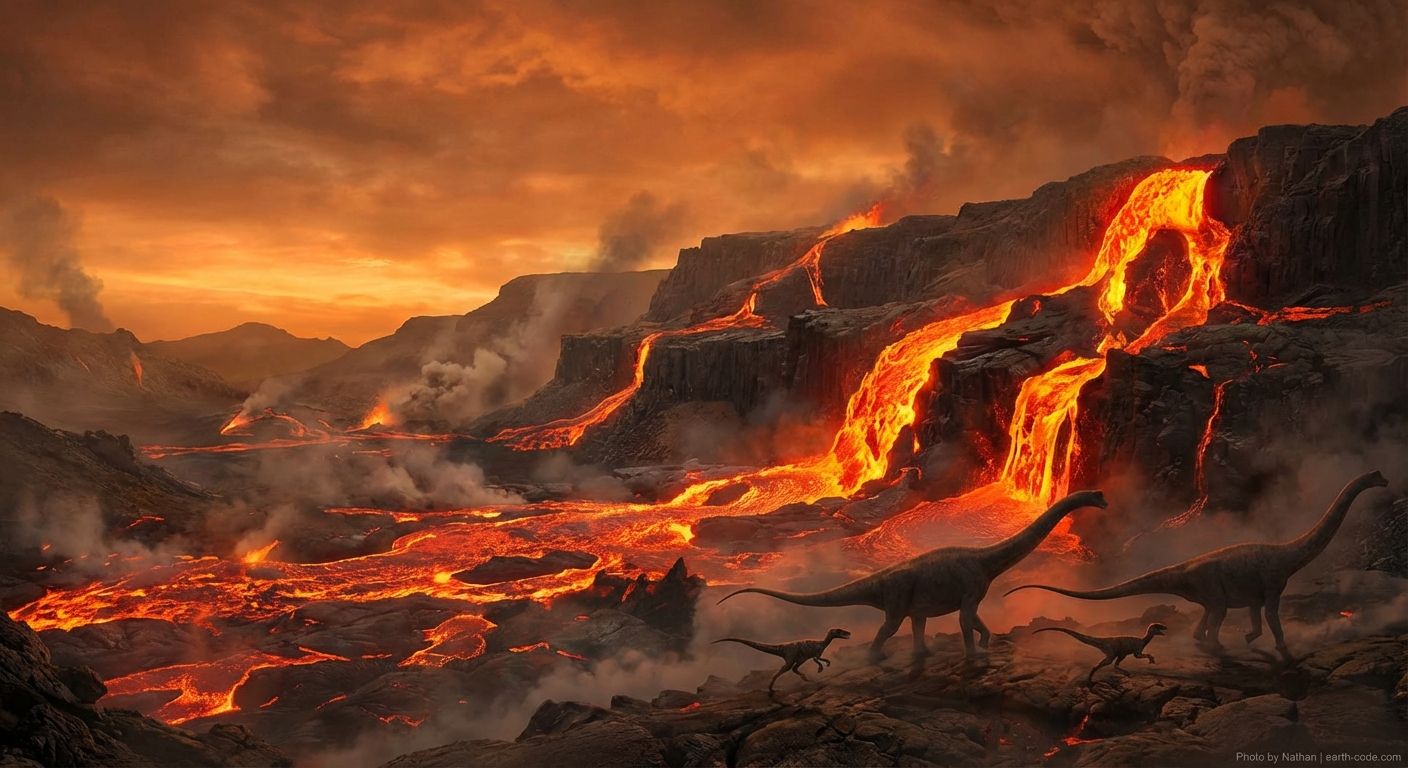
The Deccan Traps: India's Ancient Volcanic Catastrophe and the Dinosaur Apocalypse
Deep beneath the bustling cities of Mumbai and Pune lies one of Earth's most dramatic geological monuments—a testament to an ancient volcanic catastrophe that may have sealed the fate of the dinosaurs. The Deccan Traps, covering an astonishing 500,000 square kilometers of western and central India, represent one of the largest volcanic provinces on our planet and offer crucial evidence about the end-Cretaceous mass extinction event 66 million years ago.
A Landscape Forged by Fire
The term "traps" comes from the Swedish word "trappa," meaning steps, perfectly describing the distinctive stepped landscape created by these ancient lava flows. In some regions, particularly around the Western Ghats, these basaltic layers reach depths of up to 2 kilometers, creating a geological record that spans approximately 30,000 years of continuous volcanic activity.
This wasn't a single catastrophic eruption, but rather a prolonged volcanic nightmare that transformed the landscape of what would become the Indian subcontinent. The sheer volume of lava produced—estimated at over 1 million cubic kilometers—makes the Deccan Traps one of the most voluminous continental flood basalts in Earth's history.
The Killing Mechanism
While the famous Chicxulub asteroid impact in Mexico has long been considered the primary culprit in dinosaur extinction, the Deccan Traps present compelling evidence for a more complex extinction scenario. These massive eruptions released enormous quantities of sulfur dioxide and carbon dioxide into the atmosphere, creating a toxic cocktail that would have had devastating global effects.
The sulfur compounds would have formed acid rain and created a "volcanic winter" by blocking sunlight, while the CO2 emissions contributed to severe climate warming once the sulfur particles settled. Recent research suggests that the most intense phase of Deccan volcanism occurred within 400,000 years of the asteroid impact, creating a one-two punch that proved lethal for non-avian dinosaurs.
Reading the Lava Record
Scientists have discovered fascinating details encoded within the Deccan lava flows. Mercury concentrations in sedimentary rocks from around the world show spikes that correlate with major Deccan eruption phases, providing a global chemical fingerprint of these ancient volcanic events. Additionally, paleomagnetic studies of the lava flows reveal that the eruptions occurred during rapid changes in Earth's magnetic field, adding another layer of environmental stress.
The timing is particularly intriguing—radiometric dating places the most voluminous Deccan eruptions at precisely 66.3 million years ago, overlapping almost exactly with the Cretaceous-Paleogene boundary and the asteroid impact event.
A Collaborative Catastrophe
Modern scientific consensus increasingly favors a synergistic extinction model, where both the Deccan volcanism and the Chicxulub impact worked together to create conditions too extreme for dinosaur survival. The volcanism may have already stressed global ecosystems when the asteroid delivered the final blow, or the impact may have triggered increased volcanic activity.
Today, the weathered remnants of the Deccan Traps support over 400 million people and some of India's most productive agricultural regions, transformed from an ancient agent of destruction into fertile foundation of modern civilization.
[!] Various theories exist. Information may contain errors.