Kensington Runestone - Did Vikings Reach American Interior
Runic stone found in Minnesota. Record of 1362 Norse expedition or forgery?
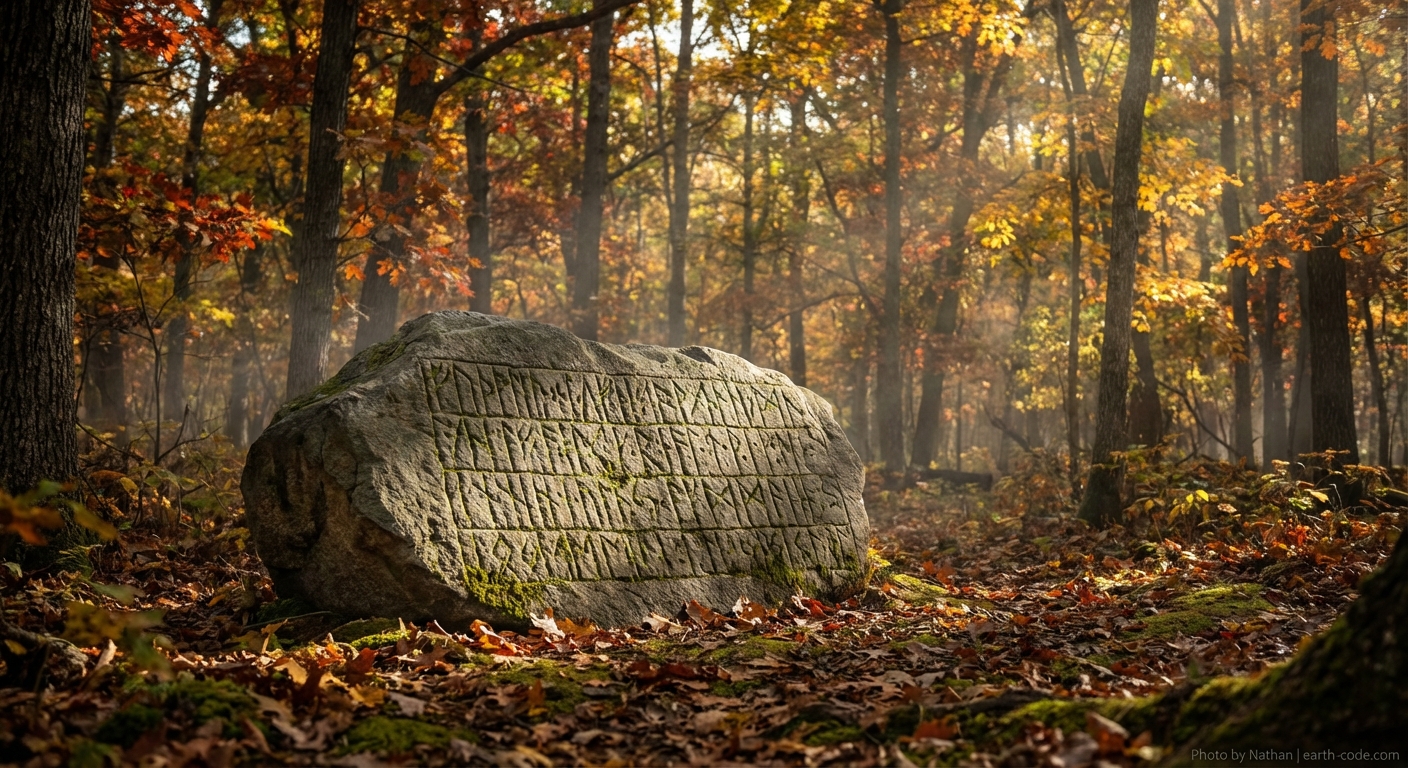
Vikings reached America's heartland before Columbus? A mysterious stone tells its tale
The Kensington Runestone: A Medieval Norse Mystery in the American Heartland
The Discovery That Shook Archaeological Orthodoxy
In 1898, Swedish-American farmer Olof Ohman made a discovery that would ignite one of archaeology's most enduring controversies. While clearing trees on his farm near Kensington, Minnesota, Ohman unearthed a 202-pound slab of graywacke bearing mysterious runic inscriptions. The carved message, when translated, told an extraordinary tale: a Norse expedition had reached the American interior in 1362, decades before Columbus's voyage.
The runic text describes fourteen Norsemen—eight Goths and six Norwegians—who had traveled from Vinland on an exploration journey. According to the inscription, ten of their companions had been killed, leaving the survivors to carve this desperate message: "Save us from evil. We have ten men by the sea to look after our ships, fourteen days' journey from this island. Year 1362."
The Case for Authenticity
Proponents argue that the runestone represents genuine evidence of pre-Columbian Norse exploration deep into North America. They point to several compelling factors: the weathering patterns on the stone suggest centuries of exposure, and certain runic characters match 14th-century Scandinavian writing styles that weren't well-documented until decades after the stone's discovery.
Geologist Newton Winchell of the University of Minnesota conducted early studies indicating the inscriptions were ancient, noting that tree roots had grown around and partially covered the stone. Supporters also highlight that the 1362 date aligns with known Norse presence in Greenland and historical records of westward expeditions during this period.
The stone's location in west-central Minnesota correlates with ancient waterways that could have provided access from Hudson Bay, offering a plausible route for Norse explorers traveling inland via the Red River system.
The Forgery Theory
However, mainstream archaeologists and linguists have largely dismissed the runestone as a 19th-century fabrication. Critics argue that the runic characters contain anachronisms—mixing symbols from different time periods in ways inconsistent with authentic medieval Norse writing. The language itself appears to blend modern Swedish and Norwegian dialects rather than reflecting genuine 14th-century usage.
Skeptics note that Olof Ohman had sufficient knowledge of Scandinavian languages and history to create such a hoax. The 1890s saw intense interest in Norse exploration among Scandinavian-American communities, providing both motive and cultural context for fabrication.
Modern Scientific Analysis
Recent investigations have employed advanced techniques including electron microscopy and geological dating methods. While some studies suggest the weathering patterns are consistent with centuries of exposure, others indicate the carving techniques match modern tool marks rather than medieval methods.
Linguist Erik Wahlgren and other scholars have identified numerous grammatical and stylistic inconsistencies that they argue definitively prove the inscription's modern origin. Yet amateur historians and some researchers continue advocating for authenticity, citing new archaeological evidence of pre-Columbian trans-oceanic contact.
The Enduring Mystery
Whether authentic medieval artifact or elaborate hoax, the Kensington Runestone continues captivating researchers and the public alike. It challenges conventional narratives about European exploration of North America while highlighting the complex relationship between archaeological evidence and historical interpretation.
The stone now resides in the Runestone Museum in Alexandria, Minnesota, drawing thousands of visitors annually to ponder this enigmatic piece of potential Viking heritage in America's heartland.
[!] Various theories exist. Information may contain errors.