Kailasa Temple - Carved from a Single Rock
Indian temple carved top-down from rock mountain. Ancient technique removed 200,000 tons of rock
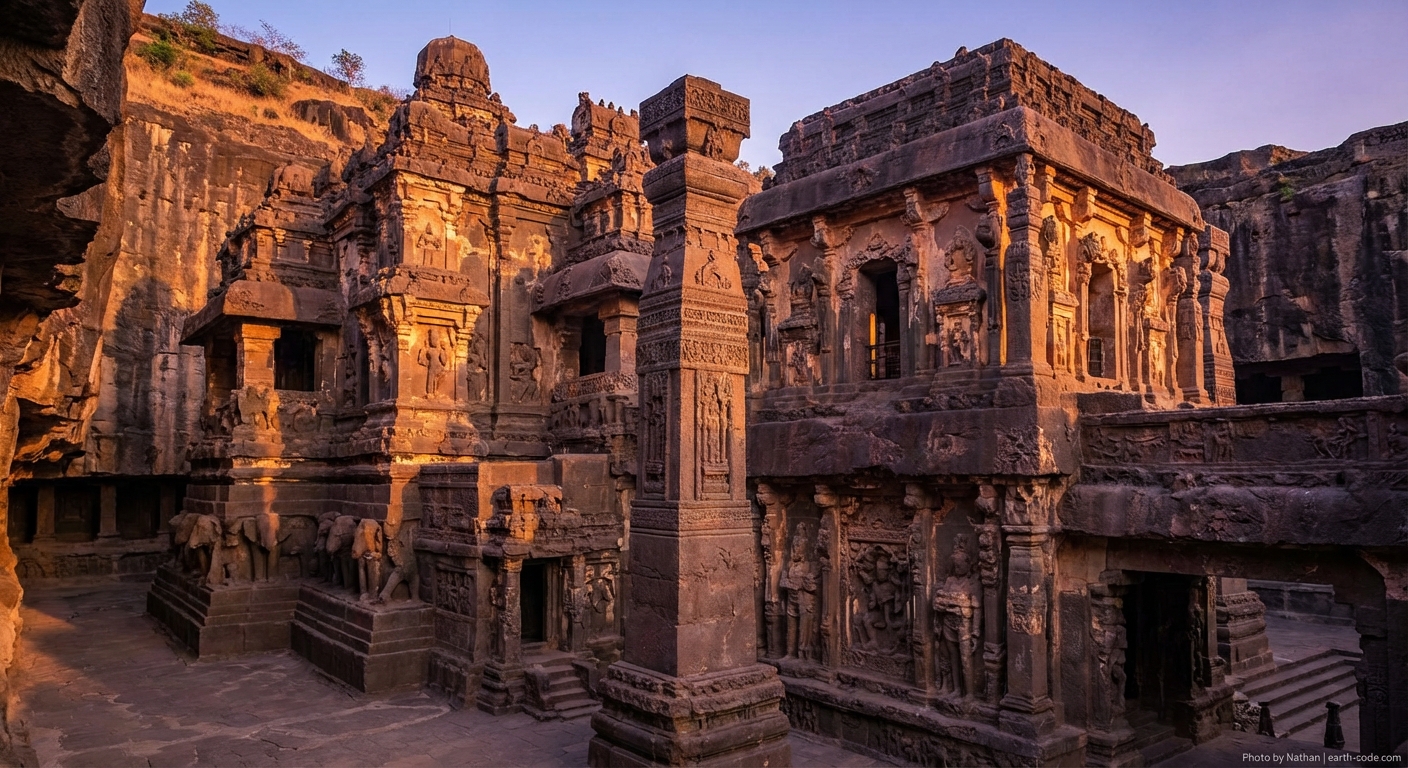
How did ancient Indians carve out 200,000 tons of rock to create this mysterious temple?
The Kailasa Temple: An Ancient Marvel Carved from a Living Mountain
In the heart of Maharashtra, India, stands one of humanity's most bewildering architectural achievements—the Kailasa Temple at Ellora. This 8th-century marvel wasn't built upward like conventional structures, but rather carved downward from a single, massive rock formation. The sheer audacity of this undertaking continues to baffle archaeologists, engineers, and visitors alike.
A Monument Defying Convention
The Kailasa Temple, designated as Cave 16 in the Ellora complex, represents the pinnacle of rock-cut architecture. Commissioned around 756-773 CE by the Rashtrakuta king Krishna I, this monolithic wonder required the removal of an estimated 200,000 tons of volcanic basalt rock. To put this in perspective, that's equivalent to removing the weight of approximately 1,300 blue whales worth of solid stone.
The temple complex spans 164 feet in length, 109 feet in width, and rises 98 feet high, making it larger than the Parthenon in Athens. What sets it apart isn't just its size, but its top-down carving technique—a method that left no room for error. Unlike traditional construction where mistakes can be corrected by adding materials, any miscalculation in rock-cutting would be permanently etched in stone.
Engineering Mysteries and Ancient Techniques
The precision of the Kailasa Temple raises profound questions about ancient Indian engineering capabilities. Archaeological evidence suggests that craftsmen worked with simple hand tools—chisels, hammers, and picks—yet achieved architectural details rivaling modern precision. The temple features intricate sculptures, multi-story structures carved as single units, and elaborate drainage systems that still function after 1,250 years.
One of the most puzzling aspects involves the waste rock removal. Extracting 200,000 tons of material would have required sophisticated planning and transportation methods. Some researchers theorize that the removed stone was used for construction projects elsewhere, though no definitive evidence supports this claim.
The temple's design incorporates complex engineering solutions, including load-bearing pillars carved from the original rock face and sophisticated weight distribution systems. The main shrine houses a massive Shiva lingam surrounded by life-sized elephant sculptures, all carved from the same basalt formation.
Theories and Ongoing Debates
Several competing theories attempt to explain the temple's construction. Traditional archaeological consensus suggests a workforce of thousands laboring for decades, possibly 100-150 years. However, some alternative researchers propose more controversial timelines, suggesting advanced ancient technologies or even earlier construction dates.
Recent ground-penetrating radar studies have revealed additional chambers and structures beneath the visible temple, indicating the complex may be even larger than previously understood. These discoveries continue to fuel debates about the true scope and timeline of the project.
A Living Testament to Ancient Ingenuity
The Kailasa Temple stands as proof of ancient India's remarkable architectural and engineering capabilities. Whether viewed as a testament to human persistence, advanced ancient technology, or divine inspiration, it remains one of archaeology's most compelling mysteries. The precision, scale, and artistic achievement continue to challenge our understanding of what ancient civilizations could accomplish with their available tools and techniques.
[!] Various theories exist. Information may contain errors.