Homo Naledi - The Primitive Humans Who Buried Their Dead
New human species discovered in South African cave. Shock that they buried their dead despite primitive brains
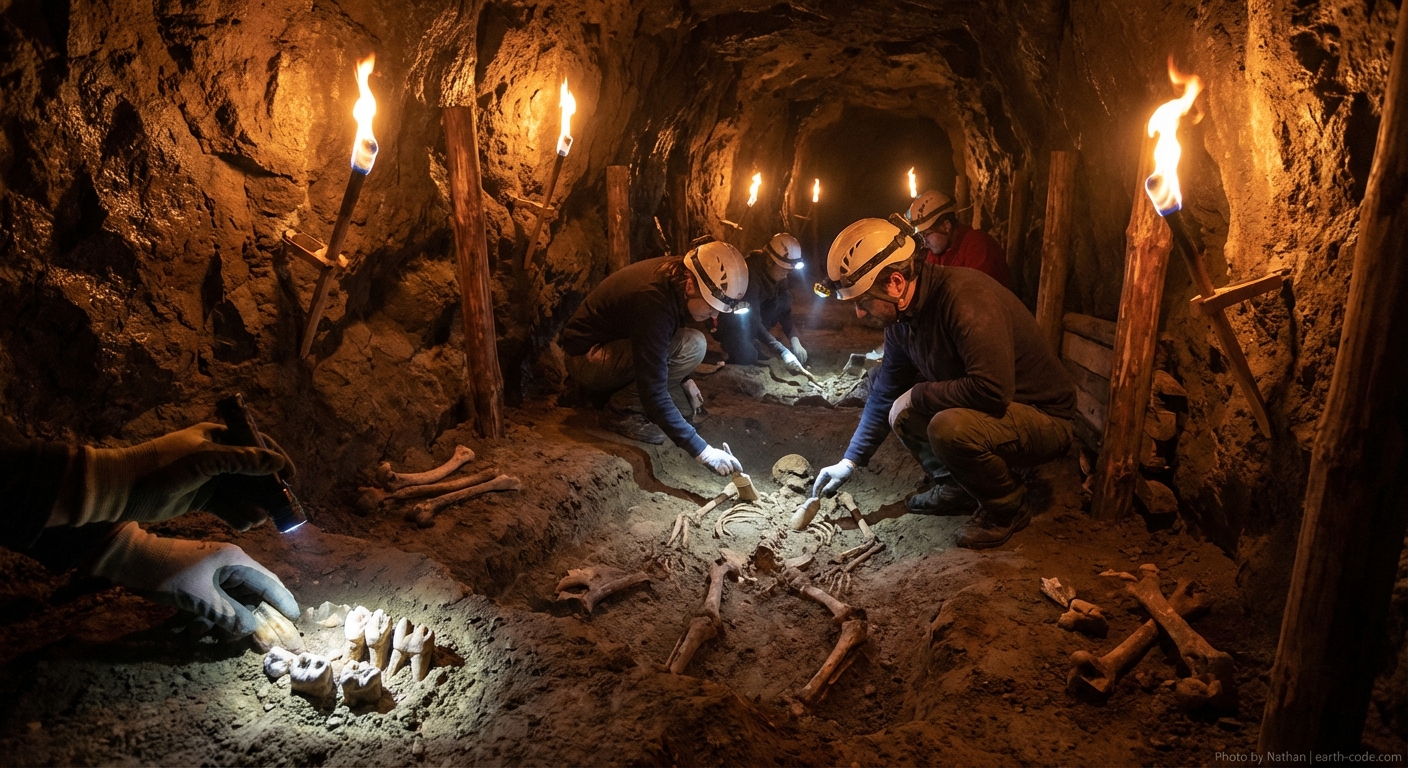
The Cave Dwellers Who Changed Everything We Know About Death
A Revolutionary Discovery in the Heart of Africa
Deep within the limestone chambers of the Rising Star Cave system in South Africa, archaeologist Lee Berger and his team made a discovery in 2013 that would fundamentally challenge our understanding of human consciousness and ritual behavior. Hidden in the remote Dinaledi Chamber—accessible only through a narrow 7.5-inch gap—lay the remains of Homo naledi, a previously unknown human species that would rewrite the story of our evolutionary past.
The Paradox of Small Brains and Complex Behavior
Homo naledi presents an extraordinary paradox that continues to puzzle researchers. These ancient humans possessed brains measuring only 465-610 cubic centimeters—roughly one-third the size of modern human brains and comparable to early australopithecines who lived millions of years earlier. Their physical characteristics include curved fingers adapted for climbing, primitive shoulder structure, and relatively small stature of approximately 4.5 to 5 feet tall.
Yet despite these seemingly primitive features, the evidence suggests these small-brained humans engaged in one of humanity's most sophisticated behaviors: intentional burial of their dead.
Evidence of Deliberate Death Rituals
The Dinaledi Chamber contained an astounding 1,550 fossil specimens representing at least 15 individuals of various ages, from infants to elderly adults. What makes this discovery remarkable isn't just the quantity of remains, but their context. The chamber shows no evidence of carnivore activity, water transport, or accidental death—the bones appear to have been deliberately placed there.
Professor Berger's team argues that the only plausible explanation for this concentration of remains is intentional disposal by living members of the species. The chamber's inaccessibility—requiring navigation through pitch-black passages and dangerous drops—suggests a purposeful journey to deposit the deceased in this specific location.
Dating Mysteries and Evolutionary Implications
Recent dating efforts have placed Homo naledi between 236,000 and 335,000 years ago, making them contemporaries with early Homo sapiens in Africa. This timeline is particularly shocking because it suggests that multiple human species with vastly different cognitive capabilities coexisted on the same continent.
The discovery challenges the long-held assumption that complex symbolic behavior, including burial practices, required large brains. Traditional archaeological thinking linked ritual burial to the emergence of modern cognition around 100,000 years ago with Homo sapiens. If Homo naledi truly buried their dead, it suggests that the capacity for symbolic thought may have evolved much earlier and independently across different human lineages.
Reshaping Our Understanding of Human Evolution
This discovery forces us to reconsider what makes us uniquely human. The ability to contemplate death and respond with ritual behavior has long been considered a hallmark of advanced consciousness. Homo naledi suggests that perhaps the relationship between brain size and complex behavior is more nuanced than previously believed.
The implications extend beyond archaeology into philosophy and anthropology, raising profound questions about the nature of consciousness, the origins of spiritual behavior, and the diversity of cognitive evolution in our human family tree.
[!] Various theories exist. Information may contain errors.