The Gulf War Code (1991) - Hussein and Scud Missiles
Related to the 1991 Gulf War, 'Hussein', 'Scud', and 'missile' were found in the Torah. Dr. Rips' team research noted these patterns existed before the war began
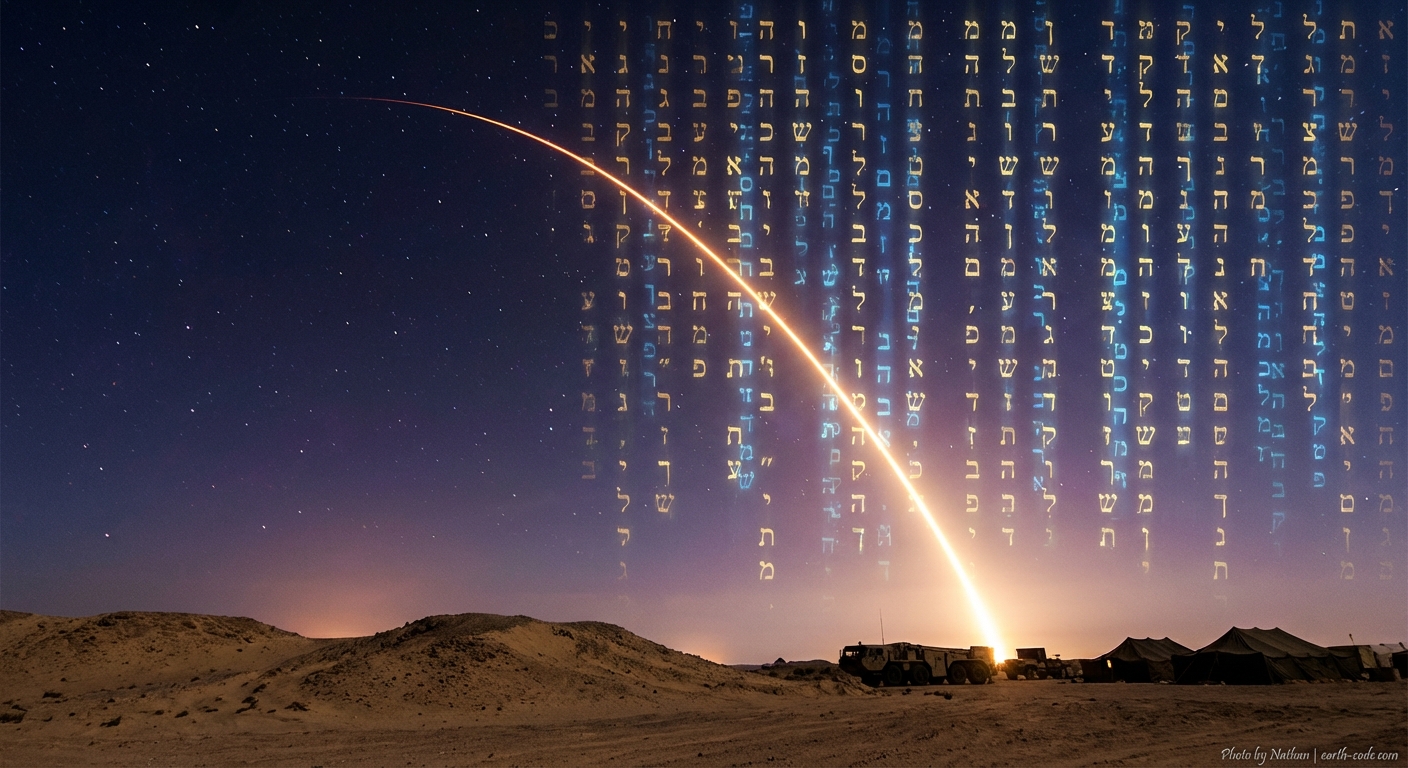
The Gulf War Torah Code: Ancient Text Meets Modern Warfare
In the winter of 1991, as Scud missiles streaked across Middle Eastern skies during the Gulf War, a team of Israeli mathematicians was making what they claimed to be an extraordinary discovery. Dr. Eliyahu Rips and his colleagues at Hebrew University reported finding encoded references to the conflict hidden within the ancient text of the Torah—including the names 'Hussein' (חוסיין), 'Scud' (סקאד), and 'missile' (טיל).
The Discovery During Wartime
The Gulf War lasted from January 17 to February 28, 1991, during which Iraq fired 42 Scud missiles at Israel in an attempt to draw the nation into the broader conflict. As these events unfolded, Dr. Rips' research team was analyzing the Torah using Equidistant Letter Sequences (ELS)—a method that searches for words by counting letters at regular intervals throughout the text.
According to their findings, these war-related terms appeared in close proximity within the biblical text when examined through ELS methodology. The Hebrew year 5751 (corresponding to 1991) was also reportedly found encoded near these terms, creating what researchers described as a coherent cluster of related information.
Mathematical Methodology
The ELS technique works by treating the Torah as one continuous string of 304,805 Hebrew letters without spaces or punctuation. Researchers then search for meaningful words by selecting every nth letter, where n represents the "skip distance." Dr. Rips' team claimed that finding 'Hussein,' 'Scud,' and 'missile' in proximity was statistically significant, given the vast number of possible letter combinations.
The discovery gained particular attention because the research was reportedly conducted during the actual conflict, rather than being identified retroactively. This timing element became crucial to proponents' arguments about the code's predictive nature.
Scientific Reception and Controversy
The Torah Code research sparked intense academic debate. In 1994, a paper by Doron Witztum, Eliyahu Rips, and Yoav Rosenberg was published in the journal Statistical Science, though it focused on different examples rather than the Gulf War findings. Critics, including mathematicians Brendan McKay and Dror Bar-Natan, later published rebuttals questioning the methodology and statistical analysis.
Skeptics argued that given the Torah's length and the flexibility inherent in Hebrew spelling variations, almost any combination of words could be found using ELS methods. They suggested that the apparent clustering of Gulf War-related terms might result from selection bias or post-hoc analysis rather than genuine prophetic encoding.
Historical Impact
The Gulf War Torah Code became one of the earliest modern Bible Code discoveries to capture public imagination, predating the popular 1997 book The Bible Code by Michael Drosnin. The research contributed to a broader cultural fascination with hidden messages in ancient texts, inspiring numerous books, documentaries, and continuing research efforts.
Conclusion
Whether viewed as mathematical coincidence or divine encryption, the claimed discovery of Gulf War references in the Torah represents a fascinating intersection of ancient text, modern warfare, and statistical analysis. The debate surrounding these findings continues to engage mathematicians, theologians, and skeptics alike.
[!] Various theories exist. Information may contain errors.