Gobekli Tepe's Vulture Stone - Record of a Comet Impact?
A 2017 study proposed that animal reliefs on Pillar 43 (the Vulture Stone) at Gobekli Tepe encode a comet impact event around 10,950 BC during the Younger Dryas, using constellation symbolism
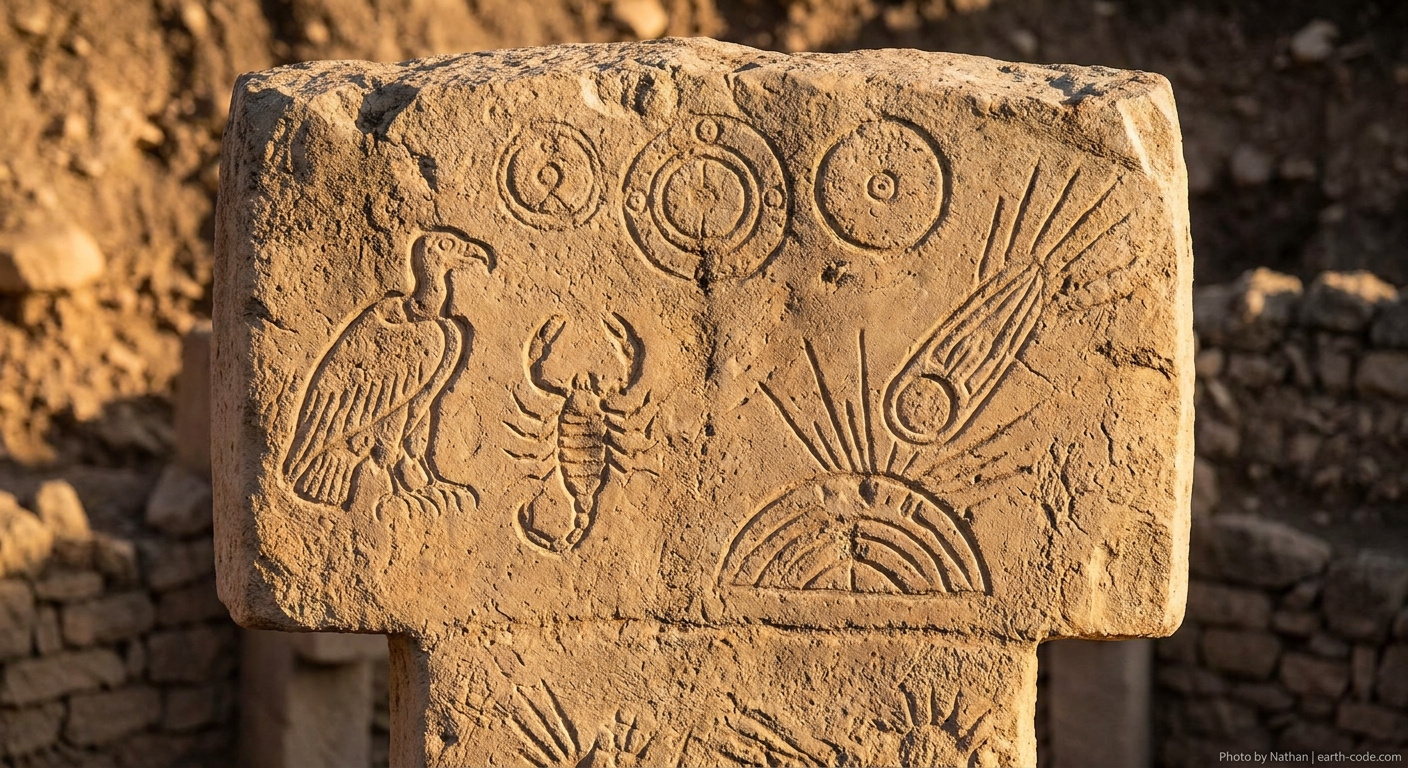
The Vulture Stone of Gobekli Tepe: Ancient Record of Cosmic Catastrophe?
Deep in the rolling hills of southeastern Turkey, carved into limestone pillars that predate Stonehenge by over 6,000 years, lies what may be humanity's oldest written record of a cosmic disaster. Pillar 43 at Gobekli Tepe—better known as the "Vulture Stone"—displays a haunting array of animal figures that some researchers believe encode the memory of a comet impact that nearly extinguished human civilization 13,000 years ago.
This weathered monument challenges everything we thought we knew about prehistoric human capabilities, suggesting that our ancestors possessed sophisticated astronomical knowledge and the ability to preserve complex information in stone long before the invention of writing. But does this ancient artwork truly depict the cataclysmic event that triggered the Younger Dryas period, or are we projecting modern concerns onto enigmatic symbols whose true meaning died with their creators?
The Discovery That Rewrote History
When German archaeologist Klaus Schmidt first glimpsed the artificial mounds of Gobekli Tepe in 1994, he realized he was looking at something extraordinary. What emerged from decades of careful excavation was a complex of massive stone circles, each dominated by T-shaped limestone pillars weighing up to 20 tons and standing over 18 feet tall. Radiocarbon dating revealed the site's most stunning secret: these monuments were constructed around 9600 BCE, making them approximately 11,600 years old—older than agriculture, older than pottery, older than metal tools.
Among the dozens of intricately carved pillars scattered across the site, Pillar 43 stands out for its particularly rich and mysterious iconography. Located in Enclosure D, this limestone monolith displays a complex arrangement of animals carved in relief: vultures with outstretched wings, a scorpion, a snake, various birds, and most intriguingly, what appears to be a headless human figure. The pillar's base features three handbag-like symbols that have sparked intense debate among researchers.
Schmidt, who directed excavations until his death in 2014, initially interpreted the carvings as totemic animals or religious symbols related to death and rebirth. However, a groundbreaking 2017 study would propose a radically different interpretation that sent shockwaves through both archaeological and astronomical communities.
Decoding the Cosmic Message
Dr. Martin Sweatman and Dimitrios Tsikritsis from the University of Edinburgh's School of Engineering published their controversial findings in the journal Mediterranean Archaeology and Archaeometry, arguing that Pillar 43's animal reliefs represent a sophisticated star map encoding the date of a comet impact around 10,950 BCE. Their computer modeling suggested that the carved animals correspond to constellation patterns visible in the night sky during that specific time period.
According to their analysis, the prominent vulture figure with spread wings represents the constellation Sagittarius, while other animals on the pillar—including the scorpion, snake, and various birds—correspond to additional zodiacal and circumpolar constellations. The researchers used astronomical software to reconstruct the ancient night sky, finding what they claimed was a remarkable match between the stone carvings and stellar positions during the proposed impact date.
"The date carved into the stone is 10,950 BCE, plus or minus 250 years," Sweatman declared in interviews following the study's publication. This date aligns closely with the beginning of the Younger Dryas period, a mysterious 1,300-year return to near-glacial conditions that interrupted the natural warming trend following the last Ice Age.
The headless human figure on the pillar, according to this interpretation, represents the constellation of the headless man (possibly corresponding to Ophiuchus) and symbolically depicts the mass casualties that would have resulted from such a cosmic impact. Some researchers argue that this figure specifically commemorates widespread death and destruction, preserved in stone as a warning to future generations.
The Younger Dryas Impact Hypothesis
The Edinburgh team's interpretation gains significance when considered alongside the controversial Younger Dryas Impact Hypothesis, first proposed by nuclear chemist Richard Firestone and his colleagues in 2007. This theory suggests that a fragmented comet or asteroid struck Earth around 12,900 years ago, triggering massive wildfires, flooding, and climate change that led to the extinction of North American megafauna and potentially caused a population bottleneck in early human societies.
Proponents of the impact hypothesis point to evidence including elevated levels of platinum and iridium in sediment layers dating to the Younger Dryas onset, widespread deposits of microscopic diamonds and other impact-related materials, and burn layers indicating massive continental fires. The Hiawatha crater in Greenland, discovered in 2018 and measuring 19 miles across, has been proposed as a potential impact site, though its precise age remains disputed.
Dr. James Kennett of UC Santa Barbara, a leading advocate for the impact hypothesis, argues that such an event would have been clearly visible to human populations across the Northern Hemisphere. "A comet impact of this magnitude would have created spectacular atmospheric phenomena—brilliant meteor showers, auroras, and daytime fireballs—that would have been remembered and passed down through oral traditions," he explains.
If the Gobekli Tepe builders witnessed such an event, encoding it in their monument would represent an extraordinary feat of cultural memory preservation. The site's apparent abandonment around 8000 BCE, when it was deliberately buried under tons of earth, adds another layer of mystery. Some researchers speculate that this burial was intentional, designed to preserve the cosmic warning for future discovery.
Global Echoes: The Handbag Mystery
Adding to the intrigue surrounding Pillar 43 are the three handbag-like symbols carved at its base. These motifs, which researchers call "handbags" for lack of a better term, appear with remarkable consistency across ancient cultures worldwide, from Mesopotamian cylinder seals to Olmec carvings in Mexico, Easter Island petroglyphs, and Aboriginal rock art in Australia.
Dr. Bruce Masse, an environmental archaeologist at Los Alamos National Laboratory, has spent decades documenting these symbols and believes they may represent a shared cultural memory of cosmic events. "The global distribution of these motifs suggests they encode information of universal significance," he argues. "Comet impacts would have been visible across vast distances and could explain why similar symbols appear in isolated cultures."
Some researchers propose that these handbag symbols represent the Orion constellation, specifically Orion's Belt and the surrounding star patterns. Others suggest they symbolize containers of knowledge or seeds—perhaps referencing the preservation of essential information or genetic material following a global catastrophe.
The precision with which these symbols appear across cultures separated by thousands of miles and years raises profound questions about ancient human communication networks and the persistence of cultural memory. Were these symbols part of a deliberate system for encoding and transmitting crucial information about cosmic dangers?
Scientific Scrutiny and Alternative Interpretations
The Edinburgh team's astronomical interpretation has faced significant criticism from both archaeologists and astronomers. Dr. Jens Notroff from the German Archaeological Institute, who has worked extensively at Gobekli Tepe, argues that the researchers are "seeing patterns that aren't necessarily there" and cautions against imposing modern astronomical concepts on Neolithic artwork.
Critics point out that constellation patterns are largely arbitrary human constructs that vary significantly between cultures. The idea that Neolithic peoples would have recognized the same stellar groupings that we do today is questionable. Additionally, the precession of Earth's axis means that star positions have shifted considerably over the past 13,000 years, making precise correlations problematic.
Dr. Ed Krupp, director of the Griffith Observatory in Los Angeles and an expert on ancient astronomy, notes that "humans are pattern-seeking creatures who often find meaningful connections where none exist." He suggests that the apparent correlation between the Gobekli Tepe carvings and ancient star patterns may be coincidental rather than intentional.
Some archaeologists propose alternative explanations for the Vulture Stone's imagery. The vulture, they argue, was likely associated with death and rebirth rituals, as evidenced by Neolithic practices of sky burial where corpses were exposed to scavenging birds. The headless figure might represent shamanic transformation or spiritual death rather than cosmic catastrophe.
Dr. Oliver Dietrich, current field director at Gobekli Tepe, emphasizes the site's probable ritual function, noting that the enclosures show clear evidence of feasting and communal gatherings. "We must be careful not to let sensational interpretations overshadow the remarkable social and religious developments that Gobekli Tepe actually represents," he warns.
The Persistence of Cosmic Memory
Despite ongoing debates about specific interpretations, a growing body of evidence suggests that ancient cultures possessed more sophisticated astronomical knowledge than previously recognized. The Nebra sky disc from Germany (c. 1600 BCE) demonstrates Bronze Age understanding of celestial mechanics, while sites like Newgrange in Ireland (c. 3200 BCE) show precise astronomical alignments that required detailed observations of celestial patterns.
Ethnographic studies of indigenous cultures worldwide reveal that cosmic events, particularly those perceived as threatening or unusual, are consistently preserved in oral traditions and symbolic systems. Australian Aboriginal dreamtime stories contain remarkably accurate descriptions of sea level changes from the last Ice Age, preserved through tens of thousands of years of oral transmission.
Dr. Duane Hamacher, a cultural astronomer at the University of Melbourne, has documented numerous examples of indigenous knowledge systems that encode accurate astronomical and geological information. "Traditional cultures have sophisticated methods for preserving important information across generations," he explains. "A cosmic impact would certainly qualify as information worth preserving."
The possibility that Gobekli Tepe's builders possessed detailed astronomical knowledge gains credibility when considered alongside other aspects of the site's construction. The precise orientation of the stone circles, the complex logistics required to quarry and transport massive limestone blocks, and the sophisticated carving techniques all suggest capabilities that exceed conventional assumptions about Neolithic societies.
Implications for Human History
If the Vulture Stone does indeed encode memories of a cosmic impact, the implications extend far beyond archaeology and astronomy. Such a discovery would demonstrate that human cultural memory can preserve accurate information for unprecedented lengths of time, challenging assumptions about the reliability of prehistoric traditions and oral histories.
The hypothesis also raises questions about the role of cosmic events in shaping human civilization. Did near-extinction experiences drive the rapid development of agriculture, complex societies, and monumental architecture? Some researchers propose that trauma-based cultural evolution could explain the sudden appearance of sophisticated technologies and social systems following the Younger Dryas period.
Dr. Randall Carlson, a geologist who has studied impact evidence across North America, suggests that cosmic catastrophes may have been more frequent and influential in human development than generally recognized. "If our ancestors experienced and remembered these events, their entire worldview would have been shaped by cosmic awareness," he argues.
The potential for future impacts adds contemporary relevance to these ancient warnings. NASA and other space agencies now actively monitor near-Earth objects, recognizing that cosmic impacts remain a genuine threat to human civilization. Could ancient monuments like Gobekli Tepe represent humanity's first attempt at creating a cosmic early warning system?
Unanswered Questions and Future Research
As excavations at Gobekli Tepe continue—with only an estimated 5% of the site revealed—new discoveries may provide crucial evidence for or against the cosmic impact interpretation. Advanced archaeological techniques, including ground-penetrating radar and high-resolution dating methods, could reveal additional astronomical alignments or temporal correlations.
Interdisciplinary collaboration between archaeologists, astronomers, and cultural anthropologists will be essential for properly evaluating these complex hypotheses. Computer modeling of ancient night skies continues to improve, potentially providing more definitive answers about the astronomical significance of ancient carvings.
The search for impact evidence from the proposed Younger Dryas event remains active, with researchers examining sediment cores, ice samples, and geological formations worldwide. If definitive impact markers are discovered and precisely dated, they could provide the crucial link needed to validate or refute the Gobekli Tepe astronomical interpretation.
Meanwhile, the global distribution of similar symbols and motifs demands systematic comparative analysis. Digital databases and machine learning techniques could help identify patterns and connections that human researchers might miss, potentially revealing a worldwide network of ancient astronomical knowledge.
The Enduring Mystery
Standing before Pillar 43 today, visitors encounter the same enigmatic figures that have puzzled researchers for decades. The vulture spreads its wings in eternal vigilance, the headless figure maintains its silent vigil, and the mysterious handbags continue to guard their secrets. Whether these carvings represent humanity's oldest written record of cosmic catastrophe, sophisticated religious symbolism, or something else entirely, they remind us that our ancestors were far more complex and capable than we often assume.
The debate over Gobekli Tepe's true meaning reflects broader questions about human consciousness, cultural memory, and our relationship with the cosmos. In an age where light pollution obscures the night sky for most of humanity, ancient peoples lived in constant awareness of celestial patterns and changes. Their monuments may preserve not just religious or artistic impulses, but genuine scientific observations encoded in humanity's earliest permanent records.
As we face contemporary challenges including climate change and potential cosmic threats, these ancient stones take on new relevance. Did our ancestors experience global catastrophe and seek to warn future generations? Do these monuments represent not just the beginning of monumental architecture, but humanity's first attempt at creating permanent archives of essential knowledge?
The Vulture Stone keeps its secrets, challenging each generation of researchers to decode its message. Perhaps that itself was the builders' intention—to create a mystery so compelling that future humans would never stop asking questions about our cosmic environment and our place within it.
What cosmic memories might be preserved in stone, waiting for us to develop the wisdom to understand them? As we continue to explore the relationship between ancient knowledge and modern science, the vultures of Gobekli Tepe maintain their eternal watch over the answers we seek.
[!] Various theories exist. Information may contain errors.