Gobekli Tepe - The 12,000 Year Old Temple Rewriting Human History
Massive temple built before agriculture. A discovery that fundamentally challenges our understanding of human history
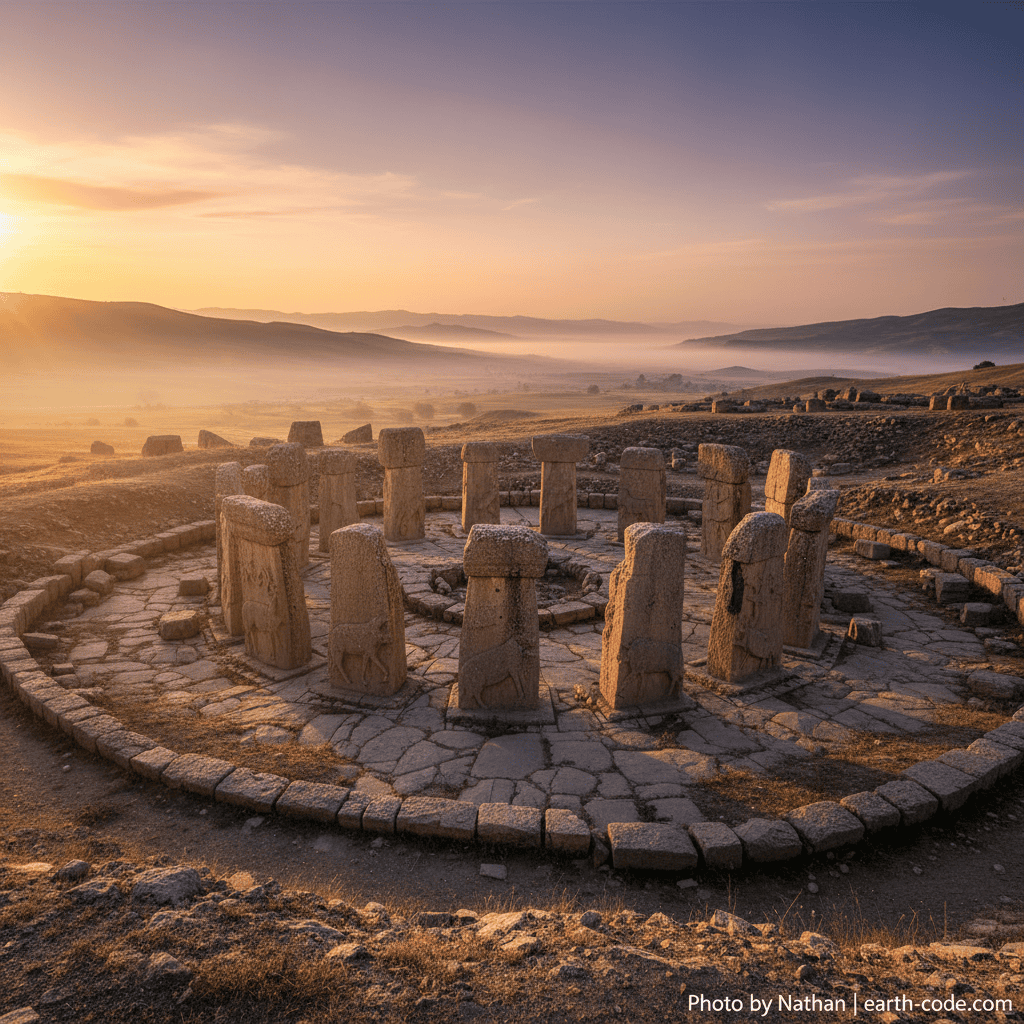
Temples before farming? Ancient ruins reveal shocking truths about human history
Göbekli Tepe: The 12,000-Year-Old Temple That Rewrote Human History
In the rolling hills of southeastern Turkey lies a discovery so profound that it has fundamentally challenged everything archaeologists thought they knew about early human civilization. Göbekli Tepe, meaning "Potbelly Hill" in Turkish, stands as humanity's oldest known temple complex—predating Stonehenge by approximately 6,000 years and the Great Pyramids by 7,000 years.
A Monument Before Its Time
Dating to approximately 9600 BCE, Göbekli Tepe was constructed during the Pre-Pottery Neolithic period, when humans were still primarily hunter-gatherers. This timing is revolutionary: conventional archaeological wisdom held that monumental architecture only emerged after the development of agriculture and settled communities. Yet here stands proof that our ancestors were capable of sophisticated construction projects while still living nomadic lifestyles.
The site spans 22 acres and consists of multiple circular enclosures, each containing massive T-shaped limestone pillars. These monoliths, some standing over 16 feet tall and weighing up to 20 tons, were quarried from nearby bedrock and transported using techniques that remain mysterious. The pillars are arranged in circles, with two larger central pillars surrounded by smaller ones—a design that suggests careful planning and shared cultural meaning.
Astronomical Sophistication
Recent research has revealed that Göbekli Tepe demonstrates remarkable astronomical alignments. The site's orientation appears deliberately designed to track celestial movements, with some pillars aligned to significant stellar events. Computer modeling suggests the complex may have served as an ancient observatory, allowing its builders to predict seasonal changes crucial for hunting and gathering activities.
The intricate carvings adorning the pillars further hint at sophisticated knowledge systems. Relief sculptures depict various animals including lions, foxes, wild boar, and birds, possibly representing constellations or seasonal markers. Some researchers propose these images constitute humanity's earliest known pictographic communication system.
The Great Mystery: Deliberate Burial
Perhaps most intriguingly, Göbekli Tepe was deliberately buried around 8000 BCE. Someone—presumably the descendants of its builders—made the monumental decision to cover the entire complex with tons of earth and debris. This wasn't abandonment; it was intentional preservation.
Why would a civilization bury their most sacred site? Some theories suggest climate change forced migration, while others propose religious transformation. The burial coincides roughly with the emergence of agriculture in the region, leading some researchers to hypothesize that Göbekli Tepe's hunter-gatherer religion became incompatible with farming communities' needs.
Rewriting the Textbooks
Göbekli Tepe forces us to reconsider the "Neolithic Revolution"—the transition from hunting and gathering to agriculture. Rather than religion following agricultural surplus, Göbekli Tepe suggests organized religion may have preceded and possibly driven agricultural development. The need to support large construction projects requiring hundreds of workers might have incentivized food production intensification.
German archaeologist Klaus Schmidt, who led excavations from 1995 until his death in 2014, estimated that only 5% of the site has been excavated. Ground-penetrating radar suggests at least 16 additional circular structures await discovery beneath the soil.
This ancient temple complex continues yielding secrets that challenge our understanding of human cognitive and social evolution. Göbekli Tepe demonstrates that our ancestors possessed far more sophisticated organizational abilities, astronomical knowledge, and artistic expression than previously imagined—12,000 years ago.
[!] Various theories exist. Information may contain errors.