The Second Sphinx Buried Under Giza
Ancient stele analysis suggests a second sphinx may be buried near the Great Sphinx of Giza
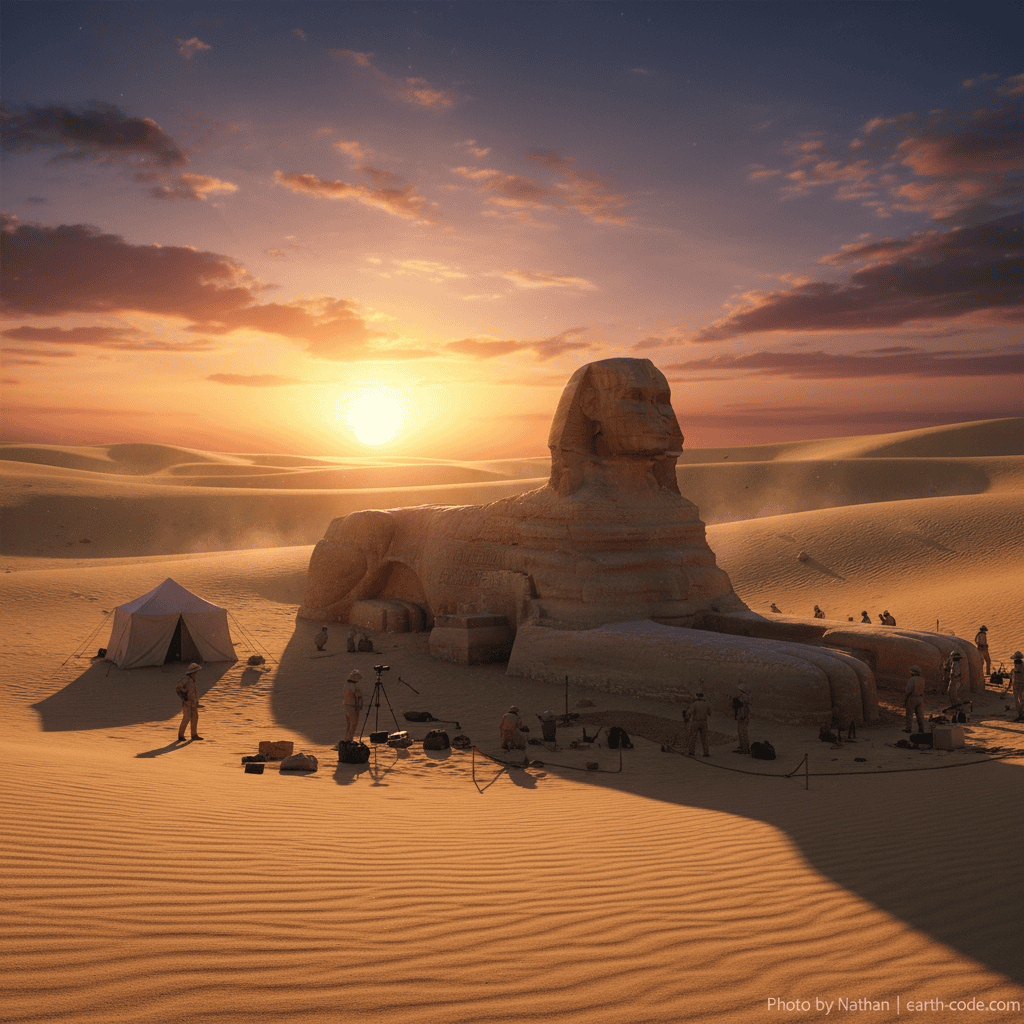
Could Giza's hidden ancient mystery finally be revealed?
The Hidden Guardian: Evidence for a Second Sphinx at Giza
Ancient Texts Point to a Lost Twin
Deep beneath the sands of the Giza plateau, archaeologists believe a second sphinx may lie dormant, waiting to be uncovered. This tantalizing possibility stems from careful analysis of ancient Egyptian texts and modern ground-penetrating radar surveys that have revealed mysterious anomalies in the area surrounding the famous Great Sphinx.
The most compelling evidence comes from the Dream Stele of Thutmose IV, erected around 1401 BCE between the paws of the Great Sphinx. This granite monument tells the story of how the future pharaoh fell asleep in the shadow of the sphinx and was visited by the sun god Ra-Horakhty. However, careful examination of the hieroglyphic text reveals intriguing references that suggest the presence of two sphinxes, not just one.
Archaeological Evidence Beneath the Sand
Modern technology has breathed new life into this ancient mystery. Ground-penetrating radar surveys conducted between 2017 and 2019 detected significant subsurface anomalies approximately 350 meters east of the Great Sphinx. These readings indicate large, carved stone structures buried under 8-12 meters of sand and debris accumulated over millennia.
Dr. Zahi Hawass and his team identified geometric patterns consistent with carved limestone blocks similar to those found in the Great Sphinx itself. The anomalies stretch roughly 57 meters in length and 20 meters in width, dimensions that would accommodate a sphinx-sized monument. Additionally, electromagnetic surveys revealed void spaces that could indicate internal chambers or passageways.
The Guardian Lions of Ancient Tradition
Ancient Egyptian texts frequently reference paired guardian lions protecting sacred sites and temples. The Pyramid Texts from the Old Kingdom period (2686-2181 BCE) describe twin lions flanking the entrance to the afterlife, while temple reliefs from Karnak and Luxor consistently show sphinxes in pairs guarding ceremonial pathways.
Archaeological evidence from other Egyptian sites supports this pattern. At Tanis, excavations revealed twin sphinx statues dating to the 12th Dynasty (1991-1802 BCE). Similarly, the avenue of sphinxes connecting Karnak and Luxor temples originally featured over 1,000 paired sphinx statues arranged in symmetrical formation.
Theories and Ongoing Investigation
Some researchers propose that the second sphinx may have been deliberately buried during the Roman period (30 BCE - 641 CE) as part of early Christian efforts to suppress pagan monuments. Others suggest that natural sand accumulation over centuries simply concealed the structure, as happened repeatedly with the Great Sphinx itself, which required major excavations in 1817, 1925, and 1936.
The Egyptian Ministry of Tourism and Antiquities has approved limited excavation permits for 2024, focusing on the areas where radar anomalies are strongest. If confirmed, this discovery would revolutionize our understanding of the Giza complex and provide new insights into 4th Dynasty architectural planning under Pharaoh Khafre (2558-2532 BCE).
Awaiting Archaeological Confirmation
The possibility of a second sphinx at Giza represents one of archaeology's most exciting current mysteries. While definitive proof awaits careful excavation, the convergence of ancient textual evidence, modern technological surveys, and established Egyptian architectural patterns creates a compelling case for this hidden monument.
[!] Various theories exist. Information may contain errors.