Ancient Egyptian Light Bulbs? Mystery of Dendera
Light bulb-like objects depicted on Dendera Temple walls. Ancient electrical technology?
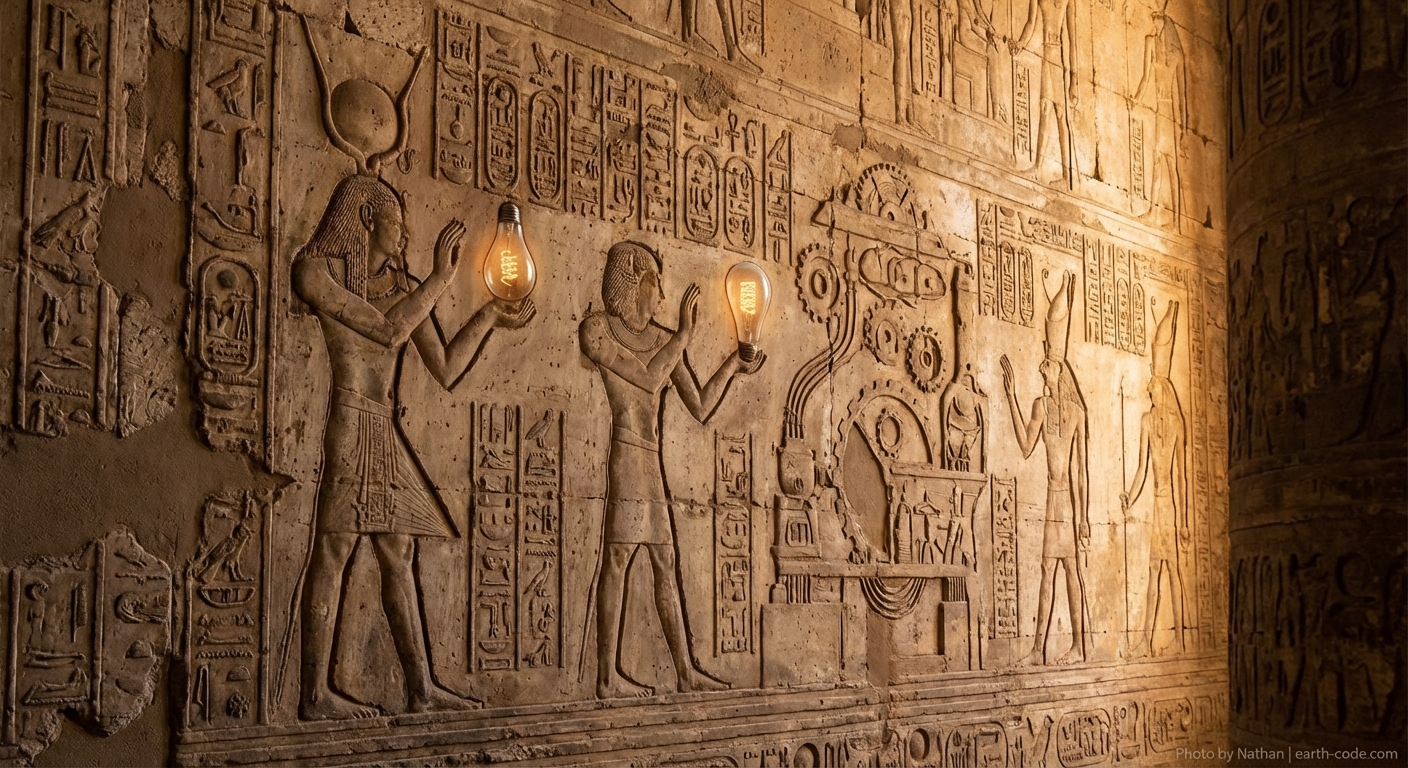
Ancient Egyptian Light Bulbs? The Electrical Enigma of Dendera Temple
The Illuminating Mystery
Deep within the sandstone walls of the Dendera Temple complex in Egypt, approximately 60 kilometers north of Luxor, lies one of archaeology's most controversial and mind-bending puzzles. Carved into the sacred walls of this 2,000-year-old Ptolemaic temple are images that have sparked decades of heated debate among Egyptologists, electrical engineers, and alternative historians alike. At first glance, these reliefs appear to depict what modern eyes immediately recognize as light bulbs – complete with filaments, electrical cables, and what seems to be sophisticated power generation equipment.
Could the ancient Egyptians have possessed advanced electrical technology thousands of years before Alessandro Volta invented the first battery in 1800? Or are we projecting our modern technological understanding onto sacred religious symbolism that has entirely different meanings? The mystery of Dendera continues to illuminate one of the most fascinating questions in archaeological interpretation.
Historical Background: Discovery and Context
The Dendera Temple complex, known in ancient Egyptian as Iunet or Tantere, was primarily dedicated to Hathor, the goddess of music, dance, foreign lands, and fertility. While the site has been sacred for millennia, the current temple structure was built during the Ptolemaic period, between 125 BCE and 60 CE, making it one of the best-preserved temple complexes in Egypt.
The controversial reliefs in question are located in the Dendera Crypts – a series of underground chambers beneath the temple that were first systematically documented by French Egyptologist Auguste Mariette in 1858. However, it wasn't until the 1970s that these images gained widespread attention outside academic circles, when Austrian electrical engineer Walter Garn and author Peter Krassa published their interpretation in "Das Licht der Pharaonen" (Light of the Pharaohs) in 1992.
The most famous of these reliefs is found in Crypt 5, where what appears to be a large bulb-shaped object dominates the scene. Inside this bulb-like form, a serpentine figure extends from a lotus flower, while human figures appear to manipulate the object. Below the "bulb," a pillar-like structure supports the entire apparatus, and cables seem to connect to a box-like object that some interpret as a power source.
The Case for Ancient Electrical Technology
The Bulb Theory: Technical Analysis
According to electrical engineer Walter Garn, the Dendera reliefs display unmistakable characteristics of electrical lighting systems. Garn's detailed analysis, published in multiple papers throughout the 1980s and 1990s, identified several key components that parallel modern electrical technology:
The Bulb Structure: The egg-shaped or elongated bulb form closely resembles early Crookes tubes or modern fluorescent bulbs. Garn calculated that the proportions match those of efficient gas-discharge lamps, with the bulb measuring approximately 1.5 meters in length according to the relief's scale.
The Serpent Filament: Inside the bulb, the serpentine figure bears striking resemblance to the glowing filament or plasma discharge found in electrical lighting. The serpent emerges from what appears to be a lotus flower, which could represent the cathode or electron emission point.
The Djed Pillar Insulator: Perhaps most intriguingly, the pillar supporting the bulb is consistently depicted as a Djed pillar – a symbol associated with stability and the backbone of Osiris. However, proponents of the electrical theory argue that its distinctive ribbed structure perfectly matches the design of modern electrical insulators used in high-voltage applications.
The Cable Connection Evidence
Researcher Reinhard Prahl conducted extensive photographic analysis of the Dendera reliefs in 1998, documenting what he interpreted as electrical cables connecting the bulb apparatus to a mysterious box-like object. These "cables" appear to follow realistic paths that would be necessary for electrical connections, complete with what seems to be proper insulation and connection points.
The box itself has been interpreted by some researchers as a battery or power source. This theory gained additional support when archaeologist Wilhelm König discovered the famous "Baghdad Battery" in 1936 – a clay jar containing copper and iron elements that could theoretically produce electrical current, proving that ancient civilizations had access to the basic components necessary for electrical generation.
The Soot-Free Paradox
One of the most compelling pieces of circumstantial evidence supporting the electrical lighting theory is the absence of soot deposits in many Egyptian tombs and underground chambers. Traditional Egyptology explains this by suggesting that ancient Egyptians used mirrors and polished metal reflectors to redirect sunlight into dark spaces, or employed clean-burning oil lamps with efficient ventilation systems.
However, electrical theory proponents argue that the pristine condition of many wall paintings and reliefs, particularly in deep underground chambers like those at Saqqara and Abydos, would be impossible to achieve with flame-based lighting. Engineer Christopher Dunn, author of "The Giza Power Plant" (1998), calculated that the amount of oil and wicks required to provide adequate lighting for the intricate artwork found in tombs would have produced detectable soot residues, regardless of ventilation systems.
Scientific Counterarguments and Orthodox Interpretations
The Religious Symbolism Perspective
The overwhelming majority of Egyptologists and art historians reject the electrical interpretation of the Dendera reliefs, instead viewing them through the lens of traditional Egyptian religious symbolism. Dr. Aidan Dodson of the University of Bristol, one of the world's leading experts on Egyptian temple art, argues that every element of the Dendera reliefs has well-documented religious significance.
According to orthodox interpretation, the "bulb" represents the primordial lotus from which the sun god emerged at creation. The serpent within is identified as the Nehebkau or another protective deity, not an electrical filament. Dr. Joann Fletcher of York University emphasizes that the lotus emerging from water was a central creation myth in Egyptian religion, representing rebirth and the daily solar cycle.
The Djed Pillar: Symbol, Not Insulator
The Djed pillar, rather than serving as an electrical insulator, represents the backbone of Osiris and symbolizes stability, endurance, and resurrection. Professor Mark Lehner, director of Ancient Egypt Research Associates, points out that Djed pillars appear in thousands of Egyptian artworks and have consistent symbolic meaning throughout 3,000 years of Egyptian civilization.
Dr. Melinda Hartwig of the Metropolitan Museum of Art argues that interpreting the Djed pillar as an electrical component ignores the extensive textual evidence explaining its religious significance, including its central role in the annual "Raising of the Djed" ceremony during the Opet Festival.
Alternative Explanations for Soot-Free Chambers
Recent experimental archaeology has provided compelling explanations for the absence of soot in Egyptian tombs. Dr. Denys Stocks of the University of Liverpool conducted extensive experiments demonstrating that ancient Egyptians could indeed illuminate underground spaces without creating soot deposits.
His research, published in the Journal of Archaeological Science in 2003, showed that sesame oil lamps with specially designed wicks could burn with minimal smoke production. Additionally, systematic ventilation systems discovered in tombs like that of Seti I demonstrate sophisticated air circulation methods that would effectively remove any combustion byproducts.
Modern Scientific Investigation and Technology
Electromagnetic Surveys and Analysis
In recent decades, various scientific teams have attempted to apply modern technology to investigate the Dendera mystery. In 2005, Dr. Ala Eldin Fahmy of Cairo University conducted electromagnetic surveys of the Dendera temple complex, searching for any evidence of ancient electrical installations or unusual metal deposits that might support the electrical theory.
The surveys revealed standard construction materials and no anomalous electromagnetic signatures. However, proponents argue that any ancient electrical systems would likely have deteriorated beyond detection over millennia.
Chemical Analysis of Stone Surfaces
Dr. Andreas Schmidt of the German Archaeological Institute conducted detailed spectroscopic analysis of the stone surfaces around the Dendera reliefs in 2010, searching for chemical evidence of electrical activity such as ozone residues or metallic deposits that might result from electrical discharge.
The analysis revealed only standard limestone composition with typical mineral deposits consistent with age and environmental exposure. No evidence was found of chemical changes that would indicate electrical activity.
The Broader Context: Other "Impossible" Ancient Technologies
The Baghdad Battery and Ancient Electrochemistry
The Dendera electrical theory gained additional credibility when placed in the context of other potential ancient electrical devices. The Baghdad Battery, discovered by Wilhelm König in 1936 near Baghdad, consists of a clay jar containing a copper cylinder and iron rod that could theoretically produce about 1.1 volts of electricity when filled with an acidic solution.
While mainstream archaeology interprets these objects as storage vessels for sacred scrolls, researchers like Dr. Marjorie Senechal of Smith College have demonstrated that they could indeed function as galvanic cells. However, no evidence exists connecting these Mesopotamian artifacts to Egyptian technology.
Precision Manufacturing and Advanced Techniques
The electrical theory proponents often point to other examples of seemingly impossible ancient Egyptian achievements, such as the precision granite work at Puma Punku, the perfectly round drill holes in hard stone at Saqqara, and the acoustic properties of certain temple chambers.
Christopher Dunn's analysis of ancient Egyptian stonework, published in "Advanced Machining in Ancient Egypt" (2010), documented evidence of what appears to be precision machining techniques that would require advanced tools. While this doesn't prove electrical lighting, it suggests that ancient Egyptian technology may have been more sophisticated than traditionally assumed.
Unexplained Aspects and Continuing Questions
The Consistency Problem
One puzzling aspect of the Dendera reliefs that neither interpretation fully explains is the remarkable consistency of the imagery across different chambers and time periods. If these are purely religious symbols, why do they appear so technological to modern eyes? If they represent actual technology, why are they depicted in religious contexts rather than practical settings?
Dr. Robert Schoch of Boston University, known for his controversial re-dating of the Sphinx, argues that the consistency suggests these images represent something more concrete than purely symbolic religious art, though he stops short of endorsing the electrical theory.
The Missing Link: No Physical Evidence
Perhaps the most significant challenge to the electrical theory is the complete absence of physical electrical artifacts from ancient Egypt. Despite extensive excavation over 150 years, no ancient Egyptian electrical components, wiring, generators, or other technological elements have been discovered.
This absence is particularly puzzling given the Egyptians' practice of including practical objects in tombs and their meticulous record-keeping. If electrical lighting was commonplace, some physical evidence should have survived.
The Temporal Paradox
The Dendera temple dates to the Ptolemaic period (305-30 BCE), a time when Egypt was under Greek influence and technological knowledge from across the Mediterranean world was available. Some researchers argue that if electrical technology existed, this would be the most likely period for its development.
However, this creates another puzzle: why would such revolutionary technology appear only in religious art and apparently disappear without influencing subsequent civilizations? The Romans, who conquered Egypt shortly after, made no mention of electrical lighting in their detailed records of Egyptian technology.
The Quest for Truth Continues
The mystery of Dendera represents more than just an archaeological puzzle – it challenges our assumptions about the linear progression of human technology and the interpretation of ancient art. Whether these reliefs depict advanced electrical technology, sophisticated religious symbolism, or something entirely different remains an open question that continues to fascinate researchers across multiple disciplines.
As we develop new analytical techniques and archaeological methods, perhaps future investigations will finally illuminate the true nature of these enigmatic images. Until then, the walls of Dendera continue to spark our imagination and remind us that ancient civilizations may hold more secrets than we ever imagined.
What do you see when you look at the Dendera reliefs? Advanced technology lost to time, or religious symbolism misinterpreted by modern eyes? The answer may change how we understand both ancient Egyptian civilization and the nature of human technological development itself.
[!] Various theories exist about the Dendera Temple reliefs. Information presented may contain errors and interpretations remain highly debated among scholars.