Dogon Tribe and Sirius B - Ancient Astronomical Knowledge
African tribe knew about Sirius companion star without telescopes? Alien contact theory exists
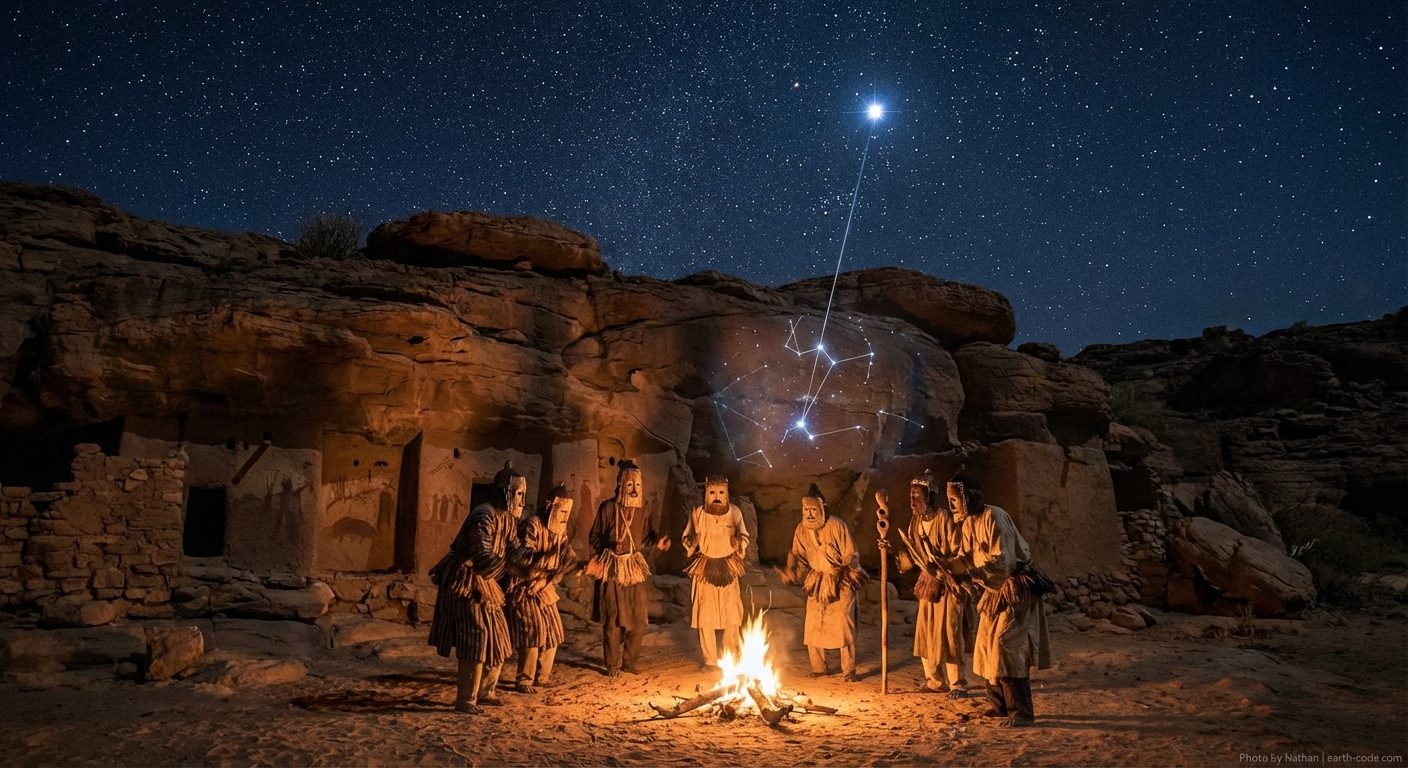
How did they know about an invisible star without telescopes?
The Dogon Mystery: Ancient African Astronomers and the Invisible Star
A Puzzle from the Heart of Mali
Deep in the cliffs of Mali's Bandiagara Plateau, the Dogon people have preserved oral traditions that challenge our understanding of ancient astronomical knowledge. For over 700 years, this West African tribe has maintained detailed cosmological beliefs centered around Sirius, the brightest star in our night sky. But their knowledge extends far beyond what the naked eye can observe—they speak of Po Tolo, an invisible companion star that modern astronomy didn't confirm until 1862.
The Extraordinary Claims
The Dogon cosmology, recorded by French anthropologists Marcel Griaule and Germaine Dieterlen between 1931 and 1956, contains remarkably specific details about the Sirius star system. According to their traditions, Po Tolo (identified by some researchers as Sirius B) is:
- An extremely dense, white star invisible to the human eye
- The most important celestial body in their cosmology
- Orbiting Sirius A in a 50-year cycle
- Made of matter "heavier than all the iron on Earth"
These descriptions align uncannily with modern scientific understanding of Sirius B, a white dwarf star with a density of approximately 1 ton per cubic centimeter and an orbital period of 50.1 years. The star remained invisible to astronomers until Friedrich Bessel detected it mathematically in 1844, and it wasn't photographed until 1970.
The Archaeological Context
The Dogon people, numbering approximately 800,000 today, have inhabited the Bandiagara Escarpment since the 10th century CE. Their cliff dwellings and rock art demonstrate sophisticated astronomical observations, with structures aligned to celestial events and detailed star maps carved into stone. Archaeological evidence suggests their ancestors were accomplished farmers and metalworkers who developed complex irrigation systems in this challenging desert environment.
Their oral traditions, passed down through generations of priests called Hogon, encompass not only Sirius knowledge but detailed understanding of planetary movements, Saturn's rings, and Jupiter's four largest moons—all invisible without telescopic aid.
Competing Explanations
Contamination Theory: Skeptics argue that Dogon knowledge resulted from contact with Western astronomers or missionaries who introduced modern astronomical concepts. However, Griaule and Dieterlen documented these beliefs decades before Sirius B's properties were fully understood.
Ancient Contact Hypothesis: Some researchers, notably Robert Temple in his 1976 book "The Sirius Mystery," propose that extraterrestrial visitors from the Sirius system shared this knowledge with the Dogon ancestors. This theory, while popular in certain circles, lacks archaeological evidence.
Indigenous Innovation: A growing number of scholars suggest the Dogon developed sophisticated observational techniques and mathematical models that allowed them to deduce Sirius B's existence through careful study of Sirius A's motion over centuries.
The Enduring Mystery
Whether through remarkable indigenous astronomy, cultural transmission, or other means, the Dogon case highlights the sophisticated scientific achievements of ancient African civilizations. Their knowledge challenges Western assumptions about the development of astronomical understanding and demonstrates the importance of preserving indigenous wisdom traditions.
The 400,000 Dogon people continue to practice their ancient rituals today, maintaining a living connection to one of archaeology's most intriguing puzzles.
[!] Various theories exist. Information may contain errors.