Ten Plagues of Exodus - Timeline Match with Thera Eruption
Rivers of blood, plague of frogs, darkness... The Ten Plagues of Exodus and their remarkable connection to the Thera eruption
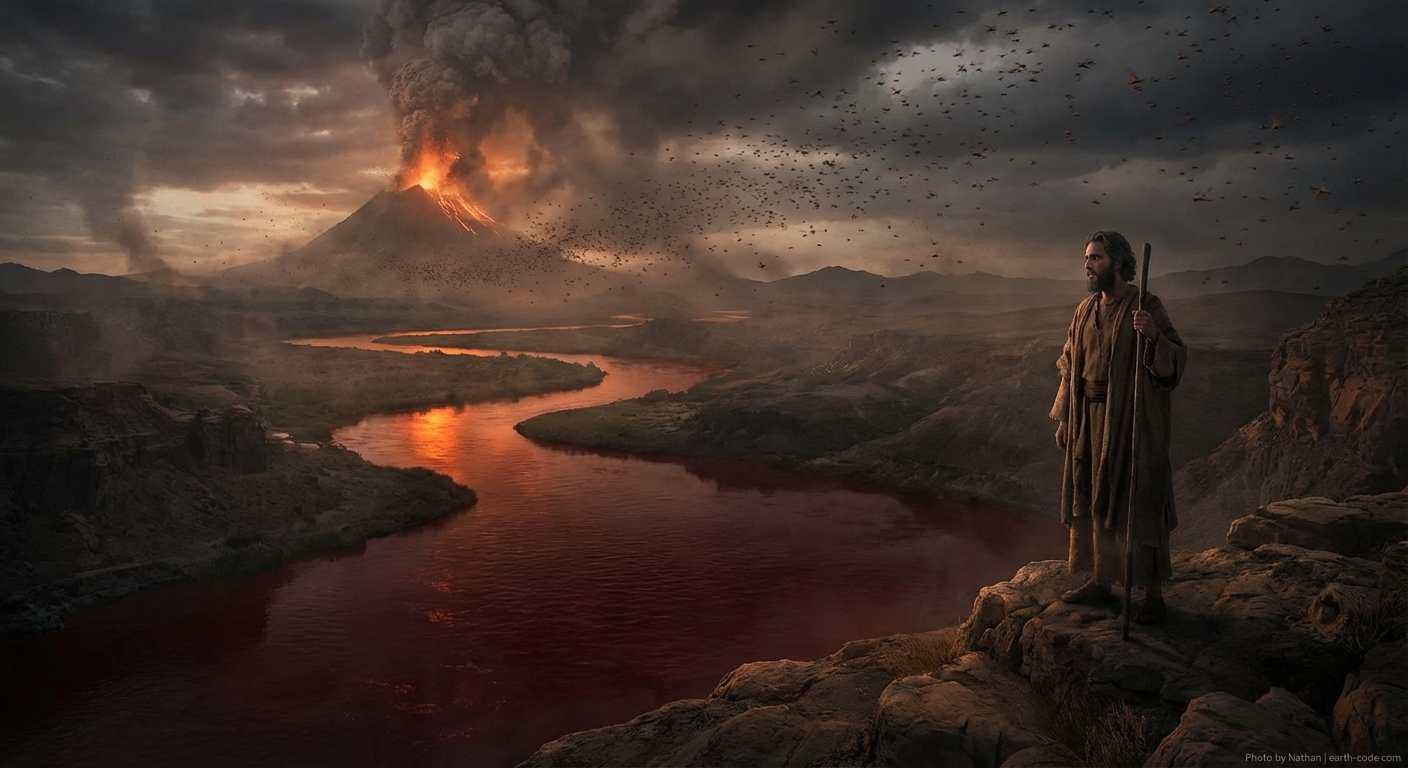
When Divine Wrath Met Volcanic Fury: The Thera Eruption and the Ten Plagues of Exodus
The Mystery That Bridges Scripture and Science
In the summer of 1967, marine geologist Dragoslav Ninkovich pulled up a sediment core from the eastern Mediterranean seafloor that would forever change how we view one of history's most dramatic biblical narratives. The core contained a distinctive layer of volcanic ash—a geological fingerprint that pointed to one of the most catastrophic natural disasters in human history. What Ninkovich and his colleagues discovered would spark decades of scholarly debate: could the legendary Ten Plagues of Exodus be explained not by divine intervention, but by the explosive eruption of Thera?
The parallels are striking. Ancient texts describe rivers turning to blood, swarms of insects, three days of impenetrable darkness, and the miraculous parting of waters. Modern volcanology reveals that the Thera eruption around 1600 BCE—the largest volcanic catastrophe in 10,000 years—would have produced exactly these phenomena across the eastern Mediterranean. But is this remarkable correlation mere coincidence, or does it reveal a hidden truth about one of the Bible's most pivotal moments?
The Archaeological Discovery That Started It All
The Thera eruption, also known as the Santorini eruption, occurred on what is now the Greek island of Santorini in the southern Aegean Sea. Archaeological evidence suggests the eruption took place sometime between 1650 and 1600 BCE, though some researchers argue for dates as late as 1500 BCE. The explosion was so massive that it created a caldera 12 kilometers wide and ejected an estimated 60 cubic kilometers of magma—making it roughly four times more powerful than the famous 1883 Krakatoa eruption.
The first systematic archaeological investigation of Thera began in 1967 under Spyridon Marinatos, who uncovered the remarkably preserved Minoan city of Akrotiri beneath layers of volcanic ash. The site revealed a sophisticated Bronze Age civilization that had been buried alive, much like Pompeii. But it was the work of scientists like Ninkovich and Bruce Heezen that truly revealed the eruption's massive scale through their analysis of ash deposits across the eastern Mediterranean.
Carbon-14 dating of organic materials trapped beneath the ash layers has provided increasingly precise dates. Recent studies by researchers like Sturt Manning from Cornell University suggest the eruption occurred around 1627-1600 BCE, based on analysis of tree rings and radiocarbon evidence. This timeframe places the catastrophe squarely within the traditional chronological range proposed for the Exodus narrative.
When Waters Turn to Blood: The First Plague Explained
The first plague described in Exodus 7:20-21 tells of the Nile turning to blood, killing all the fish and making the water undrinkable. Dr. Gilles Fumey, a volcanologist at the University of Paris, argues that massive volcanic eruptions can indeed cause water sources to turn red through several mechanisms.
Iron oxide particles ejected during volcanic eruptions can travel hundreds of kilometers in ash clouds. When these particles settle into water sources, they create a distinctive reddish coloration that ancient observers would have described as blood. The phenomenon has been documented in modern volcanic events—during the 1815 eruption of Mount Tambora in Indonesia, witnesses reported rivers turning red across Southeast Asia.
Dr. Barbara Sivertsen, author of "The Parting of the Sea," points to additional evidence from the Thera eruption. She notes that the massive explosion would have released hydrogen sulfide gas, which could have poisoned water sources across Egypt and caused mass fish kills—exactly as described in the biblical account. The dead fish would have created ideal breeding conditions for the bacteria that cause red tide phenomena, further explaining the blood-red waters.
Some researchers, including Dr. Siro Trevisanato from the University of Toronto, propose an even more dramatic mechanism. He suggests that the Thera eruption could have triggered a chain reaction of geological events, including underwater landslides that might have disturbed deep-sea sediments rich in iron compounds, eventually affecting the Nile's tributaries through underground water connections.
Ecological Catastrophe: Frogs, Lice, and Flies
The second through fourth plagues describe successive waves of animal infestations—frogs leaving the rivers, followed by swarms of lice and flies. Environmental archaeologist Dr. Yoel Elitzur from Hebrew University argues that these phenomena follow a logical ecological sequence that could result from massive environmental disruption.
When water sources become toxic (as in the first plague), amphibians like frogs are forced to leave their normal habitats en masse, seeking cleaner water. Dr. Sivertsen notes that this creates perfect conditions for the explosion of insect populations described in the subsequent plagues. Dead frogs and fish provide ideal breeding grounds for flies, while disrupted ecosystems allow normally controlled insect populations to explode.
Entomologist Dr. Myles Liptrot from Oxford University has studied similar phenomena following modern volcanic disasters. He documented that the 1980 Mount St. Helens eruption caused dramatic shifts in insect populations across the Pacific Northwest, with some species experiencing population booms while others crashed. The pattern closely mirrors the biblical sequence of animal plagues.
The Plague of Darkness: Three Days Without Light
Perhaps the most striking parallel between the Thera eruption and the biblical plagues is the ninth plague—three days of darkness so complete that it could be "felt" (Exodus 10:21-23). Volcanologists have long recognized that massive eruptions can create darkness over vast areas through ash clouds that block sunlight.
Dr. Floyd McCoy from the University of Hawaii, a leading expert on the Thera eruption, calculated that the ash cloud would have been carried south and east by prevailing winds, potentially reaching Egypt within days of the eruption. His analysis of ash distribution patterns suggests that parts of Egypt could have experienced 72 hours of near-total darkness—precisely matching the biblical account.
The description of darkness that could be "felt" particularly intrigues researchers. Atmospheric scientist Dr. Richard Stothers from NASA notes that volcanic ash can create an oppressive, tangible quality to darkness due to the physical presence of particles in the air. Survivors of major volcanic eruptions consistently describe this peculiar, heavy quality of volcanic darkness.
Tree ring analysis from ancient Egyptian sites has provided supporting evidence. Dendrochronologist Dr. Mike Baillie from Queen's University Belfast identified growth anomalies in ancient wood samples that suggest a period of reduced sunlight around 1600 BCE, consistent with a major atmospheric disturbance.
The Ultimate Mystery: Parting of the Red Sea
The most dramatic element of the Exodus narrative—the parting of the Red Sea—has long seemed beyond scientific explanation. However, recent research suggests the Thera eruption might provide answers here as well. Tsunami expert Dr. Gerassimos Papadopoulos from the National Observatory of Athens has modeled the potential tsunami effects of the Thera eruption across the eastern Mediterranean.
The eruption would have generated massive tsunamis radiating outward from Santorini. Computer modeling by Papadopoulos and his colleagues suggests these waves could have reached heights of 35-150 meters near the source, diminishing but still significant as they traveled south toward Egypt and the Red Sea region.
Dr. Doron Nof from Florida State University proposed an alternative mechanism in 2010. His research suggests that strong east winds, possibly intensified by the atmospheric disturbances caused by the volcanic eruption, could have temporarily pushed back waters in the shallow areas of the Red Sea, creating a temporary land bridge. When the winds subsided, the waters would have rushed back with devastating force.
Archaeological oceanographer Dr. Robert Ballard has investigated underwater formations in the Red Sea that might support these theories. His team identified several locations where underwater topography could have created the conditions described in biblical texts, particularly in the Gulf of Suez area where many scholars place the crossing.
Counter-Arguments and Alternative Theories
Not all researchers accept the Thera-Exodus connection. Biblical archaeologist Dr. William Dever argues that the chronological evidence doesn't support a direct correlation. He points out that the most widely accepted dates for the Exodus place it in the 13th century BCE, centuries after the Thera eruption. This chronological gap, Dever argues, makes any direct causal relationship impossible.
Egyptologist Dr. Aidan Dodson from the University of Bristol raises additional concerns about the historical record. He notes that Egyptian texts from the proposed period make no mention of the catastrophic plagues or the loss of a slave population, which would have been economically devastating. The absence of Egyptian documentation, Dodson argues, suggests either the events didn't occur as described or happened on a much smaller scale.
Volcanologist Dr. Haraldur Sigurdsson from the University of Rhode Island questions whether the Thera eruption's effects could have reached Egypt with sufficient intensity to cause the described plagues. His atmospheric modeling suggests that while ash and gases from Thera could have affected the eastern Mediterranean, the concentration reaching Egypt might have been insufficient to cause the dramatic effects described in Exodus.
Some scholars propose alternative volcanic sources. Dr. Jelle Zeilinga de Boer from Wesleyan University suggests that eruptions from Italian volcanoes like Vesuvius or Etna might better explain the geographical and chronological evidence. These volcanoes were more active during the proposed Exodus period and are located closer to traditional trade routes connecting the Mediterranean with Egypt.
Unresolved Questions and Continuing Research
The relationship between natural disasters and religious narratives remains one of archaeology's most fascinating puzzles. Recent advances in dating techniques continue to refine our understanding of when both the Thera eruption and the historical Exodus might have occurred. Dr. Christopher Ramsey from Oxford University's radiocarbon dating laboratory is leading efforts to create more precise chronologies using improved carbon-14 techniques.
Climate scientists are also contributing new evidence. Ice core data from Greenland and Antarctica show clear evidence of a major volcanic event around 1600 BCE, but researchers like Dr. Jiangnan Li from the University of Cambridge are working to determine whether this signature definitively matches Thera or might represent a different volcanic catastrophe.
DNA analysis of ancient populations is providing another avenue of research. Dr. Johannes Krause from the Max Planck Institute is studying ancient DNA from Egyptian sites to look for evidence of population changes that might correlate with the biblical narrative of Hebrew departure.
The search continues for direct archaeological evidence of Hebrew presence in Egypt. While sites like Tell el-Dab'a (ancient Avaris) show evidence of Semitic populations in ancient Egypt, researchers like Dr. Manfred Bietak are still working to definitively connect these archaeological remains with the biblical narrative.
The Enduring Mystery
Whether the Ten Plagues of Exodus represent divine intervention, natural disaster, or elaborate literary construction may ultimately remain beyond definitive proof. What seems increasingly clear is that the ancient world experienced natural catastrophes of unprecedented scale, and these events profoundly shaped the stories and beliefs of the people who survived them.
The Thera eruption stands as one of history's most dramatic natural disasters, capable of affecting civilizations across the eastern Mediterranean. That such an event might have influenced one of humanity's most enduring religious narratives speaks to the power of catastrophe to shape human consciousness and memory.
As research continues, new technologies may yet provide definitive answers to these ancient mysteries. Until then, we're left to contemplate whether the plagues that freed the Israelites from bondage might have been written not just in sacred text, but in layers of volcanic ash beneath the Mediterranean Sea.
What stories might our own natural disasters inspire? And how many other "miraculous" events from antiquity might find their explanations in the geological record, waiting to be discovered by future archaeologists and volcanologists?
[!] Various theories exist. Information may contain errors.