Dragon Legends Worldwide × Dinosaur Fossil Distribution
Chinese Long, Western Dragons, Japanese Ryu... Dragon legends worldwide mysteriously overlap with dinosaur fossil sites
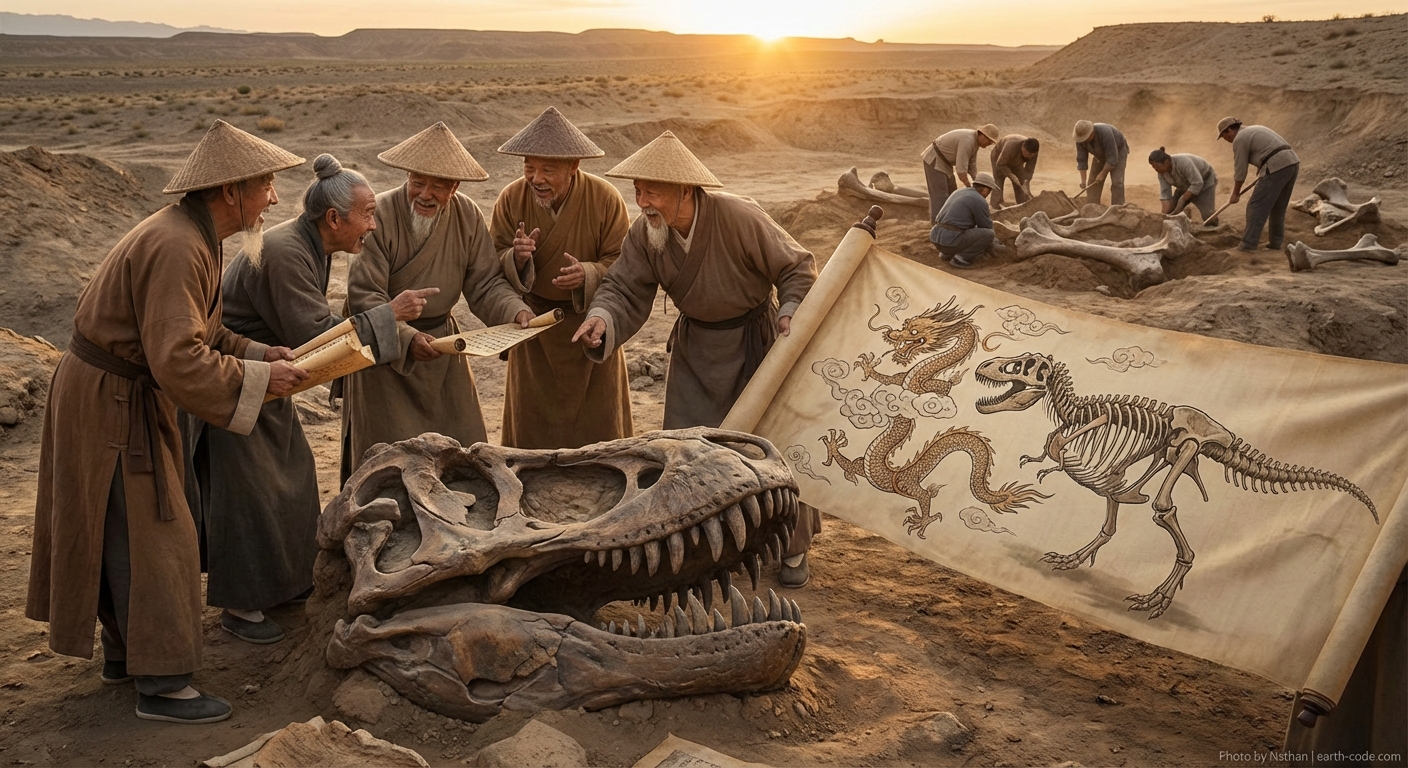
Dragons and Dinosaurs: When Ancient Legends Meet Paleontological Reality
Could the world's most enduring mythological creatures be echoes of humanity's earliest encounters with prehistoric giants?
Across every continent and culture, from the fire-breathing wyrms of medieval Europe to the benevolent Long of ancient China, dragon legends have captivated human imagination for millennia. Yet beneath these fantastical tales lies a pattern so striking that it has captured the attention of archaeologists, paleontologists, and mythologists alike: the uncanny correlation between dragon legend hotspots and the world's richest dinosaur fossil beds.
This isn't merely coincidence. As researchers have mapped both ancient mythologies and fossil distributions, a compelling picture emerges—one that suggests our ancestors may have been unwitting paleontologists, weaving scientific discoveries into the fabric of legend and lore.
The Archaeological Trail: From "Dragon Bones" to Dinosaur Fossils
The first concrete evidence of this connection emerged in China, where traditional medicine has long prized "dragon bones" (longgu) as powerful healing ingredients. For over two thousand years, Chinese apothecaries ground these mysterious bones into powders and potions, believing them to possess the essence of celestial dragons.
In 1899, paleontologist Barnum Brown made a startling discovery while working in Chinese pharmacies: many of these "dragon bones" were actually fossilized remains of prehistoric creatures. Professor Zdansky of Uppsala University later documented how Chinese fossil collectors had been systematically harvesting dinosaur remains from sites across northern China, unknowingly supplying the paleontological community with specimens that would reshape our understanding of prehistoric life.
Dr. Roy Chapman Andrews, leading the American Museum of Natural History's Central Asiatic Expeditions in the 1920s, found that local Mongolian guides consistently directed his team to fossil-rich areas using traditional "dragon" folklore as their roadmap. The legendary Gobi Desert, long celebrated in Mongolian mythology as the domain of powerful earth-dragons, proved to contain one of the world's most spectacular dinosaur graveyards.
The expedition's findings were extraordinary: over 100 dinosaur skeletons, including the first confirmed dinosaur eggs, were discovered in locations that Mongolian oral tradition had marked as dragon territories for centuries. Andrews noted in his expedition journals that locals spoke of these areas with a mixture of reverence and caution, describing them as places where "dragon spirits" still dwelled among the bones of their ancestors.
European Echoes: Medieval Dragons and Mesozoic Giants
The pattern extends far beyond Asia. Dr. Adrienne Mayor, a classical folklorist at Stanford University, has extensively documented how European dragon legends cluster around regions now known to be rich in fossil deposits. Her groundbreaking research, published in The First Fossil Hunters (2000), reveals striking geographical correlations that suggest a deeper historical connection.
Medieval chronicles from the Wealden Basin in southern England—now recognized as one of Europe's premier dinosaur fossil sites—are filled with accounts of terrible wyrms terrorizing the countryside. The famous legend of the Lambton Worm in Durham County, documented in the 12th century, describes a serpentine creature of enormous size discovered in limestone quarries. Modern paleontologists working these same quarries have unearthed Baryonyx fossils and other large theropod remains.
Professor Mark Witton of the University of Portsmouth argues that these medieval accounts may represent genuine folk memories of fossil discoveries. "When you consider that medieval stone masons were constantly breaking through rock faces and uncovering large, mysterious bones, it's entirely plausible that these finds influenced local dragon mythology," he explains.
The pattern repeats across continental Europe. The Solnhofen Limestone formations in Bavaria, famous for yielding Archaeopteryx and other flying reptile fossils, were traditionally known as hunting grounds of the Lindworm—serpentine dragons capable of flight. Similarly, the fossil-rich Tendaguru Formation beds, known to medieval German miners, were associated with tales of underground dragons guarding treasure.
The Greek Connection: Cyclopes and Mastodon Skulls
Perhaps the most compelling evidence comes from ancient Greece, where Dr. Mayor's research has uncovered direct links between specific mythological creatures and identifiable fossil remains. The legendary Cyclopes—one-eyed giants of Greek mythology—appear to have originated from ancient Greek encounters with elephant and mastodon skulls.
The large nasal cavity in the center of an elephant skull, when viewed from the front, bears an uncanny resemblance to a single, massive eye socket. Classical scholars have noted that Cyclops sightings in Greek literature consistently occur on islands in the Mediterranean where dwarf elephant fossils are now known to exist, including Sicily, Crete, and Cyprus.
Professor Othenio Abel of the University of Vienna first proposed this connection in 1914, noting that ancient Greek writers like Empedocles had documented the discovery of enormous bones on Sicily, describing them as remains of giants. Modern paleontological surveys of these same locations have revealed extensive deposits of Elephas falconeri and other dwarf elephant species.
The Japanese Dragon Paradigm: Ryu and Fossil Distribution
Japan's dragon traditions offer another fascinating case study. The Japanese Ryu, unlike their fire-breathing Western counterparts, were primarily associated with water, earthquakes, and underground forces. Dr. Yoshikazu Hasegawa of the Gunma Museum of Natural History has documented how traditional Ryu sighting locations correspond remarkably well with Japan's known fossil deposits.
The Sanchu Group formations, rich in marine reptile fossils from the Cretaceous period, have been associated with sea-dragon legends for over a thousand years. Local fishing communities passed down detailed descriptions of "dragon bones" washing ashore after storms—descriptions that closely match the fossilized remains of plesiosaurs and mosasaurs found in these formations.
Mount Katsuyama in Fukui Prefecture, site of Japan's most significant dinosaur discoveries, features prominently in regional folklore as the dwelling place of an earth-dragon capable of causing earthquakes. The Fukui Prefectural Dinosaur Museum, built at the base of this legendary mountain, now houses fossils of Fukuiraptor and other indigenous species discovered in the surrounding rock formations.
Scientific Perspectives: The Fossil-Folklore Interface
Modern researchers have proposed several theories to explain these correlations. Dr. Charles Pellegrino, author of Ghosts of Vesuvius, argues that ancient peoples were far more observant naturalists than previously assumed. According to his research, indigenous cultures worldwide developed sophisticated methods for locating and interpreting fossil remains, often incorporating these discoveries into their mythological frameworks.
Professor Paul Sereno of the University of Chicago suggests that the connection may be even more direct. His expeditions in the Sahara Desert have revealed that local Tuareg guides use traditional "dragon" stories to navigate to fossil sites, indicating that oral traditions may preserve precise geographical information across centuries.
Some researchers propose that the correlation reflects ancient peoples' attempts to explain spectacular fossil discoveries within their existing worldview. Dr. Mayor notes that many dragon descriptions include anatomically accurate details that would be difficult to imagine without direct observation of large fossil skeletons.
Counter-Arguments and Alternative Interpretations
Not all scholars accept the fossil-folklore connection. Professor David Lewis-Williams of the University of Witwatersrand argues that universal dragon symbolism may stem from neuropsychological factors rather than paleontological discoveries. His research suggests that dragon imagery emerges from altered states of consciousness and may represent archetypal patterns in human cognition rather than folk memories of fossil encounters.
Dr. Wendy Doniger of the University of Chicago points out that dragon legends often predate recorded fossil discoveries by centuries, suggesting that the correlation may be coincidental rather than causal. She argues that humans naturally gravitate toward dramatic landscapes—exactly the types of geological formations where fossils are likely to be exposed.
Some paleontologists remain skeptical of the entire premise. Professor Jack Horner of Montana State University notes that many regions rich in dragon mythology, such as Ireland and Scotland, have relatively few significant fossil deposits. He suggests that cultural diffusion and storytelling traditions may better explain the global distribution of dragon legends.
Unexplained Mysteries and Ongoing Questions
Despite decades of research, significant questions remain unanswered. Why do dragon legends consistently describe creatures with anatomical features—such as large skulls, elongated necks, and powerful limbs—that closely match dinosaur morphology? How did isolated cultures develop remarkably similar dragon iconography without apparent contact?
The timing puzzle presents another challenge. Many dragon traditions appear to preserve specific anatomical details that would require direct observation of articulated skeletons, yet such preservation is extremely rare in surface fossil exposures. Dr. Robert Bakker of the Morrison Natural History Museum has noted that the accuracy of some traditional dragon descriptions suggests access to more complete fossil remains than typically survive natural weathering processes.
Recent discoveries continue to complicate the picture. The 2019 excavation of a complete Borealopelta specimen in Alberta, Canada, revealed armor plating that matches medieval descriptions of dragon scales with startling precision. Similarly, the discovery of Therizinosaurus claws in Mongolia—some reaching over three feet in length—provides a possible explanation for Asian legends of dragons with "sword-like talons."
The Enduring Enigma
As we stand at the intersection of mythology and paleontology, the dragon-dinosaur connection continues to evolve our understanding of both ancient cultures and prehistoric life. Whether these correlations represent genuine folk memories, remarkable coincidences, or something altogether more mysterious remains an open question.
The implications extend beyond academic curiosity. If ancient peoples did indeed encounter and interpret dinosaur fossils, it suggests a level of observational sophistication and cultural memory preservation that challenges conventional assumptions about prehistoric human societies. It also raises intriguing possibilities about what other "mythological" creatures might have paleontological origins.
Perhaps the most profound question isn't whether our ancestors discovered dinosaur fossils, but what other scientific truths lie hidden within the world's mythological traditions. Could other legendary creatures—from sea monsters to giant birds—preserve echoes of vanished species? Might traditional knowledge systems contain paleontological insights we have yet to decode?
The next time you encounter a dragon legend, consider the possibility that you're reading humanity's earliest paleontological report—a scientific observation wrapped in the language of myth, preserved across millennia in the collective memory of our species.
[!] Various theories exist. Information may contain errors.