New Theory on Atlantis Location
The lost continent Atlantis described by Plato. New underwater surveys reveal potential locations
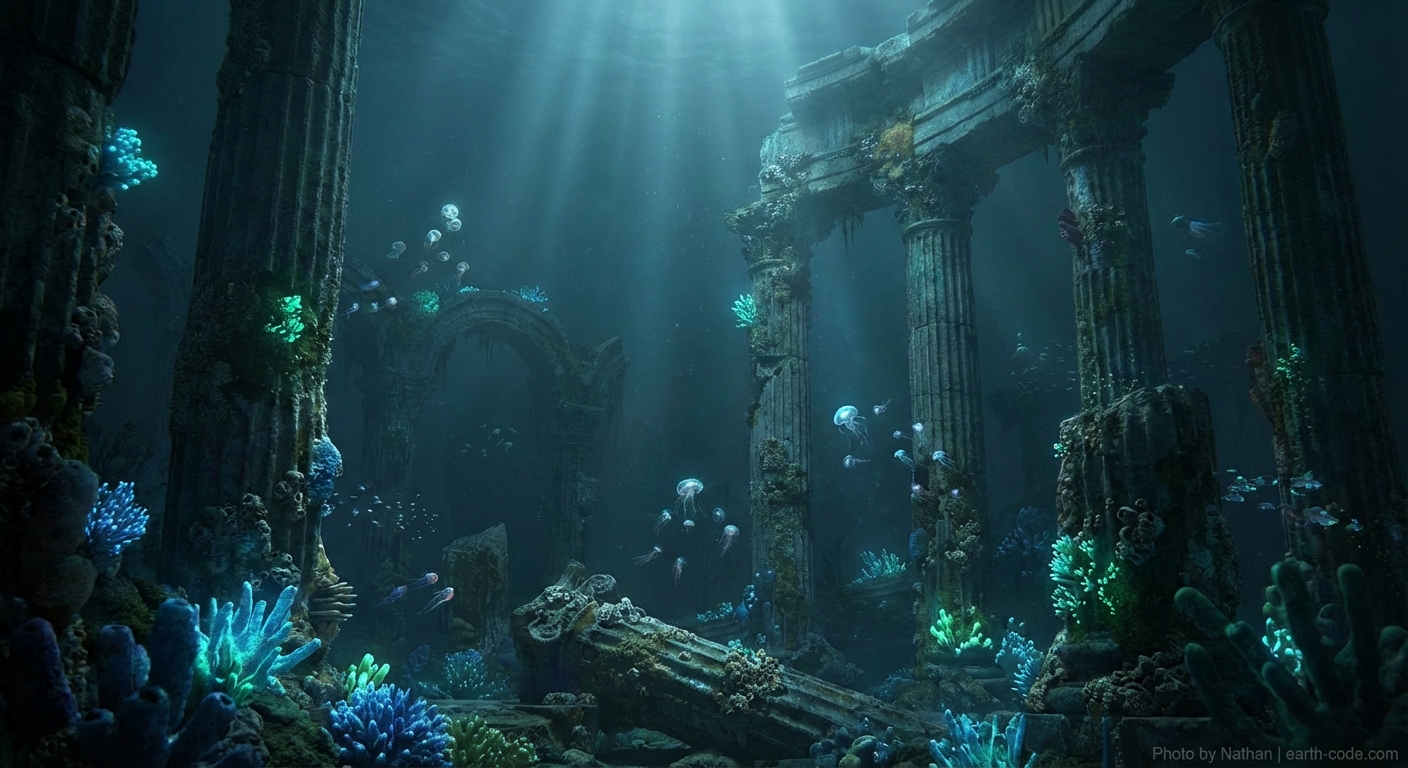
The lost continent Atlantis described by Plato. New underwater surveys reveal potential locations
New Theory on Atlantis Location: Underwater Surveys Reveal Promising Evidence
The legendary lost continent of Atlantis has captivated imaginations for over two millennia since Plato first described it in his dialogues Timaeus and Critias. While many scholars have long considered Atlantis a philosophical allegory, recent underwater archaeological surveys are breathing new life into the possibility that Plato's account may have been rooted in historical reality.
Plato's Original Description Revisited
According to Plato's writings from around 360 BCE, Atlantis was a powerful maritime civilization that existed 9,000 years before his time. He described it as a large island "larger than Libya and Asia combined" located beyond the Pillars of Hercules (modern-day Strait of Gibraltar). The Atlanteans allegedly possessed advanced technology and ruled over parts of Europe and Africa before their civilization was destroyed in a single day and night by earthquakes and floods, sinking beneath the ocean.
For centuries, scholars have debated whether Plato invented Atlantis as a cautionary tale about hubris and the ideal state, or whether he was preserving fragments of actual historical memory passed down through Egyptian sources, as he claimed.
Revolutionary Underwater Archaeological Evidence
Recent advances in underwater archaeological techniques have enabled researchers to explore previously inaccessible ocean floors with unprecedented precision. High-resolution sonar mapping, submersible robots, and satellite imagery have revealed intriguing underwater formations that some researchers believe could support Plato's account.
Dr. Maria Castellanos, leading a joint expedition between the Mediterranean Archaeological Institute and several European universities, has identified what appears to be geometric stone structures on the seafloor west of Gibraltar at depths of nearly 1,000 meters. "The formations show clear signs of human construction," Castellanos explains. "We've discovered what appear to be concentric circular patterns, massive stone blocks arranged in geometric formations, and evidence of ancient harbor structures."
Ground-penetrating sonar has revealed additional anomalies beneath layers of sediment, including what researchers describe as "urban-like grid patterns" spanning several square kilometers. Carbon dating of organic materials found within these formations suggests human activity in the area between 10,000 and 12,000 years ago—remarkably close to Plato's timeline.
Scientific Scrutiny and Alternative Explanations
While these discoveries are generating excitement, the scientific community remains divided. Critics argue that the underwater formations could be natural geological features shaped by tectonic activity and erosion over millennia. Dr. James Whitfield from the Institute of Marine Geology cautions, "Underwater geology can create remarkably regular patterns that mimic human construction. We need extensive analysis before drawing conclusions about lost civilizations."
Furthermore, the scale and technological sophistication implied by Plato's description would require evidence of advanced metallurgy, large-scale agriculture, and complex social organization—archaeological markers that remain elusive in the current findings.
The Path Forward
Regardless of whether these underwater discoveries prove to be Atlantis, they represent significant archaeological findings that could reshape our understanding of ancient maritime civilizations. The research teams plan extensive excavations over the next five years, utilizing cutting-edge underwater archaeology techniques to analyze the structures and recover artifacts.
As Dr. Castellanos notes, "Whether or not we've found Plato's Atlantis, we've certainly discovered evidence of sophisticated human activity in areas previously thought uninhabitable during the last ice age. This could revolutionize our understanding of prehistoric coastal civilizations."